Defender 2.2 TDCi Engine Rebuild in the UK: Specialist Puma Reconditioning, Repair and Replacement Options

Your Defender is knocking on start-up. Or it is smoking, losing power, or has stopped altogether. Now you are facing a decision that matters: rebuild the original engine, or replace it?
That is the question a Defender 2.2 TDCi engine rebuild is designed to answer. It means a full strip-down, inspection, machining where needed, rebuild to specification, testing and refitting of the Ford Duratorq Puma engine fitted to the 2012 to 2016 Land Rover Defender. The right route depends on what a proper inspection finds, not on a guess over the phone.
At Range Rover Garage, we work on Land Rover engines, including the Defender Puma. We inspect first, explain what we find in plain English, and quote for a rebuild, a reconditioned engine or supply and fit. If your Defender is showing any of the signs below, contact the team to arrange an engine inspection.
Which Engine Does Your Defender Have, and What Are the Signs the 2.2 TDCi Needs Rebuilding?

Before any work is quoted, the engine must be identified correctly. Ordering parts or a replacement unit for the wrong engine is an expensive mistake, and it happens more often than it should.
Is the Defender 2.2 TDCi the Same as the 2.4 Puma or the Freelander 2.2 Diesel, and What Problems Lead to a Rebuild?
No. The 2.2 TDCi in the 2012 to 2016 Defender is a Ford Duratorq Puma engine. It is related to, but not the same as, the earlier 2.4 Puma. It should also not be confused with the 2.2 diesel fitted to the Freelander 2 and Range Rover Evoque, which is a different engine family.
You may see references such as DT224 and ZSD-422 linked to the Defender 2.2. Treat these as starting points. The exact engine reference must always be confirmed against your vehicle before any replacement engine or parts are ordered. That applies across the Defender 90, 110 and 130.
Symptoms point towards a cause, but they do not prove one. This table shows what we investigate for each.
What you notice | Possible causes | What a specialist checks |
| Blue exhaust smoke | Oil entering the combustion chamber or exhaust | Piston rings, valve seals, turbocharger seals, compression |
| White smoke | Coolant entering the cylinders, unburnt fuel or cold-start conditions | Cooling system pressure, head gasket, cylinder head condition |
| Black smoke | Fuelling, intake, boost or EGR faults | Injectors, airflow, turbo boost, EGR operation |
| Engine knocking | Bearing wear, combustion or internal mechanical problems | Oil condition, bearing clearances, injector operation |
| Low oil pressure | Oil pump wear, bearing clearance, low oil level or lubrication faults | Pressure test, oil pump, bearing inspection |
| Loss of power | Turbocharger, EGR, intake, fuel or sensor faults | Boost readings, fault codes, fuel pressure |
| Hard starting | Fuel pressure, injector, electrical or compression faults | Injector testing, compression test, electrical checks |
| Overheating | Thermostat, water pump, radiator or head gasket faults | Cooling system test, combustion gas test |
| Excessive oil consumption | Worn rings, seals, turbo or external leaks | Leak inspection, compression and leak-down tests |
| Metallic timing noise | Timing chain, guides or tensioner wear | Chain stretch, guide and tensioner condition |
Several faults are commonly reported on these engines, including injector and injector seal problems, EGR valve and cooler faults, timing chain and tensioner wear, and turbocharger issues. We describe these as patterns specialists see, not as defects in every engine. Every Defender is different, which is why diagnosis comes before any decision to rebuild.
It also helps to understand the difference between a fault that needs a repair and one that needs a rebuild:
- Component repair. A faulty injector, a blocked EGR valve or a worn turbo can often be fixed without opening the engine. These are repairs, not rebuilds.
- Full rebuild. When the damage is internal, involving bearings, pistons, rings, cylinder bores or the crankshaft, the engine needs to come apart.
- Replacement. When the block or crankshaft is beyond recovery, a reconditioned or replacement engine may be the more sensible route.
Paying for a rebuild you do not need wastes money. Skipping one you do need costs more later. A proper inspection settles it. Book an engine inspection with Range Rover Garage and get the answer in writing.
What Is Included in a Defender 2.2 Engine Rebuild, and How Does the Process Work?
A rebuild is not a quick part swap. It is a controlled sequence, and each stage protects the next. A typical Defender Puma rebuild follows these steps:
- Initial diagnosis. The symptoms, fault codes and condition of the engine are assessed before anything is removed.
- Engine removal and strip-down. The engine is taken out of the vehicle and fully disassembled.
- Cleaning and inspection. Every component is cleaned and examined for wear, cracks and damage.
- Block and cylinder head checks. The engine block is inspected for bore wear and cracks. The cylinder head is pressure tested and checked for flatness, with skimming where needed.
- Crankshaft and bearing assessment. Journals and bearing surfaces are measured against manufacturer tolerances.
- Piston and ring assessment. Pistons, rings and connecting rods are checked and replaced where wear demands it.
- Precision machining where required. Honing, boring or crankshaft grinding is carried out only if measurements call for it.
- Replacement parts and reassembly. New gaskets, seals and bearings go in, and components are assembled to specified torque settings and clearances.
- Testing. Compression, oil pressure and general running checks confirm the work.
- Refitting and road testing. The engine is reinstalled, fluids are refilled, the cooling system is bled and the vehicle is road tested.
This describes a typical rebuild. The exact inclusions for your engine will be set out in your written quote, including whether injectors, the turbocharger, the timing chain and tensioner, and other ancillaries are part of the job. Ask for that detail before you agree to anything.
Can a Defender 2.2 Engine Be Rebuilt After Overheating, Low Oil Pressure or a Failed Timing Chain?
Sometimes, yes. It depends on whether the key components are recoverable.
An engine that overheated briefly may need a cylinder head repair and a new head gasket. One that ran with low oil pressure may have bearing damage, but still have a sound block and crankshaft. A failed timing chain can cause serious internal damage, though the extent varies widely.
A cracked block or a badly scored crankshaft can change the answer, because recovery may not be practical. That is when a reconditioned or replacement engine becomes the better route.
The most useful thing you can do is stop driving as soon as a serious warning appears. Continued running turns repairable damage into total damage, and it is the single biggest factor in whether your original engine can be saved.
Should You Rebuild or Replace Your Defender 2.2 Engine, and What Does It Cost?

For many owners, this is the real decision. The answer depends on the condition of the original engine, how you use the Defender and what you want from it over the next several years.
Is Rebuilding, Reconditioning or Replacing a Defender 2.2 Engine Better Value, and What Should a Quote Include?
Each route suits a different situation.
Situation | Usually the best route | Trade-offs |
| Single faulty component, healthy internals | Repair the component | Limited scope, only suitable when the engine itself is sound |
| Internal wear or damage, recoverable block and head | Rebuild the original engine | Keeps the original unit, depends on inspection results |
| Longer-term ownership, wish for confidence | Reconditioned engine with warranty | Tested and rebuilt, a strong balance of reliability and value |
| Older vehicle or tighter budget | Tested used engine | Lower outlay, but history can be limited |
| Severe damage and a desire for maximum assurance | New replacement engine | Highest assurance, usually the highest outlay |
Many owners of classic Defenders prefer to keep the original engine where possible. It preserves the vehicle's identity, and a properly rebuilt Puma can serve for many more years. Others prefer a reconditioned unit for speed and certainty. Neither choice is wrong. The right one depends on your Defender and your plans.
Terms matter here, because they are used loosely across the industry. In practice:
- A rebuilt engine is your original engine, stripped, inspected, machined where needed, reassembled with new or refurbished components and tested.
- A reconditioned engine is a unit that has been through a similar process, then supplied for fitting, often on an exchange basis.
- A used engine is taken from a donor vehicle. It may be tested, but its history is often limited.
Before you buy any of these, check how the engine was tested, what was replaced, what the warranty covers and whether the engine reference matches your Defender exactly.
What affects the cost of a rebuild. No honest specialist can give a fixed figure without inspecting the engine. The main factors are:
- The extent of internal damage
- Parts required, including bearings, pistons, rings, gaskets and seals
- Machining required on the block, head or crankshaft
- Labour for engine removal and refitting
- Whether injectors and the turbocharger are included
- Ancillary components such as the water pump, thermostat and oil system parts
- Whether further damage is found once the engine is stripped
Before accepting any quote, ask the specialist:
- What exactly is included in the quote?
- Are engine removal and refitting covered?
- Are the injectors and turbocharger included, inspected or excluded?
- What warranty applies, and what does it cover?
- Is the old engine returned, and is an exchange deposit required?
- What is the estimated turnaround time?
- What happens if extra faults are found during the work?
A vague quote is a warning sign. A clear, itemised one is a sign of a specialist who knows the engine.
Range Rover Garage will set out what is and is not included in every quote, and explain the reasoning behind our recommendation. Details of warranty, collection options and turnaround will be confirmed in your written quote.
Ready for a clear answer on your Defender? Request a Defender 2.2 TDCi engine rebuild quote from Range Rover Garage. Contact the team to arrange an inspection, find out whether your engine can be saved and compare your options.
How Can You Protect a Rebuilt Defender Engine and Avoid a Second Failure?
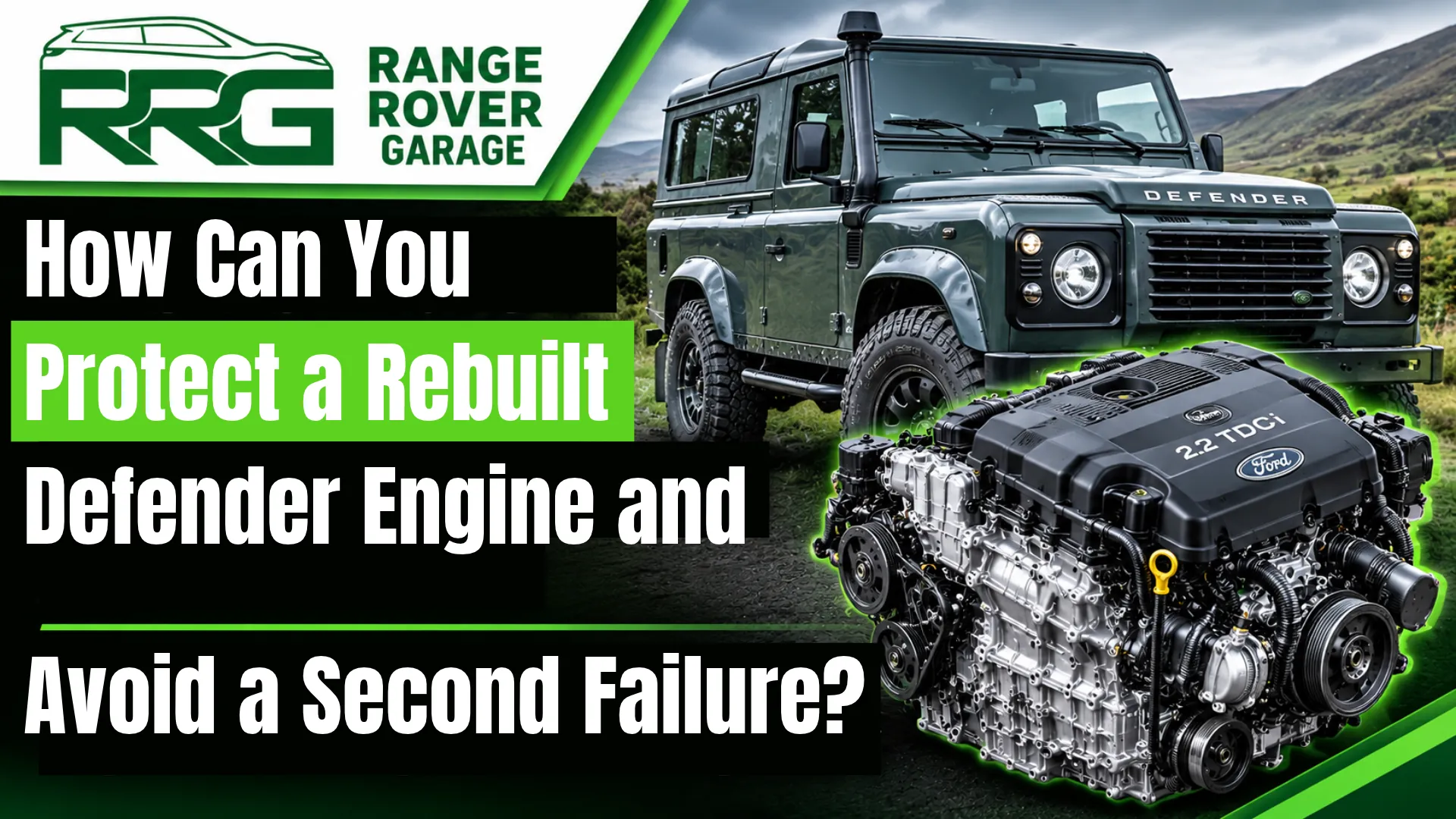
A rebuilt engine is a fresh start, and how you treat it matters. Most repeat failures trace back to the same few causes: poor lubrication, overlooked cooling faults and ignored warning signs.
Follow these habits:
- Use the correct oil specification and change it regularly. Oil is the single biggest influence on engine life.
- Act on oil pressure warnings and timing noise straight away. Small signs often come before big failures.
- Check the cooling system. Hoses, thermostat, water pump and radiator should be inspected at every service.
- Look after the fuel system. Replace fuel filters on time and have injectors checked if running quality changes.
- Follow the running-in guidance given by the builder. Gentle use early on protects new components.
- Keep all rebuild paperwork and test records. They support your warranty and add value if you sell the vehicle.
If something feels wrong after a rebuild or at any point in your ownership, do not wait. Contact a specialist who can diagnose it before it becomes a bigger problem.
Frequently Asked Questions About Defender 2.2 TDCi Engine Rebuilding
What engine is in a 2015 Land Rover Defender?
The 2012 to 2016 Defender uses the 2.2-litre TDCi Puma diesel, part of the Ford Duratorq family. Always confirm the exact engine reference against your vehicle.
What is the difference between the Defender 2.2 and 2.4 Puma engines?
Both are Puma diesels, but they are different engines with different displacement and details. Parts are not always interchangeable, so the correct engine must be identified before ordering anything.
Does the Defender 2.2 have a timing chain?
This engine is generally understood to use a timing chain rather than a belt. A specialist can confirm the exact arrangement on your vehicle and advise on inspection.
How do I confirm the correct engine reference?
Check the vehicle documentation and the engine itself, and have a specialist verify it against the vehicle details. This matters most when ordering a reconditioned or replacement engine.
Is it better to rebuild or replace a Defender 2.2 engine?
It depends on the damage. A rebuild suits engines with recoverable internals. Replacement suits severe or widespread damage. A proper inspection settles it.
Can the original Defender 2.2 engine be reconditioned?
Often, yes, provided the block, cylinder head and crankshaft are recoverable. Inspection and measurement confirm this.
How long does an engine rebuild take?
It varies with the damage, parts availability and workload. Your specialist can give a realistic timeframe once they have inspected the engine.
What warranty should a rebuilt or reconditioned engine have?
It varies by supplier. Ask what it covers, how long it lasts, whether labour is included and what conditions apply. Get the terms in writing.
Should injectors be replaced during a rebuild?
Often they should at least be tested. Faulty injectors can damage a freshly rebuilt engine, so their condition should be checked and a decision made case by case.
Do rebuilt engines need running-in?
Typically, yes. Follow the guidance from the engine builder, which usually involves gentle driving and an early oil and filter change.
Can a Defender 2.2 engine be rebuilt after overheating?
Sometimes. It depends on whether the cylinder head, block and crankshaft can be recovered. A pressure test and inspection will show this.
What causes a Defender 2.2 to lose power?
Common contributors include turbocharger faults, EGR problems, intake or fuel issues and sensor faults. Diagnosis is needed to confirm the cause before any decision is made.
Final Thoughts
A Defender 2.2 TDCi that has started to knock, smoke or lose power does not automatically need a new engine. It needs an honest inspection. That tells you whether you need a component repair, a full rebuild or a replacement, and it stops you paying for the wrong job.
A good rebuild restores a classic Defender with confidence. A rushed one repeats the failure. The difference is diagnosis, measurement and testing.
Contact Range Rover Garage today to book an engine inspection, discuss rebuild or reconditioned engine options, or request a Defender 2.2 TDCi engine rebuild quote.