Discovery 4 Turbo Replacement Cost: What You'll Pay in the UK and How to Avoid Paying Twice
The power has dropped. There is a whistle under acceleration, maybe a puff of smoke, and then the dash lights up and the car drops into limp mode. Now you are wondering what the repair will cost and whether the garage will give you a straight answer.
That is a fair worry. Discovery 4 turbo replacement cost varies more than most owners expect, because the final bill depends on three things: which engine you have (2.7 TDV6, 3.0 TDV6 or 3.0 SDV6), which turbo sequential twin-turbo charger has failed, and what caused the failure in the first place.
Range Rover Garage is a UK Land Rover specialist, and this guide explains how a Land Rover Discovery 4 turbo replacement is quoted, what is included, and what separates a repair that lasts from one you pay for twice. We have deliberately not published a single headline figure here. Every vehicle differs, and a number that ignores your engine and the condition of its oil system would mislead you.
Want a clear answer for your vehicle? Get a Discovery 4 turbo replacement quote, in writing, with every line explained.
How Much Does a Discovery 4 Turbo Replacement Cost in the UK?

The honest answer is that it depends on your engine, the turbo involved and the work needed around it. A fair quote for Discovery 4 turbo replacement in the UK should split cleanly into parts, labour, additional components and VAT, so you can see exactly what you are paying for.
Be wary of any garage that quotes a flat price over the phone without asking for your registration, engine size and symptoms. That usually means the number will change once the car is on the ramp.
Here is how a transparent quote is normally built.
Quote element | What it covers | Why it matters |
| Turbo unit | New genuine, remanufactured or reconditioned turbocharger | Quality and warranty differ between each option |
| Labour | Removal, inspection, fitting and testing | Access on the Discovery 4 engine bay is tight, so time varies |
| Additional parts | Oil feed pipe, oil return pipe, gaskets, seals, fixings | Protects the new turbo from the fault that damaged the old one |
| Fluids and filter | Fresh engine oil and oil filter | Contaminated oil can destroy a replacement turbo quickly |
| Diagnostics | Fault code reading, boost testing, visual inspection | Confirms the turbo is the real problem |
| VAT | Applied to parts and labour where relevant | Check whether a quote is shown with or without it |
You will also see three different ways of pricing the job, and they are not interchangeable:
- Supply and fit: The garage sources the turbo, fits it and tests the car. This is the simplest option and usually carries a warranty on both parts and labour.
- Parts only: You buy the turbocharger and arrange fitting elsewhere. The part cost may look lower, but warranty cover on labour is often lost, and a fitment error costs you twice.
- Labour only: You supply the turbo and the garage fits it. Many specialists limit their guarantee in this situation, because they cannot vouch for the part.
Ask every garage which of these they are quoting. Comparing a supply-and-fit price with a parts-only price tells you nothing.
At Range Rover Garage, we confirm the vehicle details first, inspect the car, and then provide a written quotation. Prices are confirmed after diagnosis rather than guessed in advance. Request a written quote and we will explain each line.
What Affects Discovery 4 Turbo Replacement Cost, and Why Do Quotes Vary So Much?
Two owners can ask about the same job and hear very different answers. The reasons are usually legitimate, so it helps to understand them. Here are the main factors, with a short note on why each one matters.
- Engine type and turbo configuration. The 2.7 TDV6 and the 3.0 TDV6 and SDV6 engines do not share identical turbo arrangements. The 2.7 TDV6 (engine code 276DT) uses a single variable geometry turbocharger. The 3.0 engines use a sequential twin-turbo setup, so the job and the parts differ.
- Primary versus secondary turbocharger. On the twin-turbo models, one turbo handles low-speed response while the other works at higher loads. Replacing the primary and replacing the secondary are different jobs with different access and parts. Sometimes both need attention.
- Labour and engine-bay access. The Discovery 4 packs a lot into a small space. Reaching the turbo can mean removing the intake, pipework, heat shields and other components first. More removal means more labour hours.
- Body-on versus body-off access. Some turbo work is possible with the body in place, while certain jobs are far easier with extra access. A specialist should tell you honestly which method they use and why.
- Oil feed and return pipe condition. Blocked or restricted pipes are one of the most common reasons a turbo dies. Fitting a new unit onto old, clogged pipework is asking for a repeat failure.
- Intercooler cleaning and contamination. When a turbo fails, oil can pass into the intercooler and pipework. If that is not cleaned out, it can flow back into the engine.
- Gaskets, seals and associated components. These are inexpensive compared with the turbo itself, but reusing them risks leaks and boost loss.
- Diagnostics before replacement. A proper inspection takes time, but it can stop you buying a turbo you do not need.
- Type of replacement unit. Genuine, remanufactured and reconditioned units come with different warranties and different histories.
- VIN-checked fitment. Part numbers vary by vehicle. A turbo that looks identical may not be correct for your car, so any serious garage checks compatibility against your VIN before ordering.
Discovery 4 TDV6 versus SDV6: how do the turbos differ?
This is where many online price guides fall short. Owners often assume one price covers "the Discovery 4 turbo". In reality, the engine decides the job.
Engine | Typical turbo arrangement | What it means for replacement |
| 2.7 TDV6 | Single variable geometry turbocharger | Fewer turbo units involved, but access still needs care |
| 3.0 TDV6 | Sequential twin-turbo system | Primary and secondary turbos, so diagnosis must identify which has failed |
| 3.0 SDV6 | Sequential twin-turbo system, higher output tune | More demanding on the oil system and boost control |
Engine codes and compatible parts must always be verified against your individual vehicle rather than assumed from the model name. If you are unsure which engine you have, your V5C and the plate details will confirm it, and we can check the rest using your VIN.
A short scenario shows why this matters. An owner of a 3.0 SDV6 notices a whining noise and a loss of response above 2,500 rpm. A quick online search suggests "replace the turbo". On inspection, the secondary unit has a seized actuator mechanism, while the primary is healthy. Repairing or replacing the one faulty unit and clearing the cause is a very different job from changing both. The only way to know is to test.
Is Your Discovery 4 Turbo Really Failing, and Should You Repair or Replace It?
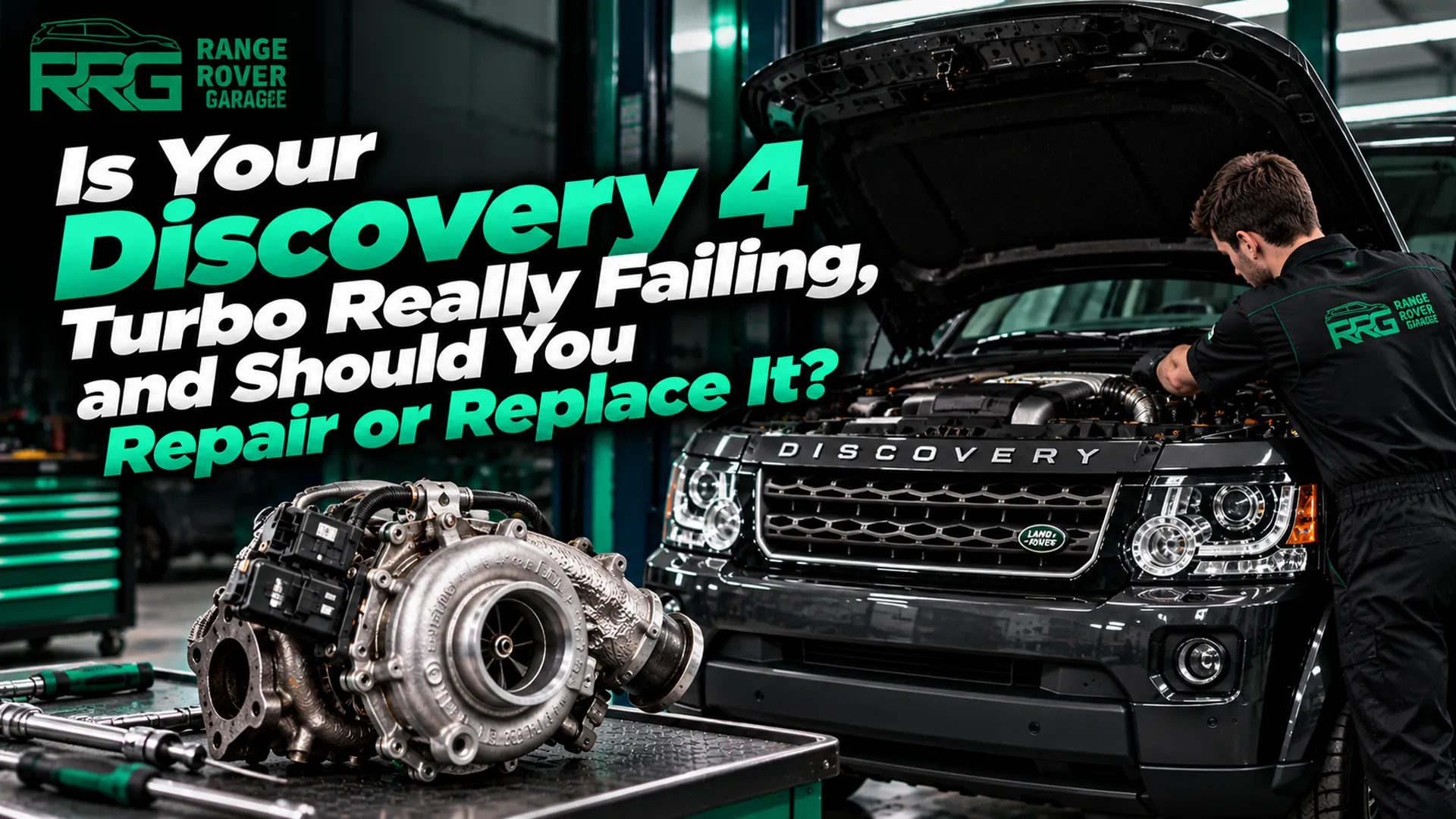
Not every boost problem means a dead turbocharger. Owners often replace a perfectly good turbo because the real fault was a split pipe, a failed boost pressure sensor or a sticking actuator. That is an expensive mistake.
The reverse also happens. Sometimes the turbo is the symptom and the real fault is an oil supply problem further back. Fit a new unit without fixing that, and the replacement can fail in a matter of weeks.
So the first job is diagnosis. A proper inspection looks at fault codes from the engine control unit, boost pressure readings, the condition of the air intake and intercooler pipework, evidence of oil leakage, and shaft movement in the turbocharger itself. Only then can you decide between repair and replacement.
What Are the Symptoms of a Failing Discovery 4 Turbo, and Can You Keep Driving?
Most turbo problems announce themselves before they become serious. Watch for these warning signs:
- Loss of acceleration and engine power. The car feels flat, especially when overtaking or climbing a hill with a load.
- Blue or black exhaust smoke. Blue smoke often points to oil passing through a worn seal. Black smoke under load can point to poor boost or an air supply problem.
- A whistle, whine or grinding noise. A siren-like whistle can mean a boost leak or a worn bearing. Grinding is more serious.
- Limp mode. The engine control unit reduces power to protect the engine when boost readings fall outside expected limits.
- Rising oil consumption. If the oil level drops without a visible leak, it may be passing through the turbo.
- Boost pressure faults. Fault codes such as P0299 (underboost) or P0234 (overboost) suggest the system is not delivering the expected pressure. These codes alone do not prove the turbo has failed, which is why testing matters.
Whether you can keep driving depends on what you are seeing. A mild loss of power with the car otherwise behaving normally gives you a little time to book an inspection. Continued driving, though, can turn a repairable fault into a larger bill.
Stop driving and arrange recovery if you notice:
- Grinding, scraping or a loud metallic noise from the engine bay
- Heavy blue or white smoke that does not clear
- A rapidly falling oil level
- Oil visible in the intake pipework or intercooler
- A red oil pressure warning light
In these situations, a failing turbo can send metal fragments or oil into the engine, and the repair can escalate quickly. Recovery costs far less than an engine repair.
Can a Discovery 4 Turbo Be Repaired, Reconditioned or Rebuilt Instead of Replaced?
Often it can, but not always. The right choice depends on what has failed and how far the damage has spread.
Option | Best suited to | Main risk | Worth considering when |
| Actuator repair or replacement | Boost control faults where the turbo itself is mechanically sound | Misdiagnosis if bearings are worn | Testing shows the turbo spins freely and the fault sits in the actuator |
| Turbo reconditioning or rebuild | Turbos with wear that can be corrected | Quality varies between reconditioners | The core is sound and a balanced, tested rebuild is available with a warranty |
| Remanufactured unit | A tested unit built to a defined standard | Not all remanufactured units are equal | You want a middle route between a rebuild and a new part |
| New genuine turbocharger | Maximum confidence and longer-term ownership | The highest upfront outlay of the options | The vehicle is staying with you, or other repairs make a cheaper unit false economy |
A few honest points on choosing:
- Reconditioned does not mean poor quality. A properly balanced and tested unit from a reputable source can perform well. A cheap, unbranded rebuild with no warranty is a different matter.
- Repair becomes false economy when the cause remains. If oil starvation caused the failure, rebuilding the turbo without fixing the oil supply simply delays the next failure.
- Age and mileage matter. On a high-mileage Discovery 4, it is worth weighing the cost against the condition of the rest of the vehicle. We will tell you plainly if another route makes more sense.
- Used turbos carry the most uncertainty. Without knowing the history or condition of the unit, you may be inheriting someone else's problem.
Whichever route you choose, ask what warranty applies to parts and to labour, and get it in writing.
What Happens During Turbo Replacement, and How Do You Choose a Trustworthy Discovery 4 Specialist?

Knowing what a proper job involves helps you spot a rushed one. A thorough Discovery 4 turbocharger replacement follows a sequence that protects the new unit and the engine behind it.
Here is how we approach it at Range Rover Garage:
- Diagnostic inspection. We read fault codes, check boost pressure and inspect for leaks, oil contamination and visible damage before recommending any work.
- Turbo removal. The faulty unit is removed carefully, with surrounding components inspected as they come off.
- Oil feed and return pipe check. We examine the pipes for blockage and restriction, and replace them where needed, because a new turbo depends on clean oil flow from day one.
- Intercooler and pipework cleaning. If oil has entered the charge air system, it is cleaned out so it does not return to the engine.
- Fitting the replacement unit. The new, remanufactured or reconditioned turbo is fitted with fresh gaskets and seals.
- Oil and filter change. Clean oil protects the new bearings during the critical first hours of running.
- Boost test and road test. We confirm that boost pressure is stable, fault codes are clear and the car drives as it should.
If you want to understand more about a related fault, read our guides on Discovery 4 turbo failure symptoms, turbo actuator problems and turbo oil feed pipe problems.
Does Turbo Failure Damage the DPF, and What Should You Ask a Garage Before You Approve the Work?
It can. When a turbo passes oil, that oil does not always stay where it entered. It can travel into the intercooler and intake, and in some cases through the engine and into the exhaust, where it may contribute to contamination of the diesel particulate filter (DPF). A blocked or restricted exhaust then raises back pressure, which puts further strain on the new turbo.
That is why a good specialist looks beyond the turbo itself. Ask about the condition of the intercooler, the intake and the DPF as part of the inspection. If the exhaust system is restricted, DPF cleaning or further inspection may be sensible alongside the turbo work.
Before approving any repair, put these questions to the garage:
- Can I have a written, itemised quote? Parts, labour and extras should be listed separately.
- Can you show me the diagnostic evidence? Fault codes, test readings and photographs of the failed component are reasonable things to request.
- Will you check parts against my VIN? Correct fitment matters.
- Will you inspect the oil feed and return pipes and the intercooler? If the answer is no, the new turbo may fail for the same reason as the old one.
- What warranty covers parts and labour? Ask for the terms in writing.
- How long will the job take, and how will you access the turbo? A good garage explains this without hesitation.
- What happens if the engine shows further damage? You should hear the plan before the work starts, not after.
A trustworthy specialist welcomes these questions. Vague or defensive answers deserve attention.
Book a diagnostic inspection with Range Rover Garage and we will walk you through the findings before any work begins.
Does Discovery 4 Turbo Replacement Need Engine Removal, and How Long Does It Take?
In most cases, no. A Discovery 4 turbo replacement does not normally require the engine to come out of the vehicle. The turbochargers sit in the valley of the V6 engine, so access involves removing surrounding components rather than lifting out the engine itself. The exact method depends on the engine, the unit being replaced and the garage's own working practice, so ask your specialist how they will approach it.
Timescale depends on the same factors. Replacing a single turbo takes less time than a job that involves both turbos, oil pipe replacement and intercooler cleaning. A realistic estimate from a garage should reflect your engine, the diagnosis and any extra work uncovered along the way. Treat a very short quoted time with caution, because rushed jobs skip important checks.
Frequently Asked Questions About Discovery 4 Turbo Replacement
How much does a Discovery 4 turbo replacement cost?
It depends on your engine, which turbo has failed, the type of replacement unit, labour time and the extra parts needed. A written, itemised quote after diagnosis is the most reliable way to get an accurate answer.
Does the Discovery 4 have two turbos?
The 3.0-litre TDV6 and SDV6 engines use a sequential twin-turbo system. The 2.7 TDV6 uses a single variable geometry turbocharger. Check your engine details to confirm which applies to your car.
Can you replace just one turbo?
Yes, on the twin-turbo engines it is often possible to replace only the failed unit. Whether that is wise depends on the condition of the other turbo and the cause of the failure, so testing both is sensible.
What is the difference between a primary and secondary turbo?
On the twin-turbo setup, the primary turbo supports response at lower engine speeds, while the secondary turbo contributes as load and engine speed rise. They are different units with different positions and parts.
Can I drive with a faulty turbo?
Light symptoms may allow short, careful driving to reach a garage. Grinding noises, heavy smoke, falling oil level or an oil pressure warning mean you should stop and arrange recovery.
Can a faulty turbo cause limp mode?
Yes. The engine control unit reduces power when boost readings fall outside expected limits. Limp mode can also come from boost leaks, sensor faults or actuator problems, so diagnosis matters.
How do I know if my Discovery 4 turbo has failed?
Common signs include power loss, blue or black smoke, whining noises, limp mode and rising oil use. Only inspection and testing can confirm whether the turbo or another component is responsible.
Can an actuator problem feel like turbo failure?
Absolutely. A sticking or failed turbo actuator can cause underboost, overboost or limp mode that looks very similar to a failed turbo. Testing separates the two.
Can a Discovery 4 turbo be rebuilt?
Yes, many can be reconditioned or rebuilt if the core is sound. Quality and warranty vary, so choose a reputable source and ask what is covered.
Is a reconditioned turbo reliable?
A properly balanced, tested and warranted unit can be. The key is who did the work and what guarantee backs it.
Does a new turbo need new oil pipes?
Not always, but the oil feed and return pipes must be inspected. If they are blocked, restricted or contaminated, replacing them protects the new unit.
Should the intercooler be cleaned after turbo failure?
Yes, where oil has entered the charge air system. Leaving contamination in place can send oil back into the engine.
Can turbo failure damage the DPF?
It can contribute to DPF contamination, particularly if oil has passed through the engine and into the exhaust. A thorough inspection should consider this.
How long does a Discovery 4 turbo last?
There is no fixed figure. Service history, oil quality, oil change intervals, driving style and the condition of the oil system all play a part. Regular servicing with the correct oil is the best protection.
What causes a new turbo to fail?
The most common causes are oil starvation, contaminated oil, blocked oil feed or drain pipes, debris entering the intake and an underlying fault that was never corrected.
How long does turbo replacement take?
It depends on the engine, the number of turbos involved and the extra work required. Your garage should give you an estimate after inspection.
Is turbo replacement worth it on an older Discovery 4?
Often it is, particularly if the rest of the vehicle is sound. Weigh the repair against the overall condition, mileage and your plans for the car. A frank conversation with your specialist helps here.
How do I choose a Land Rover turbo specialist?
Look for diagnostic evidence, itemised quotes, VIN-checked parts, oil system inspection, clear warranty terms and honest advice. Experience with Land Rover diesel engines matters.
Protecting Your Discovery 4 After Turbo Replacement
A turbo replacement works best when the cause of failure is fixed and the car is looked after properly afterwards. A few habits protect your investment:
- Service on time with the correct oil. Clean, correctly specified oil is the single biggest protection for turbo bearings.
- Let the engine settle after hard driving. A short, gentle period before switching off helps the turbo cool.
- Act on warning lights and new noises early. Small faults are far cheaper than big ones.
- Have the oil feed and return pipes and intercooler inspected during major services. Prevention costs less than repair.
- Keep an eye on oil level between services. A falling level is an early warning.
Ready for a Clear Answer on Your Discovery 4?
Discovery 4 turbo replacement cost is not a single number. It reflects your engine, the turbo involved, the condition of the oil system and the quality of the replacement unit. The best way to avoid paying twice is to diagnose properly, fix the cause and fit the right part with a warranty behind it.
Range Rover Garage will inspect your Discovery 4, explain what we find in plain language and provide a written, itemised quotation before any work starts. If a repair is not the sensible choice, we will tell you.
Get a Discovery 4 turbo replacement quote or book a diagnostic inspection today.