Freelander 2 Turbo Failure: Common Symptoms, Causes and Repair Solutions
You press the accelerator on the slip road and nothing happens. The Freelander 2 feels flat, a warning light appears, and somewhere under the bonnet there's a whistle that wasn't there last week. If that sounds familiar, you're probably dealing with Freelander 2 turbo failure, or something that looks very much like it.
The good news is that not every loss of power means a ruined turbocharger. On the Land Rover Freelander 2, built on the L359 platform and powered by the 2.2 TD4 and SD4 diesel engines, several cheaper faults produce almost identical symptoms. The bad news is that a genuinely failing turbo can do serious damage if you keep driving.
This guide explains what causes Freelander 2 turbo problems, how to recognise them, how a specialist separates a turbo fault from an actuator fault or boost leak, and what your repair options look like. It's written for owners who want straight answers before they spend money.
What Causes Freelander 2 Turbo Failure, and How Do You Spot It?
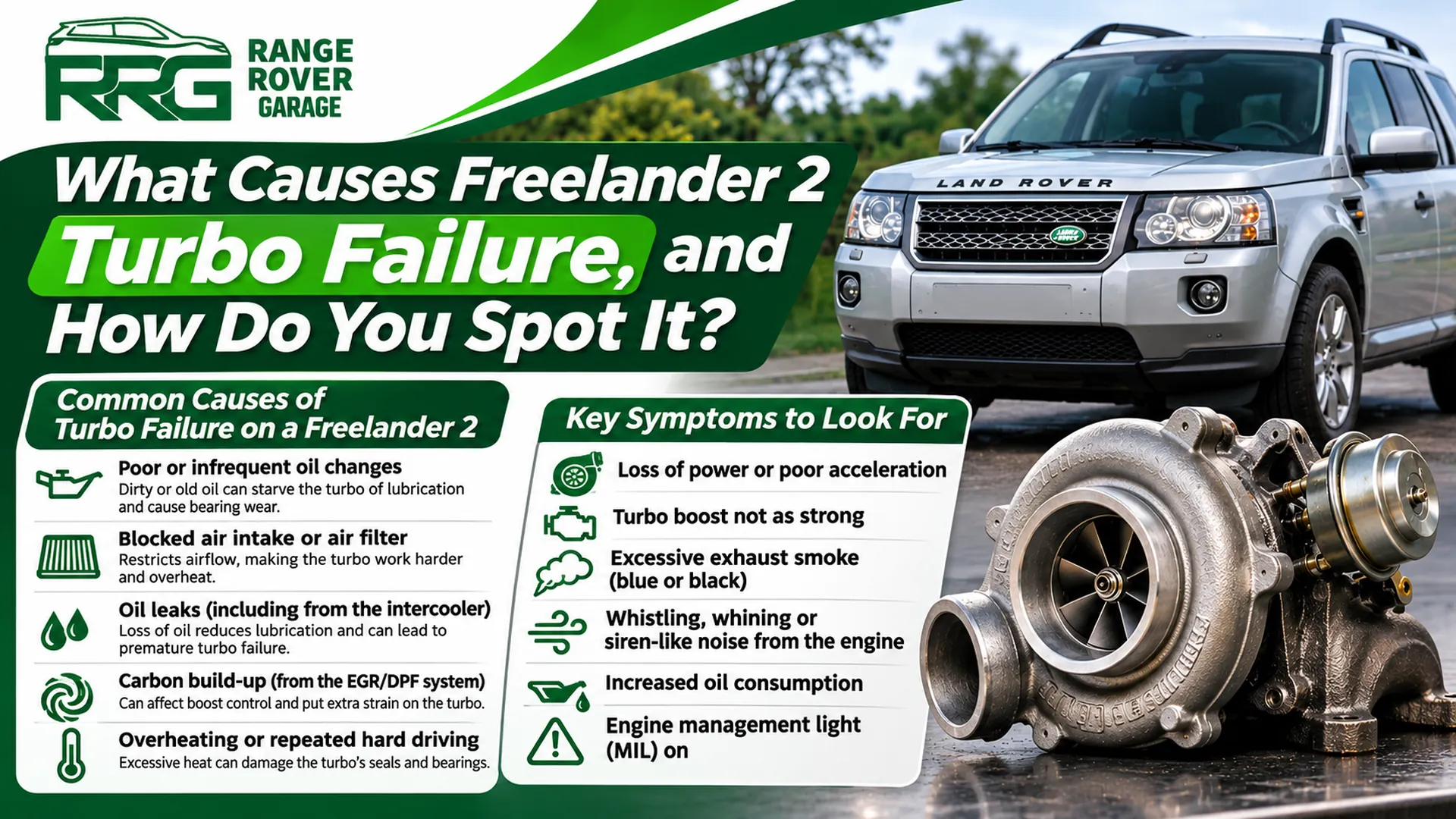
A turbocharger spins at extremely high speed, driven by exhaust gas and cooled and lubricated by engine oil. It's a precise piece of engineering, and it depends on clean oil, free airflow and correct electronic control. When any of those slip, the turbo suffers first.
Owners often assume turbo failure is random bad luck. In most cases it isn't. There's usually a root cause, and finding it matters as much as fixing the turbo itself.
What Are the Signs of a Failing Turbo on a Freelander 2 TD4 or SD4?
A failing Freelander 2 turbo usually shows up as a noticeable loss of power, a whistling or whining noise under acceleration, coloured exhaust smoke, rising oil consumption, an engine management warning light, or limp mode. Which of these you see depends on how the turbo is failing.
Here are the symptoms to watch for and what each one tends to indicate:
- Loss of engine power and poor acceleration: The engine isn't receiving the boost pressure it expects. This can point to worn turbo bearings, a stuck variable geometry mechanism, or a leak somewhere in the intake path.
- Whistling or whining turbo noise: A rising whistle under load often suggests a boost leak or a turbo that's losing efficiency. A louder, harsher whine can mean worn shaft bearings.
- Black smoke from the exhaust: The engine is getting too much fuel for the air available. Poor boost is a common reason.
- Blue or grey exhaust smoke: Oil is being burned. This can happen when turbo seals fail and oil passes into the intake or exhaust side.
- Excessive engine oil consumption: If you're topping up oil between services and can't find a leak on the driveway, the turbo is one of the places to look.
- Engine management warning light: The ECU has logged a boost, actuator or sensor fault.
- Limp mode during acceleration: The engine control unit cuts power to protect itself when boost readings fall outside expected limits.
None of these symptoms prove the turbo has failed. A split intercooler hose, a sticking actuator, a blocked DPF or a faulty boost pressure sensor can produce the same picture. That overlap is exactly why proper diagnosis matters, and we'll cover it in the next section.
One practical scenario we see often: an owner replaces a turbo because the car goes into limp mode, and the fault returns within weeks. The turbo wasn't the problem. A restricted oil feed or a boost leak was, and the new unit inherited the same fate.
Can Oil Starvation, a Blocked DPF or a Restricted Oil Feed Pipe Cause Freelander 2 Turbo Failure?
Yes, all three can contribute, and they're among the most common root causes behind a Freelander 2 turbo that fails early.
Oil starvation and the oil feed pipe. The turbo shaft spins on a thin film of pressurised oil. If the oil feed pipe becomes restricted by sludge, carbon or heat damage, the bearings run short of lubrication. They overheat, wear quickly and eventually let the compressor or turbine wheel touch its housing. A turbo that has been starved of oil rarely recovers. Replacing it without clearing the restriction simply repeats the failure.
Poor oil quality and delayed servicing. Contaminated, degraded or incorrect oil breaks down under turbo heat and leaves deposits. Long gaps between oil changes, a lot of short journeys, and the wrong oil specification all raise the risk.
Crankcase breather problems. If the breather system doesn't vent properly, pressure builds in the crankcase and pushes oil where it shouldn't go. That can show up as oil in the intercooler pipe and rising oil consumption.
Carbon build-up in the variable geometry vanes. The Freelander 2 uses a variable geometry turbocharger. Its vanes adjust to control boost across the rev range. Soot and carbon can make those vanes stick, which leads to underboost, overboost or limp mode.
A blocked DPF and exhaust back pressure. A clogged diesel particulate filter raises pressure in the exhaust. That can reduce performance and put extra strain on the turbine side. A DPF or EGR fault can mimic turbo failure without proving the turbo is damaged, so both need checking before any parts are ordered.
Excessive operating temperature. Heat is the enemy of turbo bearings and seals. Poor lubrication, restricted airflow and neglected maintenance all push temperatures up.
It's also worth knowing that oil found in an intercooler pipe doesn't automatically condemn the turbo. How much oil there is, where it came from and what else the diagnosis shows all need to be read together.
Is It the Turbo, the Actuator or a Boost Leak? How to Diagnose Freelander 2 Turbo Problems
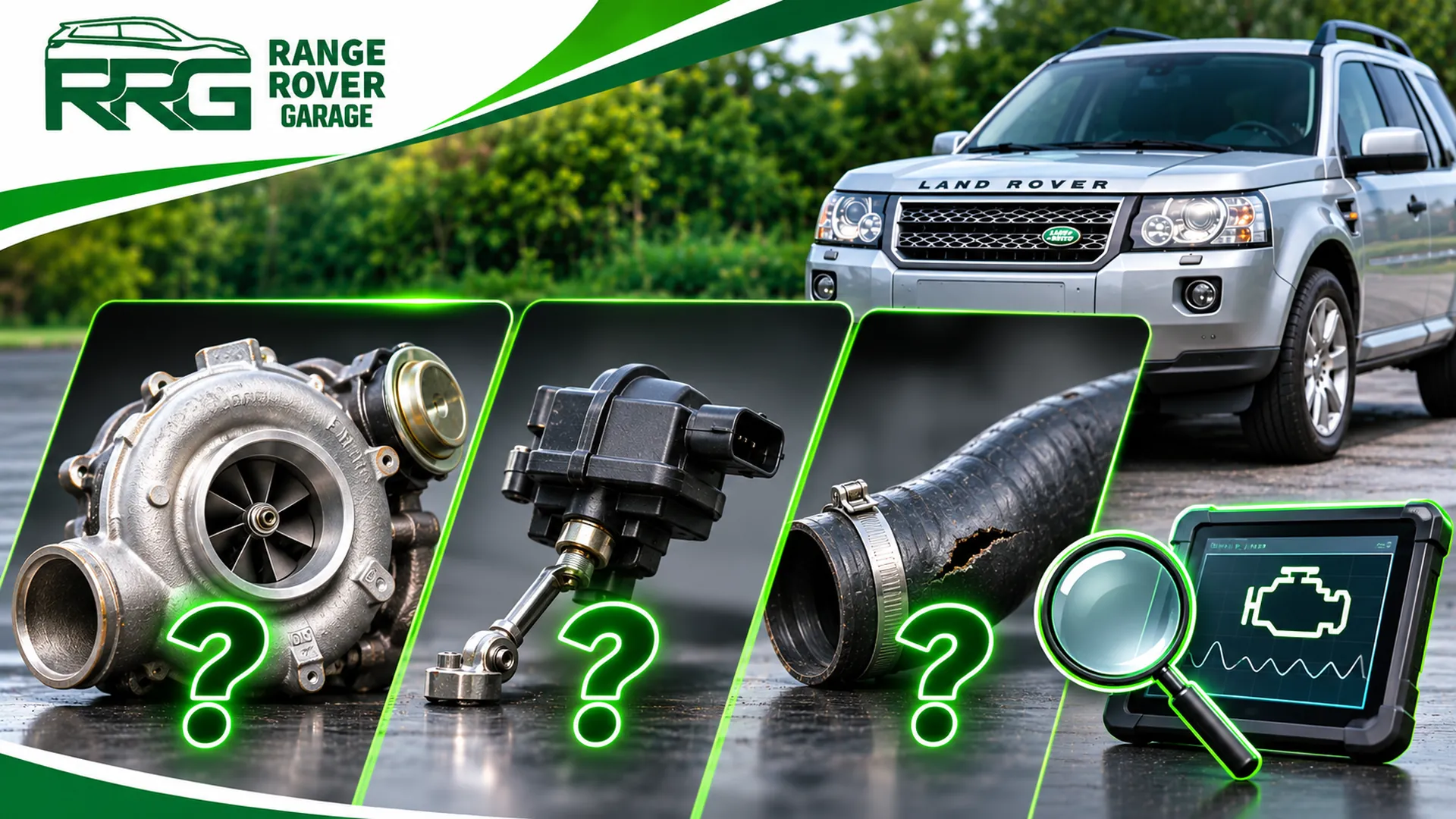
This is the part that saves owners the most money. A methodical diagnosis separates a genuinely failed turbocharger from a faulty actuator, a leaking hose or an emissions-system problem. Guessing, on the other hand, is how people end up paying for the wrong part.
A thorough Freelander 2 turbo diagnosis follows a logical order:
- Read the stored fault codes and freeze-frame data.
- Check live boost pressure against what the ECU is requesting.
- Inspect the oil feed and return pipes.
- Check the intercooler, boost pipes and intake connections for leaks.
- Test the actuator and its movement.
- Check the turbo shaft for play and the wheels for damage.
- Assess the condition of the DPF and EGR system.
How Can You Tell the Difference Between a Faulty Turbo Actuator and a Failed Turbocharger?
The turbo actuator is the electronic component that moves the variable geometry vanes. It tells the turbo how much boost to deliver. If it sticks, drifts or loses calibration, the engine can go into limp mode even though the turbo itself is mechanically sound.
The key difference is mechanical damage. A failed turbocharger has worn bearings, shaft play, damaged wheels or oil leaking past the seals. A faulty actuator typically leaves the turbo physically healthy but unable to control boost correctly.
Here's how the two compare in practice:
Feature | Faulty turbo actuator | Failed turbocharger |
| Main cause | Electronic fault, sticking linkage or calibration loss | Bearing wear, oil starvation, wheel damage |
| Typical symptom | Limp mode, inconsistent boost, warning light | Whining or grinding noise, smoke, oil loss, power loss |
| Shaft play | Normal | Often excessive |
| Oil leakage | Usually none | Common |
| Likely fix | Actuator repair, replacement or recalibration | Turbo repair, reconditioning or replacement |
In some cases an actuator-only repair is possible, and that can cost far less than replacing the whole turbo. It only works when the turbo itself passes inspection, which is why a physical check of the shaft and wheels matters.
What Do Freelander 2 Turbo Fault Codes Like P2263 and P0046 Actually Mean?
Fault codes are clues, not verdicts. A code tells a technician where the ECU noticed a problem. It doesn't tell them why.
Fault code | What it generally points to | What a technician checks next |
| P2263 | Turbocharger boost system performance | Boost leaks, actuator operation, vane movement, DPF back pressure |
| P0046 | Turbo boost control circuit range or performance | Actuator wiring, actuator movement, linkage condition |
| P0237 and P0238 | Boost pressure sensor circuit low or high | Sensor condition, wiring, connector, then actual boost readings |
| P2562 | Turbo boost control position sensor circuit | Actuator position feedback, calibration, actuator replacement need |
Take P2263 as an example. It can be triggered by a worn turbo, but it can equally be triggered by a split intercooler hose or a sticking vane. Replacing the turbo on the strength of that code alone is a gamble.
A cheap OBD scanner can read these codes, and that's a reasonable first step for an owner. Interpreting them alongside live boost data, physical inspection and the car's history is where specialist experience pays off.
Can a Split Intercooler Hose or Boost Leak Cause the Same Symptoms as Turbo Failure?
Absolutely. Boost leaks are one of the most common look-alikes for turbo failure, and they're far cheaper to fix.
When a hose splits or a clamp works loose, pressurised air escapes before it reaches the engine. The result is poor acceleration, black smoke, a hissing or whistling sound, and sometimes limp mode. To the driver it feels exactly like a dying turbo.
Technicians check for this with pressure testing, which pressurises the intake system and exposes leaks that can't be seen by eye. They'll also look at the intercooler and its pipes for oil residue, because oil there can help narrow down whether the oil is coming from the turbo, the breather system or elsewhere.
Before you condemn the turbo, make sure the air path is sound. It's the quickest way to avoid an expensive mistake.
Not sure what's failed? Book a Freelander 2 turbo diagnostic inspection with Range Rover Garage and get a clear answer on whether you're dealing with the turbo, the actuator, a boost leak or an emissions fault.
Can a Freelander 2 Turbo Be Repaired, and How Much Does Replacement Cost in the UK?
This is the question every owner asks, and an honest answer starts with what's actually wrong. Repair, reconditioning and replacement are three different routes, and the right one depends on the diagnosis.
Should You Repair, Recondition or Replace a Freelander 2 Turbo, and What Affects the Price?
When repair is realistic. If the turbo itself is mechanically healthy, repair can make sense. Typical examples are a faulty electronic actuator, a sticking linkage, or light carbon build-up in the vanes that can be cleaned and recalibrated. In these cases, an actuator repair or replacement may solve the problem without touching the turbo core.
When replacement is necessary. If the diagnosis shows shaft play, bearing damage, damaged compressor or turbine wheels, or heavy oil contamination, the turbo is beyond sensible repair. At that point the choice is between a reconditioned unit and a new one.
Here's a plain comparison of the main options:
Option | Best suited to | Points to consider |
| Actuator repair or replacement | Healthy turbo with an actuator fault | Lowest-cost route, but only valid if the turbo passes inspection |
| Turbo reconditioning or rebuild | Repairable turbo with moderate wear | Quality depends on the specialist and the parts used |
| Reconditioned replacement turbo | Failed turbo where a balanced, tested unit is available | Good value when supplied with a proper warranty |
| New turbocharger | Owners wanting a fresh unit and maximum peace of mind | Usually the highest-cost option |
| Used turbo | Tight budgets | Unknown history, so it carries the highest risk |
Does a reconditioned turbo last as long as a new one? A properly reconditioned unit, rebuilt with the right parts, balanced and tested, can perform very well. The weak link is quality. A poor rebuild fails early, so ask exactly what was replaced, how the unit was tested, and what warranty comes with it.
What affects the price. We don't quote prices without seeing the car, because the total depends on what the diagnosis finds. These are the main cost factors:
- The diagnostic inspection itself
- Whether the actuator, the turbo or both need work
- The type of unit fitted: reconditioned or new
- Replacement oil feed and return pipes
- Gaskets, seals and fixings
- Labour time
- Post-fit calibration, oil pressure checks and road testing
What a proper replacement should include. Fitting a turbo is only half the job. A careful workshop will:
- Find out why the original failed, whether that's oil supply, contamination, a breather fault or exhaust restriction.
- Replace or clean the oil feed and return pipes where needed.
- Clean or inspect the intake path and check the intercooler for oil contamination.
- Check the condition of the DPF and EGR system.
- Prime the new turbo with oil before first start, so it isn't running dry.
- Check oil pressure and confirm boost pressure against ECU targets.
- Road test the car to confirm the fault has cleared.
Skipping these steps is the main reason replacement turbos fail early. If a quote seems suspiciously simple, ask what's included.
Can you drive with a damaged turbo? It's best not to. If you see heavy blue smoke, rapid oil loss, a harsh grinding noise or a sudden collapse in power, stop and arrange recovery. In rare cases, a failing turbo can pass oil into the intake, and a diesel engine can then run on that oil uncontrolled. It's uncommon, but it's the reason a damaged turbo shouldn't be driven on. Recovery costs less than an engine.
Want a fixed quote? Contact Range Rover Garage for a Freelander 2 turbo repair or replacement quote. We'll confirm what has failed first, then explain your options and what each one includes, so you can decide with the full picture.
Frequently Asked Questions About Freelander 2 Turbo Failure
What are the common symptoms of turbo failure in a Freelander 2?
The usual signs are loss of power, a whistling or whining noise, black or blue exhaust smoke, rising oil consumption, a warning light and limp mode. Because other faults share these symptoms, a diagnostic check should confirm the turbo is the cause before any parts are replaced.
Why does a Freelander 2 turbo fail?
Most failures trace back to lubrication problems, such as a restricted oil feed pipe, poor oil quality or delayed servicing. Carbon build-up in the vanes, breather problems and exhaust restrictions from a blocked DPF can also play a part.
Can a blocked DPF cause turbo failure?
A blocked DPF raises exhaust back pressure, which can reduce performance and strain the turbo. It doesn't prove the turbo is faulty, but it should always be checked as part of the diagnosis.
Does a faulty turbo actuator cause limp mode?
Yes. If the actuator can't control the vanes correctly, boost readings fall outside expected limits and the ECU can cut power. The turbo itself may be perfectly healthy.
How do I know if my Freelander 2 turbo is faulty?
Look for power loss, unusual noises and smoke, then have the fault codes read. A specialist will check boost pressure, hoses, oil pipes, actuator movement and shaft play to confirm.
Can a Freelander 2 turbo be repaired?
Sometimes. Actuator faults and minor vane sticking can often be corrected. If the bearings, shaft or wheels are damaged, reconditioning or replacement is usually the sensible route.
Can I replace the turbo actuator without replacing the turbo?
In many cases, yes, provided the turbo passes a mechanical inspection. The actuator may then need replacement or recalibration to restore correct boost control.
Does a reconditioned turbo last as long as a new one?
A well-built, balanced and tested reconditioned turbo can give excellent service. Quality varies between suppliers, so ask what was replaced and what warranty applies.
Should the oil feed pipe be replaced with the turbo?
Usually it should be inspected, and often replaced or cleaned. A restricted feed pipe is a leading cause of early turbo failure, so ignoring it risks repeating the problem.
How can I prevent turbo failure in a Freelander 2?
Use the correct oil specification, change oil on schedule, keep the breather system healthy, act on DPF warnings and investigate unusual turbo noises early. Regular longer drives also help the DPF clear itself.
Can short journeys damage a diesel turbo?
Short journeys don't damage a turbo directly, but they let oil contamination and soot build up. Over time that raises the risk of blocked filters, sticking vanes and poor lubrication.
Is a Freelander 2 worth repairing?
Often it is, provided the root cause is identified and fixed properly. A sound diagnosis tells you whether you're facing a modest repair or a larger job, and that's the best basis for deciding.
Keep Your Freelander 2 Pulling Strongly
Freelander 2 turbo failure rarely comes out of nowhere. It tends to follow oil restrictions, contamination, boost leaks or emissions faults that went unnoticed. Catch the signs early, diagnose before you replace, and fix the root cause as well as the symptom.
To prevent a repeat, stick to a few habits. Use the correct oil and change it on time. Have the oil feed pipe and breather checked when the symptoms start. Take DPF warnings seriously. And never ignore a new whistle, smoke or a drop in power.
If your Freelander 2 is showing any of these signs, book a turbo diagnostic inspection with Range Rover Garage at rangerovergarage.co.uk. We'll tell you plainly whether it's the turbo, the actuator or something simpler, and what the right fix looks like before any work begins.