Land Rover 300Tdi Engine: Specifications, Common Problems, Rebuild and Replacement Options in the UK
A 300Tdi that overheats on a long run, starts blowing smoke, or refuses to turn over is a stressful thing to own. The question every owner ends up asking is the same: do I repair it, rebuild it, or replace it?
The Land Rover 300Tdi engine is a tough, mechanically simple 2.5-litre turbo diesel, and most faults can be fixed without condemning the whole unit. This guide covers what the engine is, what goes wrong, what the symptoms mean, and how to choose between a rebuild, a reconditioned engine and a replacement. If you'd rather talk it through with a specialist, you can contact Range Rover Garage at any point.
What Is the Land Rover 300Tdi Engine and How Reliable Is It?
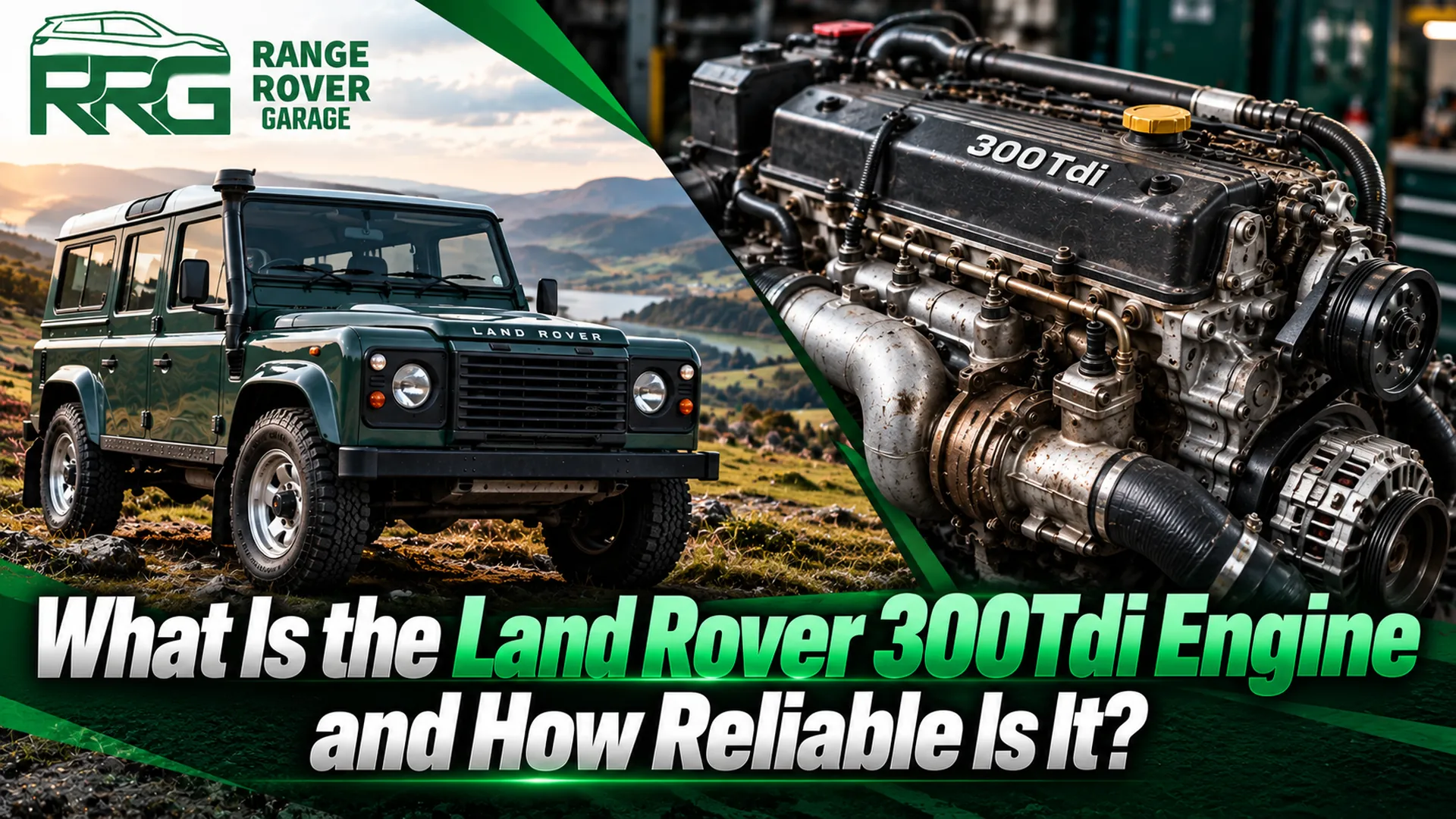
The 300Tdi engine is a 2,495cc, four-cylinder, direct-injection turbo diesel with an intercooler. It replaced the 200Tdi in the mid-1990s and powered the Defender, the first-generation Discovery and the Range Rover Classic.
It uses mechanical injection, with a rotary injection pump rather than an electronic management system. That is a big part of its reputation. There is very little to fail electronically, and a competent mechanic can diagnose most faults with basic tools and a methodical approach.
So how reliable is it? Well maintained examples regularly pass 150,000 miles, and plenty keep working long after that. The weak points are well known: the cooling system, the timing belt, the gaskets at the front of the engine, and neglect. An engine that has had regular oil changes, fresh coolant and a timely belt change will usually outlast one that has been run on a "fix it when it breaks" basis.
Which Land Rover Models Use the 300Tdi Engine and What Are Its Key Specifications?
The 300Tdi was fitted to the Defender 90, 110 and 130, the Discovery 1 and the Range Rover Classic. Gearbox pairings were usually the LT77 or the R380 manual, with an automatic offered on some vehicles.
Here are the main specifications at a glance:
Feature | 300Tdi detail |
| Capacity | 2,495cc (2.5 litre) |
| Layout | Inline four-cylinder turbo diesel |
| Fuel system | Direct injection, Bosch-type rotary pump (mechanical) |
| Induction | Turbocharged and intercooled |
| Block / head | Cast iron block, aluminium cylinder head |
| Cam drive | Timing belt |
| Typical output | Roughly 111 bhp and around 195 lb-ft in standard form |
Output varies slightly between engine codes and vehicle applications, so check the figures for your specific vehicle.
How does it compare with the engines on either side of it?
The 200Tdi came first and the Td5 followed, so owners often compare all three.
200Tdi | 300Tdi | Td5 | |
| Injection | Mechanical | Mechanical | Electronic |
| Cylinders | 4 | 4 | 5 |
| Refinement | Noisier | Smoother and quieter | Smoothest |
| Diagnostics | Basic tools | Basic tools | Needs a diagnostic tester |
| Field repair | Easy | Easy | More demanding |
The 300Tdi sits in a sweet spot. It is more refined than the 200Tdi, and simpler and easier to work on than the electronic Td5. That is why owners restoring or maintaining classic Defenders and Discoverys still favour it.
How Do You Identify a 300Tdi Engine Code and Which Version Do You Have?
Not every 300Tdi is the same, and this matters most when you're buying a replacement. Engines carry a stamped engine number that starts with a code such as 16L, 17L or 19L. Different codes relate to the vehicle application, and some versions differ in details such as EGR fitment and manual or automatic gearbox pairing.
Ordering the wrong version can mean mismatched ancillaries, brackets or fittings. Before you buy any 300Tdi replacement engine, confirm the number on your existing unit and check it against the engine you're being offered. If you're not sure where to find it or what it means, send us the number and we'll tell you what you have.
What Are the Most Common Land Rover 300Tdi Engine Problems and How Are They Fixed?
Most 300Tdi engine problems fall into a handful of predictable categories. Knowing them helps you spot trouble early, which is almost always cheaper than fixing the damage afterwards.
Why Is a 300Tdi Overheating, Losing Coolant or Suffering Timing Belt and Gasket Failure?
These faults are closely linked, and they cause the most expensive 300Tdi repairs.
Overheating and coolant loss. A 300Tdi that runs hot is telling you something. Common causes are a tired thermostat, a failing water pump, a blocked radiator or a coolant leak. The danger is that continued running can damage the aluminium cylinder head. If the temperature gauge climbs, stop and investigate. Don't just top up and carry on.
P-gasket and head gasket failure. The P-gasket at the front of the engine is a well-known weak spot on the 300Tdi, and it can leak coolant or oil. A failed head gasket is more serious. Typical signs are coolant loss with no visible external leak, white smoke, bubbles in the expansion tank and overheating.
Timing belt failure. The 300Tdi uses a belt, not a chain. If the belt, tensioner or idler pulley fails, the engine can suffer severe internal damage. Replace the belt at the interval in your handbook (commonly around 60,000 miles or five years) or sooner if the history is unknown. If you've bought a vehicle without a belt-change record, assume it hasn't been done.
A related point on crankshaft pulley bolts. A loose crankshaft pulley bolt is another fault that can quietly cause expensive damage. If you hear a new knock or rattle from the front of the engine, don't ignore it.
Real-world scenario: An owner tops up coolant every few weeks and tells himself it's "just evaporating." By the time white smoke appears, the head has been running hot for months. A pressure test earlier would have caught a failing P-gasket for a fraction of the cost of what follows.
What Do Blue, White and Black Smoke, Power Loss and Hard Starting Mean on a 300Tdi?
Smoke and driveability symptoms are often the first clue. This table helps you read them:
Symptom | Likely causes | What a specialist checks |
| Blue smoke | Oil burning: turbo seal wear, worn piston rings or bores | Turbo shaft play, crankcase pressure, compression |
| White smoke | Coolant entering the combustion chamber, poor combustion or timing | Head gasket, pressure test, injection timing |
| Black smoke | Over-fuelling or restricted air | Injectors, pump settings, air filter, intercooler hoses |
| Loss of power | Turbo, fuelling, blocked intake or exhaust | Boost pressure, injector spray, exhaust restriction |
| Hard starting | Glow plugs, fuel supply, low compression | Glow plug test, fuel system, compression test |
| Oil leaks | Worn seals and gaskets | Rocker cover, front cover, rear main seal |
| Knocking | Internal wear, loose components | Bottom end, pulley bolt, bearings |
One caution: several of these symptoms overlap. Blue smoke from a worn turbo is a very different repair from blue smoke caused by worn bores, so a proper diagnosis matters before you spend money.
When Is a 300Tdi No Longer Worth Repairing?
A repair stops making sense when the cause is internal and widespread, not isolated. The warning signs are:
- Repeated overheating that has damaged the head or block
- Low compression across more than one cylinder
- Persistent knocking from the bottom end
- Heavy crankcase pressure and constant oil consumption
If you're seeing two or more of these, patching individual faults tends to cost more over time than addressing the engine as a whole. That is the point where you should weigh up a rebuild against a replacement.
Should You Rebuild, Recondition or Replace Your 300Tdi Engine in the UK?
For many owners, this is the real question. The right answer depends on the condition of your engine, your budget and how you use the vehicle.
Rebuild means stripping your own engine, inspecting every component, machining or replacing worn parts and reassembling it. A full 300Tdi engine rebuild typically covers the cylinder head, bores, pistons and rings, crankshaft, bearings, oil pump and timing components, followed by testing. It suits owners who want to keep the original engine, which matters on some classic or numbers-matching vehicles.
Reconditioning often means an engine that has been refurbished to a specified standard and supplied as a ready-to-fit unit, usually with a warranty. It usually shortens vehicle downtime.
Replacement can mean a used engine, a reconditioned one or a rebuilt one, which brings us to the comparison below.
How Much Does a 300Tdi Engine Rebuild or Replacement Cost and What Should You Check Before Buying?
Cost varies with condition, engine code and what needs replacing, so beware of any quote given without seeing the engine. Here is how the options compare:
Used engine | Reconditioned engine | Rebuilt engine | |
| Upfront cost | Lowest | Mid-range | Highest |
| Known condition | Often unknown | Inspected and refurbished | Fully inspected, worn parts replaced |
| Warranty | Limited or none | Usually offered | Usually offered |
| Reliability | Variable | Good | Best |
| Best for | Tight budgets, short-term use | Daily use, work vehicles | Long-term keepers, restorations |
Checklist before you buy any 300Tdi engine:
Buying a second-hand or reconditioned engine without checking it is the most common way people end up paying twice. Before you commit, confirm each of these:
- Engine number: does it match the version you need?
- Compression: has a compression test been done, and can you see the result?
- Coolant and oil condition: milky oil or oily coolant suggests gasket problems.
- Timing belt history: when was it last changed?
- Turbocharger: is there shaft play or oil in the intercooler pipework?
- Warranty terms: what is covered, for how long, and who handles a claim?
- Rebuild history: who did the work, and what was replaced?
A seller who can answer these clearly is usually a seller you can trust.
Why Range Rover Garage: warranty length and terms, testing process, supply-only or supply-and-fit, UK-wide delivery, years of experience, and any trade or industry memberships.
Ready to get your 300Tdi sorted? Call us on or request a quote online. Tell us your vehicle, engine number and symptoms, and we'll advise whether a repair, rebuild or replacement makes the most sense, and what each would cost. Browse our 300Tdi engines for sale, reconditioned 300Tdi engines and pages for more.
Frequently Asked Questions About the 300Tdi
What is a Land Rover 300Tdi engine?
It is a 2.5-litre, four-cylinder, turbocharged and intercooled direct-injection diesel used in the Defender, Discovery 1 and Range Rover Classic during the 1990s.
How long does a 300Tdi engine last?
With regular servicing, fresh coolant and timely belt changes, many run well past 150,000 miles. Neglected cooling systems and missed belt changes are the most common reasons for early failure.
Is the 300Tdi better than the 200Tdi?
Most owners find the 300Tdi smoother and quieter, with better refinement. The 200Tdi is still valued for its simplicity, so "better" depends on the vehicle and how you use it.
What are the common 300Tdi engine problems?
Overheating, coolant loss, P-gasket and head gasket failure, timing belt wear, turbo wear, oil leaks and injector problems are the usual suspects.
Is a reconditioned 300Tdi engine worth buying?
Usually, yes, provided it comes with documented work and a warranty. It offers more certainty than a used unit at a lower cost than a full rebuild.
How much does a 300Tdi engine cost in the UK?
It depends on whether the engine is used, reconditioned or rebuilt, and on its condition and code. Request a written quote that states exactly what is included.
How do I identify my 300Tdi engine code?
Check the stamped engine number on the block. It starts with a code such as 16L or 19L. If you can't read it, a specialist can help.
Does the 300Tdi have a timing belt or a chain?
A belt. It needs replacing at the recommended interval, because a failure can cause serious engine damage.
Final thoughts
The Land Rover 300Tdi engine earned its reputation by being tough, honest and easy to work on. It still rewards owners who look after it, and it forgives a lot more than most modern diesels. The key is catching problems early and choosing the right fix: a repair when the damage is isolated, a rebuild when you want to keep the original engine, and a reconditioned or replacement unit when you need to get back on the road with confidence.
If you're facing a decision on your own 300Tdi, get in touch with Range Rover Garage. We'll look at the symptoms, explain your options in plain terms and give you a clear quote.