New Defender D250 Engine Problems: Common Issues, Symptoms and Repairs

A warning light appears on a Defender that costs a small fortune. Or the dash says "restricted performance" halfway up a motorway slip road. Or there's a faint smell of hot oil after a long run. The question arrives immediately: is this a quick fix, or something serious?
This guide covers the new Defender D250 engine problems UK owners report, which faults are officially documented and which are only reported by workshops, what the symptoms mean, how a proper diagnosis works and when repair stops making sense. It applies to the L663 Land Rover Defender D250, which uses the 3.0-litre six-cylinder Ingenium diesel (AJ20D6) with 48V mild-hybrid technology. It does not cover the 2.0-litre Ingenium four-cylinder diesels, the classic Puma engines or the older TDV6 and SDV6. If something already feels wrong, book Land Rover engine diagnostics with rangerovergarage.co.uk and we'll find the cause before you spend money on parts.
The short version: the D250 is not a widely failing engine, but owners report DPF and regeneration faults, oil leaks or oil pressure warnings, turbo and injector issues and 48V hybrid warnings. Some vehicles are covered by recalls. Faults vary by vehicle, mileage, use and servicing history, so diagnosis comes first.
What Are the Most Common New Defender D250 Engine Problems, and Is the Engine Reliable?
Reliability depends on how you ask the question. The 3.0-litre Ingenium inline-six is a modern, complex diesel with turbocharging, common rail injection, a diesel particulate filter, an AdBlue system and a 48V mild-hybrid layer. More technology means more things that can trigger a warning. That isn't the same as an engine that fails.
Most owners never meet serious trouble. The ones who do tend to meet a recognisable set of issues, and knowing which are confirmed and which are merely reported keeps you from worrying about the wrong thing.
Which Faults Are Officially Documented, Which Are Reported, and Which Are General Diesel Issues?
The most useful way to read any list of Defender D250 common faults is to sort it into three groups:
- Documented by the manufacturer. These appear in official recall or technical notices, such as the oil filter housing recall covered below.
- Reported by specialist workshops. These are patterns that independent specialists say they see, but they aren't necessarily confirmed as defects.
- General modern diesel issues. These affect many diesels with emissions equipment, regardless of badge.
Area | Documented | Reported by workshops | General diesel issue |
| Oil filter housing | Recall applies to certain vehicles | Leaks and oil smell | |
| Auxiliary idler pulley and oil pressure sensor | Recall entry exists, applicability must be verified | Oil leak from sensor area | |
| DPF and regeneration | Warnings after short journeys | Yes, on most modern diesels | |
| Oil level rising | Diesel fuel dilution after interrupted regeneration | Yes, on some diesels | |
| Turbocharger and injectors | Boost loss, rough running | Yes, with age and mileage | |
| 48V mild-hybrid system | Battery and powertrain warnings | Yes, on mild-hybrid vehicles |
Treat this as a guide to what to look for, never a verdict on your vehicle. Not every D250 is affected by anything above. Always check recall status by registration or VIN, and judge your own vehicle on its symptoms and history.
What Does the 3.0 Ingenium D250 Use, and How Does It Differ From Other Defender Engines?
The D250 uses the 3.0-litre AJ20D6 inline-six diesel, with a turbocharger, common rail direct injection and a 48V mild-hybrid system that includes a belt integrated starter generator. It sits alongside the D300 and D350 in the L663 range.
That distinction matters because much of the advice online mixes engines together. You'll read about timing chain failure, a piston cooling oil jet solenoid and turbocharger faults on the 2.0-litre Ingenium four-cylinder diesel. Those stories relate to a different engine. They don't automatically apply to your D250, and they shouldn't drive a repair decision on it.
The classic Defender's Puma engines and the older TDV6 and SDV6 are different families again. Keep them separate, and you'll avoid a lot of misleading advice.
Why Is My Defender D250 Showing Warning Lights, Restricted Performance or Oil Problems?
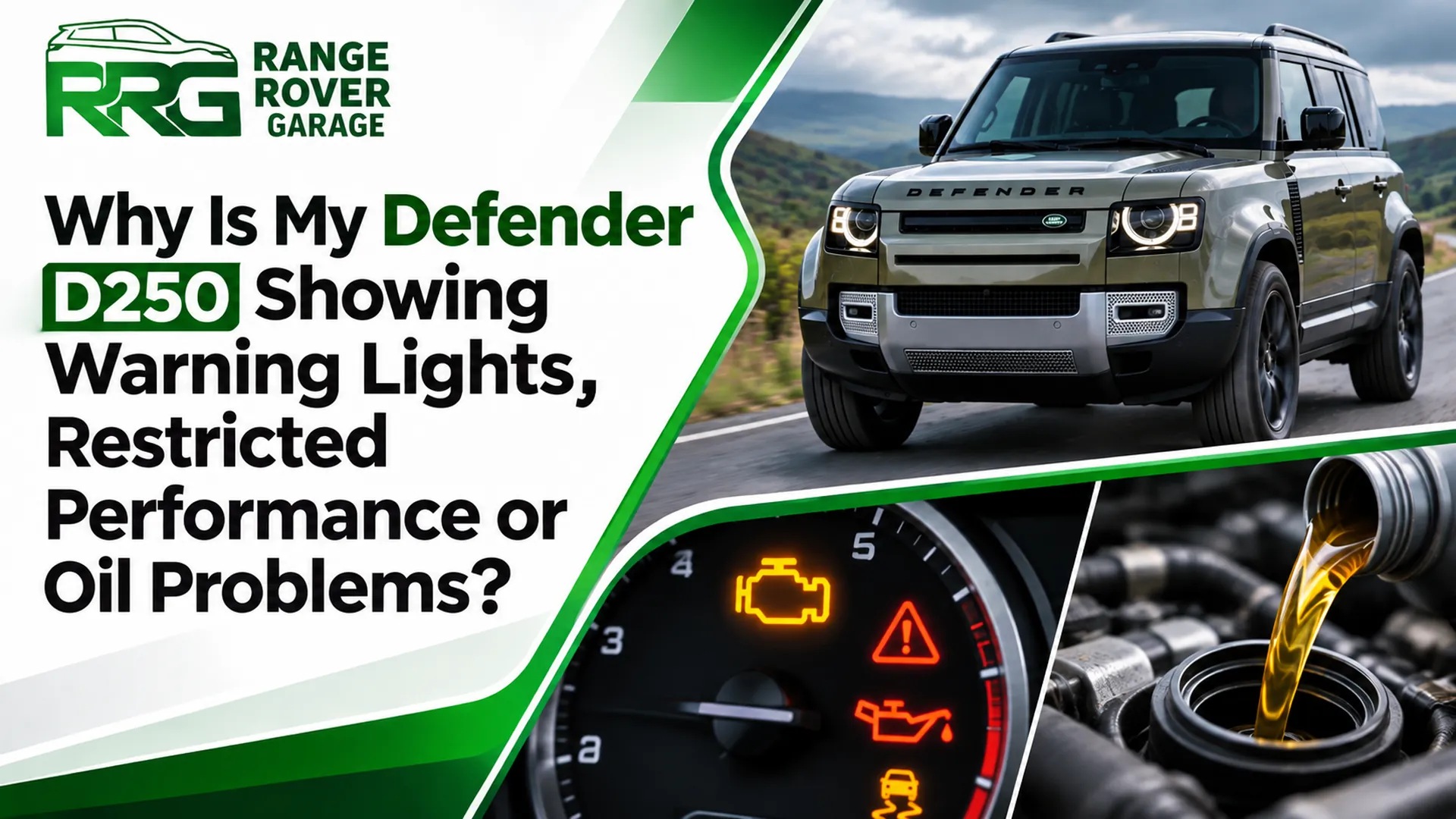
Warning lights are the way the engine management system asks for attention. Some are urgent, and some are simply the car telling you about a sensor reading. Knowing which is which saves money and, occasionally, an engine.
What Causes DPF Warnings, Restricted Performance and Rising Oil Levels on a Defender D250?
Several different faults produce overlapping symptoms. That's why testing comes before parts. This table shows the likeliest causes:
Symptom | Likely causes | Typical urgency |
| DPF warning or loss of power | Blocked filter, failed regeneration, differential pressure sensor fault | Medium. Diagnose soon |
| Restricted performance or limp mode | Boost fault, DPF issue, sensor failure, emissions fault | Medium to high |
| Rising oil level or diesel smell in the oil | Interrupted regeneration allowing fuel dilution | High. Get it checked |
| Loss of boost or flat acceleration | Turbo actuator fault, boost leak, injector problem | Medium |
| Rough idle or misfire feel | Injector problems, fuel delivery faults | Medium |
| Battery, charging or powertrain warning | 48V mild-hybrid system fault, DC-to-DC converter, starter generator | Medium |
| Red oil pressure warning, oil smell or smoke | Oil leak, low pressure, housing or sensor fault | Stop driving |
Let's look at how this plays out in real ownership.
The short-journey Defender. A D250 used mainly for school runs and town driving may rarely get hot enough, for long enough, for the DPF to regenerate. Warnings follow. If regeneration is repeatedly interrupted, unburnt diesel can find its way into the engine oil, which can raise the oil level and thin the oil. That is a reported diagnostic mechanism rather than a proven universal defect, but it's one reason a rising dipstick reading should never be ignored.
The restricted-performance message. The vehicle drops power to protect itself. A blocked DPF is one cause, but so are boost faults, sensor failures and 48V system issues. A proper diagnosis reads the live data and finds which one is responsible.
The hybrid warning. A battery or powertrain message may point to the 48V system, including the battery, the belt integrated starter generator and the DC-to-DC converter. These are electrical faults, not engine failures, and they're diagnosed with a dedicated system health check.
Stop driving straight away if you notice:
- A red oil pressure warning.
- Oil smoke from the engine bay or a burning smell.
- Oil visibly leaking onto hot components.
- A rising oil level with a strong diesel smell.
- Knocking from the engine.
- Repeated temperature warnings.
Carrying on in any of these situations is the fastest way to turn a repairable fault into a damaged engine.
Is the Defender D250 Oil Filter Housing Recall Real, and How Do You Check If Your Vehicle Is Affected?
Yes, a manufacturer recall concerning the oil filter housing exists for certain 3.0-litre Ingenium vehicles. It's referenced as N908, with the UK reference R/2024/255. In the affected vehicles, the housing can crack, allowing pressurised oil to leak onto hot engine components, which creates a fire risk.
This is a recall affecting certain vehicles, not every D250. Verify the wording and your vehicle's eligibility using official sources before acting on anything you read, including here.
Symptoms that deserve immediate attention include:
- A smell of hot or burning oil after driving.
- Smoke from the engine bay.
- Oil warning lights or oil pressure messages.
- Visible oil around the engine or on the ground.
Here is what to do:
- Check your registration on the official GOV.UK vehicle recall checker. It shows outstanding safety recalls for your vehicle.
- Contact a Land Rover dealer if a recall is outstanding. Recall repairs are carried out by the manufacturer's network.
- Don't ignore the symptoms. If you smell oil or see smoke, stop driving and arrange recovery.
There is also a recall entry relating to the auxiliary-drive idler pulley and the oil pressure and temperature sensor, which can lead to an oil leak. Its applicability varies by vehicle, so check it using the official recall database rather than assuming your D250 is affected.
How Is a Defender D250 Engine Problem Diagnosed Properly?
A good diagnosis follows a sequence. Anything less is a guess dressed up as a repair.
- Assess the symptoms. When does it happen? Cold or warm, short trips or long runs, under load or at idle?
- Check recall status. An open recall can explain a symptom immediately.
- Read the fault codes. Diagnostic equipment retrieves stored codes from the engine control module.
- Review live data. Boost pressure, fuel pressure, exhaust temperature and pressure readings, DPF data and oil readings show what the engine is actually doing.
- Run the 48V system health check. Electrical and battery warnings need a dedicated test, not a guess.
- Inspect for leaks. Oil around the housing, sensor and turbocharger area often tells the story.
- Test the components. Turbo actuator, injectors, EGR valve and sensors are checked rather than assumed.
- Confirm the repair. After the work, the vehicle is retested to confirm the fault has gone.
Fault codes deserve a word of caution. A code points to a system. It doesn't prove a part has failed, and replacing sensors without diagnosis is one of the quickest ways to run up a bill without fixing anything. There's a real difference between a basic scan, which reads what was stored, and a full diagnostic investigation, which finds out why.
Book Defender D250 engine diagnostics with us, and you'll get an answer based on testing, not guesswork.
How Much Does Defender D250 Engine Repair Cost, and When Is a Rebuild or Replacement Needed?
There is no single answer, because the cause varies enormously. A software update and a failed turbocharger can both start with the same warning light. What helps more than a guess is understanding what drives the cost and where the line sits between repair and replacement.
What Affects D250 Repair Costs, and When Does Repair Stop Making Sense?
Several factors shape the final bill:
- Diagnostic depth. A quick scan costs less, but tells you less.
- Which system is at fault. A sensor is a very different job from a turbocharger or a DPF.
- Parts. Genuine, OEM and quality aftermarket parts differ in price and longevity.
- Labour time. Access varies by component, and some jobs need extensive dismantling.
- Related damage. A long-ignored leak or contaminated oil can affect other components.
- Warranty or recall cover. Some repairs may be covered by the manufacturer, so check before paying.
A good quote is itemised, so you can see what's diagnosis, parts and labour. Be wary of a quote that names a part without explaining how the fault was confirmed.
Here is how the repair routes compare:
Situation | Typical route |
| Software issue or open recall | Update or recall repair through the manufacturer |
| Faulty sensor | Replace after testing |
| Blocked DPF or EGR fault | Forced regeneration, cleaning or replacement depending on condition |
| Turbo actuator or boost fault | Repair or replace the turbocharger or related parts |
| Injector problems | Test and replace affected injectors |
| Contaminated oil caught early | Oil change, root-cause repair and monitoring |
| Internal damage from oil starvation or severe contamination | Engine rebuild or reconditioned replacement engine |
Here's the honest picture. Most D250 faults are component-level problems, and most can be fixed without opening the engine. Rebuild or replacement is for genuine internal damage, such as bearing wear after oil starvation, or contamination that was left too long.
Picture a Defender with a DPF warning that's diagnosed and cleared early. That's a contained repair and the engine carries on. Now picture the same vehicle driven for weeks with oil levels rising and a red oil warning ignored. That's the situation where an engine rebuild or a reconditioned Land Rover engine becomes the practical choice.
If your engine has already suffered internal damage, ask about an Ingenium engine rebuild or reconditioned Land Rover engines. Request a Land Rover engine repair or replacement quote and we'll explain exactly what's needed and why.
How Can You Prevent D250 Engine Problems and Choose the Right Land Rover Specialist?
Most serious engine damage starts as a small, ignored problem. Good habits catch them early, and a good specialist keeps you from paying for guesswork.
How Do You Reduce D250 Engine Risks, and What Should You Ask a Specialist Before You Book?
These habits make a real difference:
- Use the correct oil specification and change it on time. Oil is the biggest single influence on long-term engine health.
- Give the DPF a chance to regenerate. Regular longer runs at steady speed help, especially if most of your driving is short.
- Check the oil level and smell. A rising level or a diesel smell is a warning worth acting on.
- Act early on warnings. A steady warning is a request for diagnosis, and a red one is an instruction to stop.
- Keep recall status current. Check your registration on the official recall checker regularly.
- Keep service records. History matters for diagnosis, warranty conversations and resale.
When you need help, put these questions to any specialist:
- Do you have experience with the 3.0 Ingenium? The D250 isn't the same as older Land Rover engines.
- Do you test before replacing parts? Testing separates diagnosis from guesswork.
- Will the quote be itemised? You should see diagnosis, parts and labour clearly.
- What quality of parts do you fit? Ask whether they're genuine, OEM or aftermarket.
- What warranty applies to parts and labour? Get the terms in writing.
- Will you give honest repair-versus-replace advice? A good specialist tells you when a repair is enough.
At rangerovergarage.co.uk, the process is simple:
- Send us your registration and a note of the symptoms.
- Book diagnostics. We investigate the cause properly.
- Receive findings and a clear quote. You see what's wrong, what it needs and why.
- Choose the next step. That may be a component repair or, if the damage is serious, a rebuild or replacement engine.
Prefer to talk first? Contact us about your Defender and we'll tell you what to do next.
Frequently Asked Questions About Defender D250 Engine Problems
Is the new Defender D250 engine reliable?
Many owners report no serious trouble. The engine is modern and complex, so warnings relating to emissions or the 48V system are more common than outright failure. Reliability depends on the individual vehicle, its use and its servicing history.
What are the most common Defender D250 faults?
Owners and workshops report DPF and regeneration problems, oil leaks or oil pressure warnings, turbo and injector faults and 48V mild-hybrid warnings. Not every D250 is affected.
Why is my Defender D250 showing restricted performance?
The vehicle reduces power to protect itself. Causes include a blocked DPF, boost faults, sensor failures and electrical issues. A diagnostic test finds which one applies.
Why is the oil level rising on my Defender D250?
One reported cause is diesel fuel entering the oil after repeated interrupted DPF regeneration. Check the dipstick for a rising level and a diesel smell, and have it diagnosed promptly.
Is there a recall on the Defender D250 oil filter housing?
A recall for certain 3.0-litre Ingenium vehicles concerns a cracking oil filter housing. Check your registration on the official GOV.UK recall checker to see whether your vehicle is affected.
What causes DPF warnings on a Defender D250?
Frequent short journeys, interrupted regeneration, sensor faults and exhaust restrictions can all play a part. Regular longer runs help, and diagnosis confirms the actual cause.
Why does my Defender D250 go into limp mode?
Limp mode limits power to protect the engine when it detects a significant fault. Causes include boost problems, DPF issues, sensor failures and 48V faults.
What does a battery or powertrain warning mean on a D250?
It can point to the 48V mild-hybrid system, including the battery, the starter generator or the DC-to-DC converter. A dedicated system health check identifies the cause.
Can a Defender D250 engine be rebuilLand Rover Defender t?
Yes, where there is internal damage that justifies it. A specialist can advise on rebuilding versus fitting a reconditioned engine.
Is it worth rebuilding a Defender D250 engine?
It depends on the damage, the vehicle's value and how long you plan to keep it. Many faults never reach that stage.
What is the difference between the D250 and the D300?
Both use the 3.0-litre Ingenium six-cylinder diesel with mild-hybrid technology, but they differ in output and tuning. Confirm the exact engine code for your vehicle before any repair or replacement.
Can I drive my Defender D250 with a warning light on?
If the light is amber and the vehicle drives normally, you can usually drive gently to a garage, but get it diagnosed soon. If it's red, or you notice oil smoke, burning smells or knocking, stop immediately.
Does the Land Rover warranty cover engine problems?
It depends on the vehicle's age, mileage, service history and the warranty terms. Recall repairs are handled by the manufacturer. Ask your dealer and get the answer in writing.
Get the Cause Found, Not Just the Code Read
The Defender D250 isn't a story of widespread engine failure. It's a modern diesel with a lot of technology, and most of its problems are component-level faults that respond well to early, accurate diagnosis. The real risk is delay: ignoring an oil warning, a rising dipstick or a burning smell.
rangerovergarage.co.uk helps UK owners diagnose Land Rover engine faults properly, repair them where it makes sense and, when the damage goes deeper, discuss Ingenium engine rebuilds and reconditioned engines honestly. Send us your registration, tell us what you're seeing and we'll point you to the right next step. Book Land Rover engine diagnostics today, or request a quote and speak to a Land Rover engine specialist.