Range Rover Evoque Turbo Replacement Cost in the UK: What Affects the Price, Your Repair Options and How to Get a Fair Quote
Your Evoque has lost its pull, whistles when you accelerate or has dropped into limp mode. Then the quote lands, and it feels far higher than you expected. Now you are wondering whether the turbo really needs replacing at all.Range Rover Evoque
That is a fair question. The Range Rover Evoque turbo replacement cost depends on your engine, whether the unit is repaired, reconditioned or new, the labour involved and, most importantly, what caused the failure in the first place. A proper diagnosis comes before any sensible quote.
At Range Rover Garage, we diagnose first and explain the findings in plain language. This guide covers what drives Evoque turbo replacement and turbo repair cost, how the repair options compare, how a professional job is done and how to stop the new turbo failing again.
How Much Does Range Rover Evoque Turbo Replacement Cost and What Affects the Price?
The final cost depends on your engine, the repair route you choose (actuator repair, rebuild, reconditioned, new or used), the labour time and any related damage found during the job. An accurate figure comes from a diagnosis and a written quotation, not from a number on a web page.
Quoting one price for every Evoque would be misleading. The model has used several engines across the L538 and L551 generations, and each one has its own turbo, access and labour requirements.
What Makes Up an Evoque Turbo Quotation?
These are the factors that shape the price:
Cost factor | Why it matters |
| Engine and model year | Each engine uses a different turbocharger and has different access |
| Turbo type | Variable geometry units with electronic actuators differ in complexity |
| Repair route | Actuator repair, rebuild, reconditioned, new or used units differ in parts value |
| Parts versus labour | Some engines need extensive dismantling to reach the turbo |
| Oil feed and return pipes | Often replaced to protect the new unit |
| Oil and filter | A fresh oil change is part of a sound job |
| Intercooler and boost pipe cleaning | Needed when oil or debris has travelled downstream |
| Diagnostic time | Finding the true fault takes proper testing |
| Extra damage found | Boost leaks, DPF or EGR faults, or engine wear can add work |
Think of this table as a map of where your money goes. A good garage explains each line rather than presenting one unexplained total.
Cost by Engine: Why No Single Price Fits Every Evoque
Different Evoques need different work:
- 2.2 TD4 and SD4 diesel: the earlier diesel engines, where turbo problems often link to oil supply, EGR and DPF health
- 2.0 Ingenium diesel (including D150, D180 and D240): the later diesel range, where oil feed restrictions and actuator faults feature in turbo failures
- Petrol variants: turbocharged petrol engines have their own units and service needs
Engine codes and configurations vary by model year and market. We confirm the exact engine and turbo part number from your registration or VIN before ordering anything. That step prevents the costly mistake of buying the wrong unit.
Main Dealer or Independent Specialist?
Main dealers bring brand-specific training and manufacturer backing, but their overheads usually show in the quotation. A good independent Land Rover specialist offers comparable knowledge, more flexibility on repair options and often a more competitive total. The right choice depends on your vehicle's age, warranty position and how much choice you want over the repair route.
What Should a Written Quotation Include?
Before you approve any turbo work, check that the quote lists:
- The diagnosed fault and how it was confirmed
- The turbo option being fitted
- Oil feed and return pipes, gaskets and seals
- Oil and filter replacement
- Intercooler and boost pipe cleaning where needed
- Labour and the diagnostic fee treatment
- The warranty terms
If any of these are missing, ask why. Our guides on Evoque turbo repair cost and turbo actuator replacement go deeper into individual items.
Should You Repair, Recondition, Buy New or Fit a Used Turbo for Your Evoque?
The right route depends on what has failed, so diagnosis decides. Here is how the options compare:
Option | Best for | Main advantage | Main risk |
| Actuator repair or replacement | Faults confined to the electronic actuator | Targets the actual fault | Not suitable if the turbo itself is damaged |
| Turbo rebuild | Repairable units with sound housings | Reuses the core unit | Quality depends on the rebuild standard |
| Reconditioned turbo | Many failures where a complete unit is needed | Balanced, tested unit at a sensible value | Quality varies between suppliers |
| New OEM turbo | Cases where the best available part is wanted | Known condition and full specification | Higher parts value |
| Used turbo | Tight budgets | Lowest parts value | Unknown history and limited warranty |
A turbo actuator is not the same as a complete turbocharger. The actuator controls boost, and on many Evoques it is electronic. If the actuator alone is faulty, replacing or repairing it can solve the problem without a full turbo. If the shaft has play, the bearings are worn or the compressor and turbine wheels are damaged, complete replacement is necessary.
We recommend caution with used units, because their history is unknown and warranty cover is usually limited. On an older Evoque, repair is not always worthwhile, and if internal engine damage has occurred, the whole decision changes. A specialist should tell you this honestly.
What Are the Signs of a Failing Evoque Turbo and What Causes It?
Turbo faults rarely arrive without warning. These are the symptoms owners report most often:
Symptom | What it may indicate |
| Loss of power and slow acceleration | Reduced boost from a worn or leaking turbo system |
| Whining or siren-like noise | Bearing wear, shaft play or a boost leak |
| Blue or grey smoke | Oil entering the intake or exhaust |
| Black smoke on acceleration | Poor air supply or combustion problems |
| Rising oil consumption | Turbo seal leakage |
| Restricted performance message or limp mode | The engine control unit limiting power to protect the engine |
Behind those symptoms sit a handful of common causes:
- Oil starvation, where too little clean oil reaches the turbo bearings
- Blocked or restricted oil feed pipes, which cut the oil supply
- Contaminated or incorrect oil, which damages bearings and seals
- Worn turbo bearings, causing shaft play and wheel contact
- Sticking variable geometry vanes, which upset boost control
- A faulty electronic actuator, which stops the turbo responding properly
- Excessive exhaust back pressure, often linked to DPF and EGR problems
Here is the key expert point. A split boost hose, an intercooler leak, a sticking actuator or a sensor fault can all mimic a failed turbo. Fault codes such as P0299 for underboost and P0234 for overboost are useful clues, but they do not prove the turbo has failed. Replacing the unit without testing can waste a lot of money.
Consider a typical scenario. An Evoque owner reports a whistle and a loss of power. Diagnosis finds a split boost pipe and a partly restricted oil feed. Fixing both resolves the symptoms, and the turbo itself proves sound once the root causes are addressed. Testing first saved the owner a full replacement.
How Is an Evoque Turbo Diagnosed and Replaced, and Can You Still Drive It?
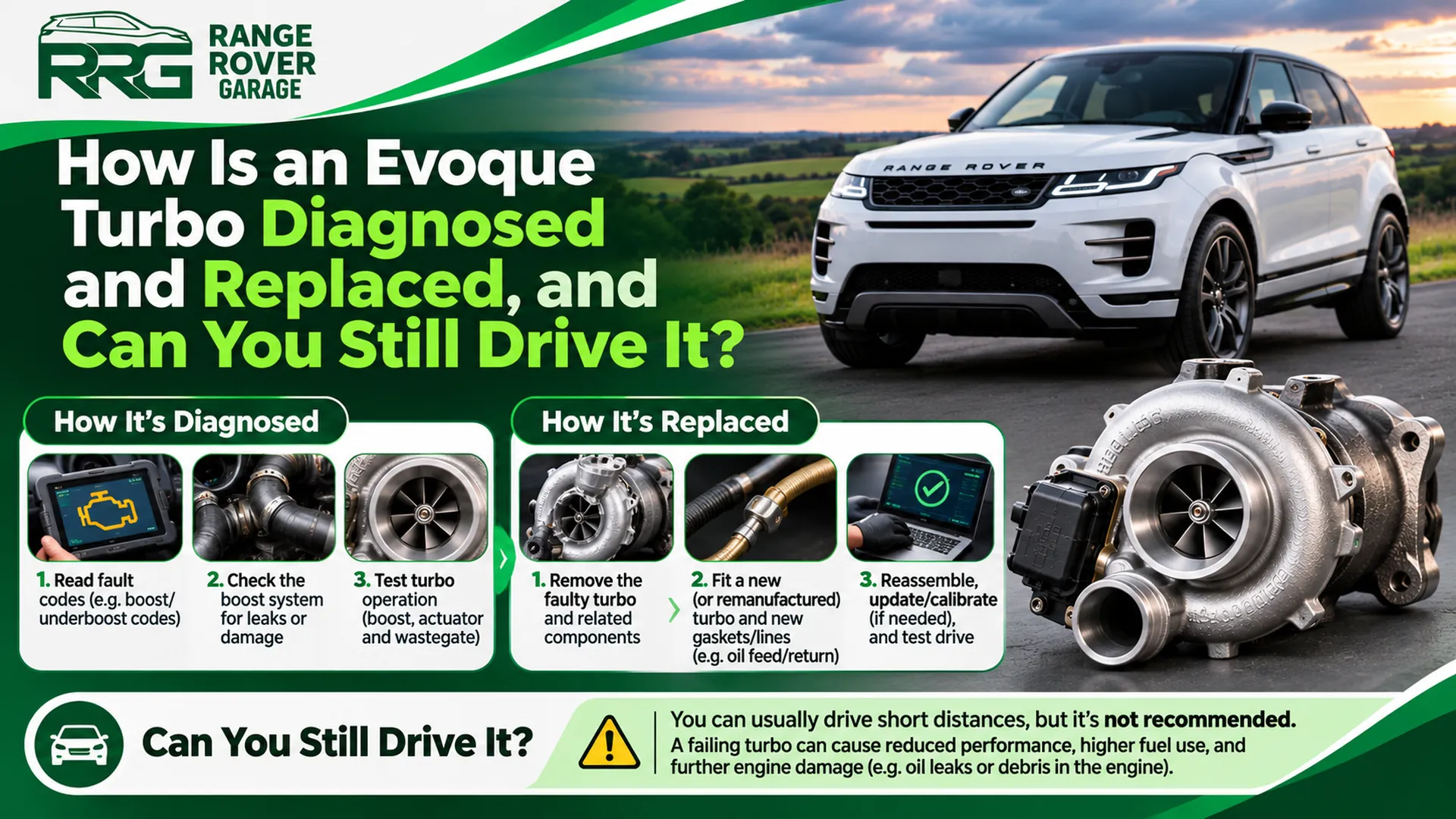
You may be able to drive carefully to a garage if symptoms are mild, but continued driving risks oil entering the intake, wider engine damage and a far larger bill. Stop and seek help if you notice heavy smoke, loud noise or sudden power loss.
Ignoring a faulty turbo is one of the most expensive decisions an owner can make. A failing unit can pass debris or oil downstream, and in a bad case, damage the engine itself.
How Do Mechanics Diagnose an Evoque Turbo Failure?
A professional diagnosis follows a sequence:
- Scan for fault codes. A diagnostic scanner reads stored codes and live data.
- Check boost pressure and look for leaks. Pressure testing finds split hoses and intercooler faults.
- Inspect the actuator. The technician checks whether it moves and responds correctly.
- Check shaft play. Excess movement points to bearing damage.
- Look for oil in the intercooler piping. Oil here suggests seal failure or crankcase issues.
- Inspect the oil feed and return pipes. Restrictions are a common root cause.
- Review DPF and EGR health. Exhaust restriction can strain the turbo.
What Is Included in a Professional Turbo Replacement?
When the turbo is confirmed as faulty, a thorough job covers far more than swapping one part:
- Removing the old unit and inspecting it for clues about why it failed
- Fitting new gaskets and seals to prevent leaks
- Replacing or cleaning the oil feed and return pipes
- Cleaning the intercooler and boost pipes to remove oil and debris
- Changing the engine oil and filter so the new turbo gets clean lubrication
- Priming the new turbo with oil before the engine starts
- Calibrating the actuator where required
- Boost testing and a road test to confirm normal operation
Priming matters because a dry turbo spinning at high speed can be damaged within seconds. That one step protects the whole job.
Why Should the Turbo Oil Feed Pipe Be Replaced?
A restricted oil feed starves the bearings, and starved bearings fail. If a technician fits a new turbo to a blocked pipe, the same fault returns, often within a short time. Replacing or properly cleaning the oil feed and return pipes protects the new unit, which is why we treat it as part of the job, not an optional extra.
How Long Does Turbo Replacement Take?
Most jobs take a working day or part of one, but the time varies with the engine, access and what the diagnosis uncovers. Extra work such as intercooler cleaning or pipe replacement can extend it. We confirm the likely timescale when we give you the quotation.
Here is a short real-world example. An owner brings in an Evoque with a loud whine and smoke on acceleration. Diagnosis finds shaft play and oil in the intercooler piping. The turbo is replaced, the intercooler cleaned, the oil feed checked and the oil and filter changed. After boost testing and a road test, the car pulls cleanly again, and the owner leaves with an itemised invoice.
A sound invoice lists the parts, pipes, oil, labour, warranty and date. If a garage cannot show you that, ask why.
Does Turbo Replacement Include a Warranty and How Can You Stop It Failing Again?
A sensible warranty covers parts and workmanship, and it should state clearly what is excluded. Failures caused by an unresolved root cause, such as a blocked oil feed that was never fixed, are often excluded. Always ask for the terms in plain language before you approve the work.
Prevention matters as much as the warranty. These habits protect a turbo:
- Use the correct oil specification and change it on schedule
- Replace oil feed pipes and filters when the turbo is renewed
- Clean the intercooler after any turbo failure
- Fix DPF and EGR problems early, because exhaust restriction strains the turbo
- Keep up with regular servicing
- Let the engine settle after hard driving before switching off
- Avoid repeated very short trips, which can leave the engine and exhaust system under-stressed
Fixing the root cause matters more than the turbo itself. A new unit in an unhealthy system will fail again.
How Do You Choose an Evoque Turbo Specialist and Get Your Replacement Quote?

Choose a Land Rover specialist who diagnoses before replacing parts, confirms the correct unit from your registration or VIN, explains your repair options and gives you a written quotation with clear warranty terms. Experience across the TD4, SD4 and Ingenium engines makes a real difference.
Main Dealer or Independent Specialist?
Factor | Main dealer | Independent specialist |
| Specialist knowledge | Brand-trained | A true specialist works on these engines regularly |
| Flexibility | Often fixed packages | Usually more flexible on repair route |
| Parts choice | Manufacturer parts | Quality options, depending on the garage |
| Records | Dealer system | Itemised invoice and service record |
| Cost factors | Typically higher overheads | Often more competitive for comparable work |
How to Get Your Quotation With Us
The process is simple:
- Contact us with your registration and a description of the symptoms.
- We carry out a diagnostic inspection to find the true fault.
- You receive a written quotation with your repair options explained.
- You approve the work and choose a date.
- We complete the repair and run post-repair checks.
- You receive an itemised invoice and a clear explanation of what was done.
Call a specialist without delay if you notice power loss, a whistle, smoke, limp mode, oil in the intercooler piping or a repeat failure.
What Should You Ask Before Agreeing to an Evoque Turbo Replacement?
A good garage welcomes questions. Ask these before you commit:
- How was the fault diagnosed? The answer should be specific.
- Will the oil feed pipe, oil and filter be replaced? These protect the new turbo.
- Is the intercooler cleaned? It should be after a failure.
- Is the part confirmed by registration or VIN? This prevents wrong-part errors.
- What warranty applies? Get the terms in plain language.
- Is a written quotation provided? It should be.
- Is replacement worth it on my older Evoque? An honest garage weighs the car's value and condition.
If a garage cannot answer these clearly, keep looking.
Frequently Asked Questions About Range Rover Evoque Turbo Replacement
How much does a Range Rover Evoque turbo replacement cost?
It depends on your engine, repair route, labour time and any related faults. A diagnosis and written quotation give you an accurate answer for your car.
What are the signs of a failing Range Rover Evoque turbo?
Loss of power, whining noise, blue or black smoke, rising oil consumption, a restricted performance message and limp mode are the most common signs.
Can a Range Rover Evoque turbo be repaired?
Sometimes. If only the actuator is faulty, it can be repaired or replaced. A rebuild may suit repairable units, while serious bearing or wheel damage needs complete replacement.
How long does an Evoque turbo replacement take?
Usually a working day or part of one, depending on the engine, access and any extra work found.
Is a reconditioned Evoque turbo reliable?
A properly balanced and tested reconditioned unit can be a sound choice. Quality varies between suppliers, so check the warranty and the standard of work.
What causes turbo failure in a Range Rover Evoque?
Oil starvation, blocked oil feed pipes, contaminated oil, worn bearings, sticking vanes, actuator faults and exhaust restriction are the usual causes.
Can I drive my Evoque with a faulty turbo?
Only briefly and with care. Continued driving risks oil entering the intake and wider engine damage.
Does turbo replacement include new oil feed pipes?
It should, or at least a proper check and clean. Restricted pipes are a leading cause of repeat failure.
What is the difference between a turbo actuator and a turbocharger?
The actuator controls boost, while the turbocharger is the complete unit that compresses the air. Sometimes only the actuator has failed.
Does a replacement Evoque turbo come with a warranty?
A reputable garage provides a written warranty. Always check what it covers and what it excludes.
How long does an Evoque turbo last?
It varies with servicing, oil quality, driving pattern and engine health. A well-maintained turbo can last a long time, while poor lubrication shortens its life.
Can a faulty turbo cause limp mode?
Yes. The engine control unit can limit power when boost readings fall outside expected limits.
Does a faulty turbo cause black smoke?
It can, particularly when air supply is reduced. Blue smoke more often points to oil entering the intake or exhaust.
Can a blocked DPF cause turbo failure?
Exhaust restriction raises back pressure and can strain the turbo, so DPF and EGR health matter.
Should I replace the turbo oil feed pipe?
In most cases, yes. A restricted pipe starves a new turbo of oil.
Do I need to clean the intercooler after turbo failure?
Yes. Oil and debris can collect in the intercooler and boost pipes, and they can harm the new unit.
Is turbo replacement worth it on an older Evoque?
It depends on the car's condition and value. A specialist can explain whether repair, a reconditioned unit or another route makes sense.
How do I find the correct turbo for my Evoque?
Use your registration or VIN to confirm the engine code and turbo part number before ordering.
Get an Honest Answer on Your Evoque Turbo
The Range Rover Evoque turbo replacement cost is not one number. It depends on your engine, the repair route, the work needed around the turbo and, above all, the root cause of the failure. The right diagnosis often saves more than the cheapest quote ever could.
At Range Rover Garage, we diagnose first, explain your options clearly, fit the right turbo for your engine and protect it with the supporting work it needs. If your Evoque has lost power, whistles or shows a restricted performance message, we can find out why.
Contact us today to request a diagnosis and written quotation through rangerovergarage.co.uk, and get your Evoque pulling the way it should.