Top 5 Common Diesel Engine Issues and Their Fixes
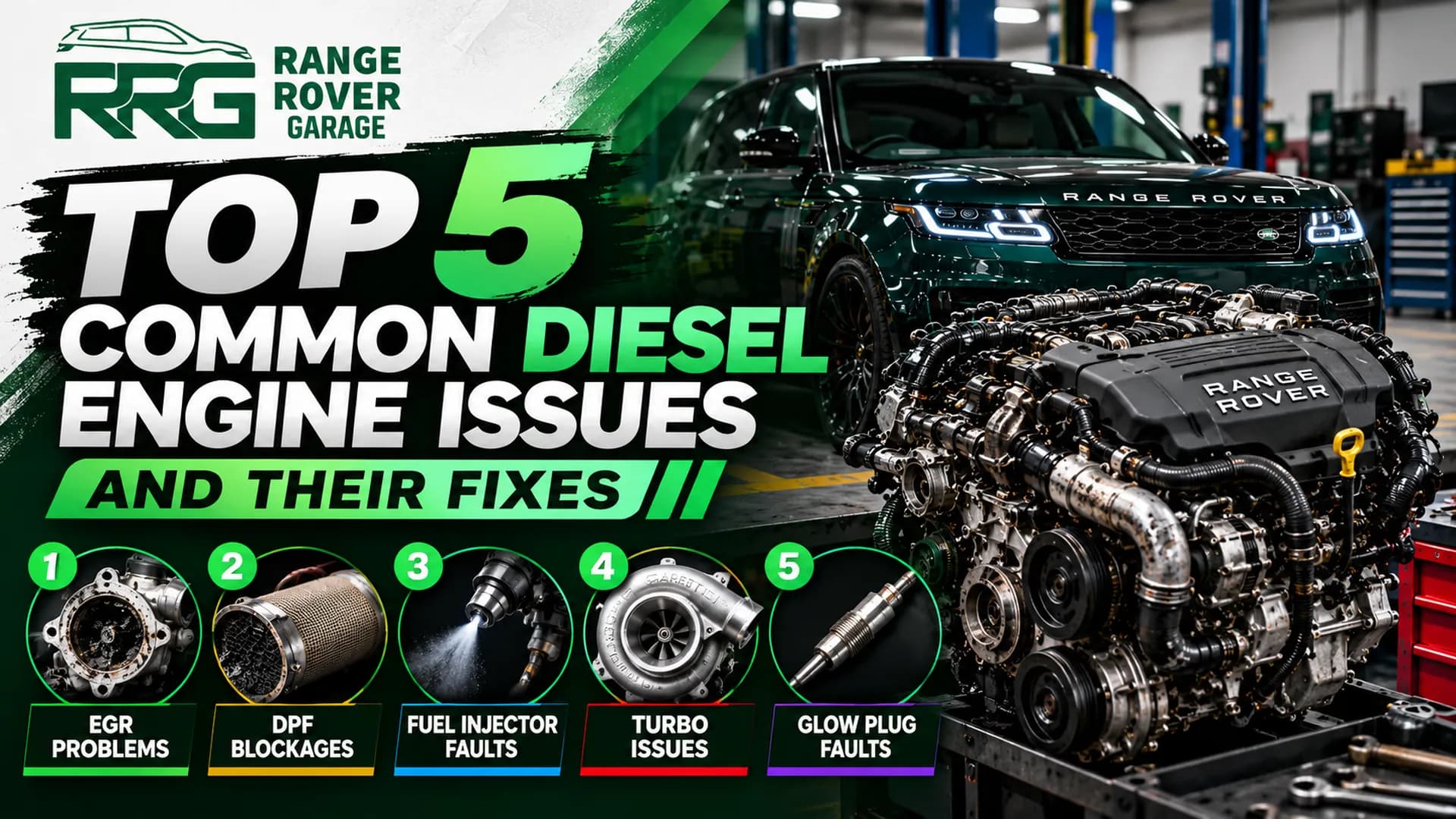
Modern diesel engines are strong and economical. They also depend on emissions equipment and high-pressure fuel systems that can cause expensive problems if neglected.
On Range Rover and Land Rover diesels, the five most common problems are:
- a blocked diesel particulate filter (DPF);
- EGR valve and cooler faults;
- injector problems;
- turbo failure;
- oil-related damage, such as fuel diluting the oil or the engine running short of oil.
These faults are often linked. A worn injector can block the DPF, and a blocked DPF can thin the engine oil. The right fix starts with finding which fault came first.
Why Range Rover Diesels Develop These Faults
Today's diesels run at high fuel pressures, recirculate exhaust gas and trap soot to meet emissions rules. Each of those systems has its own weak points.
How the vehicle is driven matters as much as the engine design. Short, slow journeys stop the exhaust from getting hot enough to burn soot out of the DPF. That single habit lies behind many of the problems below.
Which Diesel Engines Are Affected?
Engine family | Typical Range Rover / Land Rover use | Issues specialists commonly report |
| 2.7 / 3.0 TDV6 and SDV6 | Range Rover Sport, Vogue, Discovery 3/4 | EGR faults, turbo wear, crankshaft and bearing failure linked to oil supply |
| 3.6 / 4.4 TDV8 | Range Rover Vogue, Sport | Turbo and oil-system faults on higher-mileage engines |
| 2.0 / 2.2 four-cylinder diesels (incl. Ingenium) | Evoque, Velar, Discovery Sport, Discovery 5 | DPF blockage, oil dilution, timing-chain wear |
| 3.0 Ingenium six-cylinder | Newer Range Rover, Sport, Discovery | DPF and EGR issues; check open recalls |
These are patterns reported by specialists, not failure rates. Your engine's condition depends heavily on its service history and how it has been used.
Range Rover Garage's 3.0 engine page covers the TDV6, SDV6 and Ingenium six-cylinder units.
The Top 5 Diesel Engine Issues and How to Fix Them
Issues 1–3: DPF, EGR and Injector Faults
1. Blocked diesel particulate filter (DPF)
The DPF traps soot from the exhaust and burns it off during regeneration.
- Passive regeneration happens on its own during sustained, hot driving.
- Active regeneration is triggered by the engine computer, which adds extra fuel to raise exhaust temperature.
If short journeys keep interrupting this process, the filter fills up (Mr Autofixer).
- Signs: DPF warning light, then the engine light; limp mode (reduced power); poor acceleration.
- Fixes, in order:
- A sustained motorway run, if the warning has only just appeared.
- Checking the DPF pressure sensor and its hoses.
- A forced regeneration at a garage.
- A professional clean.
- Replacement, as the last resort.
- Avoid: DPF removal. Since February 2014, MOT testers check for the DPF. A car fails if a factory-fitted DPF is missing, and driving a modified vehicle is an offence (GOV.UK).
2. EGR valve and cooler faults
The exhaust gas recirculation (EGR) system feeds cooled exhaust gas back into the engine to reduce emissions. Carbon can make the valve stick, and EGR coolers can crack.
- Signs: rough idle, hesitation, black smoke, poor throttle response.
- Cooler-specific sign: unexplained coolant loss, because a cracked cooler leaks coolant into the exhaust side.
- Fixes: test that the valve is working, then clean or replace the valve. If coolant is being lost, pressure-test the EGR cooler.
3. Injector problems
Common-rail injectors spray fuel at very high pressure. Worn or leaking injectors upset combustion.
- Signs: hard starting, misfire, diesel knock, smoke, a fuel smell, and the DPF blocking repeatedly even after cleaning.
- Fixes: check the injector correction values and fuel-rail pressure using diagnostic equipment, then test or replace faulty injectors.
British Diesel Systems notes that a DPF which blocks again after cleaning often points to an injector, EGR or turbo fault upstream (British Diesel).
Issues 4–5: Turbo Failure and Oil Problems
4. Turbocharger failure
The turbo spins at very high speed and relies on a clean, steady oil supply.
- Signs:
- whistling or siren noise;
- blue, grey or black smoke;
- oil in the boost pipes;
- underboost fault codes;
- limp mode.
- Fixes: check for boost leaks and actuator faults first. Many "turbo failures" turn out to be a split hose or a sticking actuator.
If the turbo has genuinely failed, replace it. Fix the oil feed problem at the same time. Also clean or replace any oil components that the turbo's debris has contaminated.
Range Rover Garage offers turbo replacement for TDV6, SDV6, TDV8 and Ingenium engines.
5. Oil dilution and oil starvation
Each repeated failed regeneration adds a little diesel to the sump, thinning the oil. Specialists link this to timing-chain and turbo wear on four-cylinder Ingenium diesels (JLR Engines).
On the 3.0 V6 diesels, specialists associate oil starvation or poor oil condition with crankshaft and bearing failure (JLR Engines).
- Signs:
- an oil level that rises between services (a sign of fuel dilution);
- an oil-pressure warning;
- timing rattle on start-up;
- knocking.
- Fixes:
- Change the oil and filter using the correct specification.
- Fix the cause of the DPF problem.
- Investigate any timing noise straight away; timing chain replacement costs far less than the engine damage a failed chain causes.
- If bearing damage is already present, a full engine rebuild may be needed.
Diagnose Before You Fix
Fault codes are only the starting point. A DPF pressure code, for example, could come from a split sensor hose, a wiring fault, an EGR problem or faulty injectors.
Replacing the part named by the code without testing it can waste money.
Typical UK costs for DPF work, as quoted by one specialist (VAT status not stated), show why the cause matters:
DPF fix | Typical cost quoted |
| Forced regeneration at a garage | £80–£150 |
| Specialist clean | £250–£400 plus labour |
| Aftermarket DPF, fitted | £350–£800 |
| Original-equipment DPF, fitted | £800–£2,500 |
Source: Mr Autofixer. These are general UK figures, not Range Rover Garage prices. Range Rover parts can cost more.
Warning Signs and When to Stop Driving
Stop as soon as it is safe and arrange recovery if you notice any of these:
- red oil-pressure warning;
- knocking or loud rattling;
- heavy smoke;
- rising engine temperature;
- grinding noise from the turbo.
Book a diagnosis soon if you notice any of these:
- amber DPF or engine warning light;
- limp mode;
- oil level rising;
- rough running;
- hard starting;
- coolant slowly going down.
Range Rover Garage's engine repair service starts with a full diagnostic assessment and confirms the fault before quoting.
Frequently Asked Questions
Diesel Engine Issues FAQs
What are the most common diesel engine problems?
On modern diesels, the most common problems involve the DPF, the EGR system, the injectors, the turbocharger, and oil-related issues such as fuel dilution. Glow plug and cooling system faults are also common on older or high-mileage engines.
How do I fix a blocked DPF?
If the warning has only just appeared, try a sustained motorway run. If the warning stays on, have the pressure sensor checked and a forced regeneration or professional clean carried out. Repeated blockages usually mean there is an underlying injector, EGR or turbo fault to fix.
Why is my diesel oil level rising?
A rising oil level often means diesel is diluting the oil because DPF regenerations are being interrupted. Diluted oil protects the engine poorly, so have it checked promptly.
Is it legal to remove a DPF in the UK?
No. A car will fail its MOT if a factory-fitted DPF is missing, and driving a car modified this way is an offence.
Can regular servicing prevent these problems?
It reduces the risk considerably. Use the correct oil specification, keep to the service intervals for your engine, and give the car regular longer runs. Deal with warning lights early.
If your Range Rover diesel is showing any of these symptoms, contact Range Rover Garage on 07477 733313 or 01708 592377 through the contact page. Please include your registration, model, engine, mileage, symptoms and any fault codes.