Range Rover Injector Replacement Cost: What Will You Actually Pay and Why?
The Range Rover has been running rough for weeks. There's a shudder at idle, a puff of black smoke when you pull away, and now a garage has sent you a quote that looks nothing like the one your neighbour got for the same job. One says a single injector. Another says the full set. A third wants extra for something called coding.
That confusion is normal, because Range Rover injector replacement cost isn't one number. It depends on the engine, how many injectors are involved, the quality of the parts, the labour needed to reach them, whether coding is required and whether any injector has seized in its bore.
This guide explains what drives the cost of Range Rover fuel injector replacement in the UK, how a proper diagnosis avoids paying for parts that were never faulty, and how to get an accurate quote. When you're ready, you can request a repair quotation from Range Rover Garage with your model, engine and symptoms.
How Much Does Range Rover Injector Replacement Cost in the UK, and What Affects the Price?
No honest garage can name a fixed figure without knowing your engine and the condition of the injectors. Published prices online come from different suppliers, covering different engines and different scopes of work, so they aren't like-for-like. Treat any single "average" with caution, especially one written for another country.
What you can do is understand what builds a quote, so you can judge whether it's fair.
Why Does Replacing One Injector Cost Less Than a Full Set, and What Else Is on the Quote?
Replacing one injector usually costs less than a full set because you pay for fewer parts and less repeated work, but the final cost still depends on the engine, labour time, coding and the condition of the injector. A quote is the sum of several separate elements, and each one can move the total.
These are the main drivers of Range Rover injector repair cost:
- Number of injectors. One, several or a complete set. Four-cylinder, six-cylinder and eight-cylinder engines all differ.
- Parts. Genuine Land Rover injectors, quality aftermarket units and reconditioned injectors sit at different levels. New seals, copper washers and O-rings are usually needed as well.
- Labour and access. On some engines the injectors are easy to reach. On others, ancillaries and pipework must come off first, which adds hours.
- Diagnostic time. Finding which injector is at fault takes testing, and that's a legitimate part of the job.
- Injector coding and calibration. Many replacement injectors need their correction values programmed with Land Rover diagnostic equipment.
- Seized injector extraction. If an injector is stuck in the cylinder head, specialist extraction adds labour and risk.
- VAT and warranty terms. Check whether the quote includes VAT and what guarantee covers parts and labour.
Here's how three common jobs compare:
Job | What usually changes the quote | Points to ask |
| Single injector replacement | One injector, seals, coding and diagnostic confirmation | Was the faulty injector properly identified first? |
| Full injector set replacement | Several parts, more labour, coding for each injector | Is replacing the whole set justified by test results? |
| Seized injector job | Extraction time, specialist tools, risk of damage, possible extra work | What happens if the injector breaks during removal? |
Ask any garage for a quote that separates parts, labour, coding and diagnostics. A line-by-line breakdown makes it easy to compare two garages fairly. A single lump sum hides where the money goes.
Want a clear, itemised answer for your car? Request a Range Rover injector repair quotation with your model, engine and symptoms.
Does the Cost Change by Engine and Model: Range Rover, Sport, Evoque, Velar, Diesel or Petrol?
Yes. Engine type has a major effect on cost, and different engine families are not interchangeable. A price quoted for one Range Rover does not apply to another.
Here's the broad picture, engine by engine:
- 2.0 Ingenium diesel and petrol. Used across newer models, including the Evoque and Velar. The diesel uses common rail injection with coded injectors, while the petrol uses direct injection.
- 3.0 TDV6 and SDV6 diesel. Common in the Range Rover Sport and the L405 Range Rover. These V6 diesels use Bosch common rail injectors, with piezo injectors on some versions, and correction codes matter.
- 3.0 Ingenium diesel. A newer design from the older TDV6, with its own injectors and procedures. Don't treat it as the same engine.
- 4.4 SDV8 diesel. A V8 with more injectors and more labour in play.
- 5.0 supercharged V8 petrol. Petrol direct injection with its own diagnostic approach.
Diesel injectors work at very high pressure on a common rail system, so they're precision parts and often cost more than petrol injectors. Petrol injectors still fail, but the faults and repair routes differ.
Model generation matters too. Range Rover L322, L405 and the newer cars, the Range Rover Sport L320, L494 and L461, the Evoque L538 and L551 and the Velar L560 can each use different engines in different years. Always confirm your engine code against your vehicle before trusting any figure. We can check this with you when you get in touch.
What Are the Signs of a Faulty Range Rover Injector, and Can You Keep Driving?
An injector's job is to deliver a precise, finely atomised spray of fuel into the cylinder at exactly the right moment. When it leaks, clogs, sticks or loses its spray pattern, combustion suffers, and the engine tells you in several ways.
Which Symptoms Point to a Failing Injector, and What Happens If You Ignore Them?
A failing Range Rover injector typically causes rough idling, misfires, smoke, poor fuel economy and hard starting. Some symptoms are mild at first, which is why they're easy to dismiss.
Watch for these signs:
- Rough idle and vibration. One cylinder is contributing less than the others, so the engine shakes at a standstill.
- Misfires and knocking. A leaking or over-fuelling injector can cause uneven combustion and a harsh knock, particularly on diesels.
- Black or white smoke. Black smoke can mean too much fuel. White smoke can mean fuel isn't burning properly.
- Poor fuel economy. An injector that sprays badly wastes fuel.
- Hard starting. Especially when cold, or after the car has sat for a while.
- Loss of power or limp mode. The engine management system may restrict power if it detects an injector fault or abnormal fuel pressure.
- Diesel smell or leaks around the injectors. A seal failure or leaking injector can let fuel escape.
Can you drive a Range Rover with a faulty injector? For a mild fault, a short, gentle drive to a garage may be reasonable. But stop if you hear heavy knocking, see thick smoke or notice a fuel leak. An over-fuelling injector can overheat a piston and damage the cylinder, and that turns a modest repair into an engine repair. Early diagnosis nearly always costs less than waiting.
If your Range Rover has dropped into reduced power, our guide on getting a Land Rover or Audi out of limp mode explains the safe first steps, though a warning on the dashboard still needs a proper scan.
For more on what can go wrong inside the engine, see our Range Rover engine repair page.
How Is an Injector Fault Diagnosed, and Do You Need to Replace Every Injector?
This is the part many cost guides skip, and it's where the biggest savings sit. Replacing injectors on a hunch is expensive. Land Rover's own technical guidance warns against replacing injectors without following the correct diagnostic procedure, and experience shows that many injectors swapped out in error turn out to have no fault at all.
How Do Mechanics Test Range Rover Injectors Before Replacing Them?
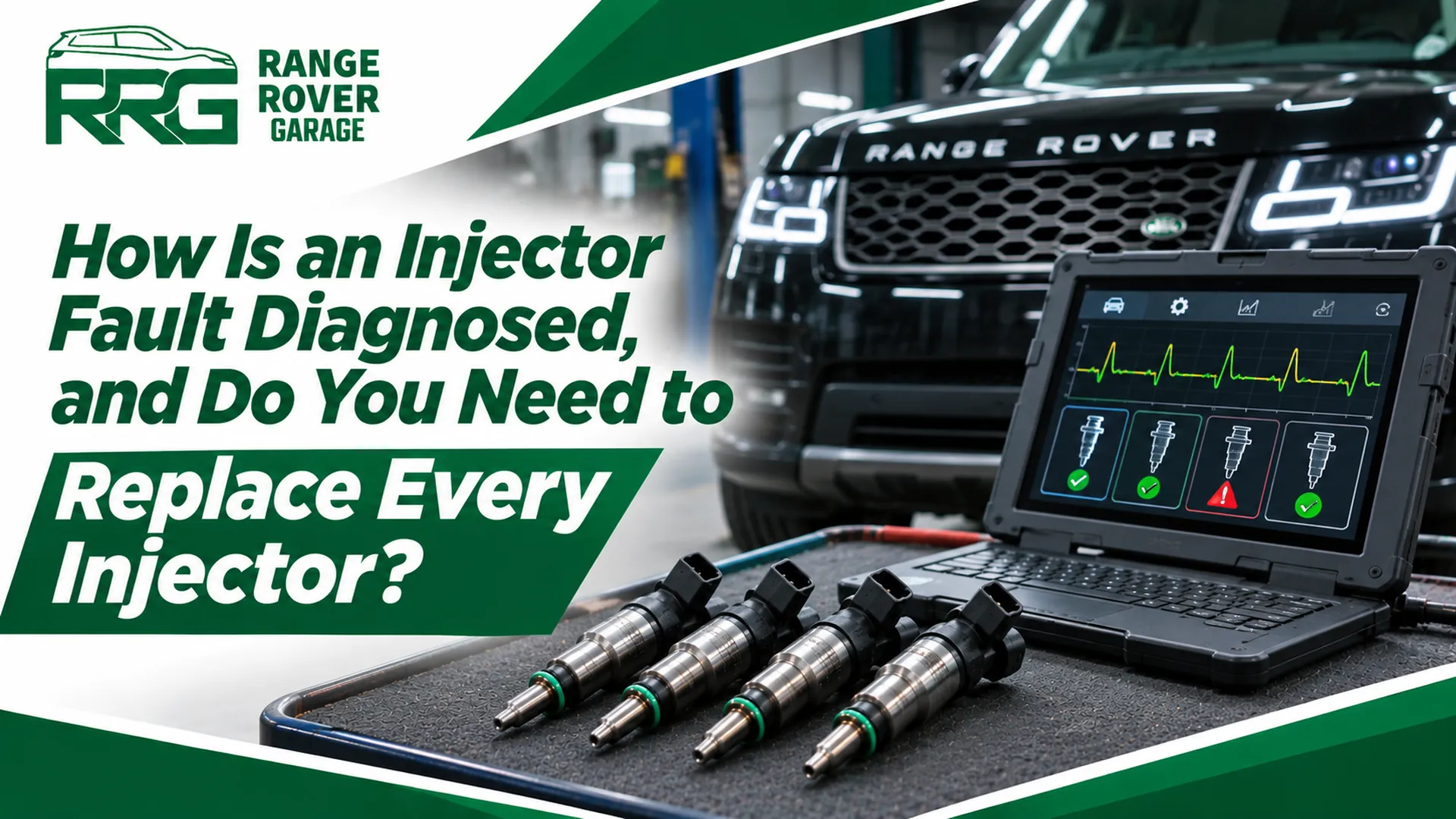
A proper diagnosis combines fault code scanning, live data, injector testing and pressure checks, so the exact faulty injector is identified before any part is ordered. A fault code is a clue, not a verdict.
A thorough injector diagnosis usually includes:
- Reading fault codes and ECU fault memory. This shows which cylinder or circuit the engine management system flagged.
- Checking live data and cylinder contribution. Comparing how hard each cylinder is working reveals an imbalance.
- Running injector balance and leak-off tests. On diesels, measuring the return flow from each injector shows whether one is leaking excessively.
- Testing fuel rail pressure. Low or unstable rail pressure can point to the injectors, but also to the high-pressure fuel pump or a pressure sensor.
- Inspecting seals, connections and leaks. A failed seal or a damaged connector can mimic an injector fault.
- Bench testing where needed. A removed injector can be tested for spray pattern and flow.
This matters because several different faults feel the same. A misfire could be a failing injector, a coil or glow plug issue, a boost leak, a fuel pump problem or a sensor fault. Fixing the wrong thing costs money and leaves the original fault in place.
Can Injectors Be Cleaned or Refurbished, Do New Ones Need Coding, and What About Seized Injectors?
Sometimes. Cleaning and refurbishment suit certain faults, while replacement is necessary when an injector is worn, leaking internally or damaged. The right answer comes from testing.
Option | What it involves | Suits |
| Injector cleaning | Removing deposits that affect spray | Mild issues caught early |
| Seal replacement | New washers and O-rings | External leaks, with the injector itself sound |
| Refurbishment | Bench rebuild of the injector | Injectors that can be restored to specification |
| Reconditioned replacement | A refurbished unit fitted to your engine | A sensible middle route when tested units are available |
| New or genuine replacement | A brand-new injector | Worn or damaged injectors, or where maximum confidence is wanted |
Do new injectors need coding? Often, yes. Many modern diesel injectors carry a correction code that tells the engine management system how that individual injector flows. It's programmed using Land Rover diagnostic software such as SDD or Pathfinder, and it must be matched to the correct cylinder. Fitting an injector without coding, or in the wrong position, can cause rough running, smoke and fault codes. That's why coding appears as its own line on a proper quote.
What about seized injectors? Carbon deposits and corrosion can bond an injector to the cylinder head. Forcing it risks snapping the injector or damaging the head. Specialist extraction takes time and care, which is why it adds cost. A good garage explains the risk before starting and tells you what happens if an injector breaks.
One injector or all of them? Replace one when testing shows a single faulty unit and the others are healthy. Consider a set when several injectors show wear, when the engine has a known pattern of failures or when the labour to reach the injectors makes doing them together more sensible. Your garage should show you the test results behind that advice.
Fuel quality plays a part too. Contaminated diesel, a neglected fuel filter and missed servicing all shorten injector life. Regular servicing and good fuel protect the whole common rail system.
Why Choose a Range Rover Injector Specialist, and How Do You Get an Accurate Quote?
Injector work on a Range Rover rewards specialist knowledge. The engines differ, the injectors need coding, access varies and wrong guesses are expensive. A Land Rover specialist knows these engines, has the right diagnostic equipment and can explain the cost line by line.
What Should You Ask a Garage Before Booking Injector Replacement?
Ask whether the fault is diagnosed before parts are ordered, and whether the quote shows parts, labour, coding and diagnostics separately. Those two questions reveal most of what you need to know.
Use this checklist before you agree to any work:
- Is the faulty injector confirmed by testing? Not just a code, but evidence.
- Is the quote itemised? Parts, labour, coding, diagnostics and VAT.
- Are the parts genuine, aftermarket or reconditioned? And what does each choice mean for warranty?
- Is injector coding included? And is it done with the correct software?
- What happens if an injector is seized? Ask about extraction and any extra charge.
- What warranty covers parts and labour? Get the terms in writing.
- How long will the car be off the road?
To get an accurate quote from Range Rover Garage, have these details ready:
- The model and year
- The engine and, if possible, the engine code
- The symptoms and when they happen
- Any fault codes or warning lights
- Photos of any visible leaks or smoke
We'll explain what's likely involved and give you a clear quotation before any work begins. See also our pages on fuel system diagnostics, injector coding and Land Rover engine repair.
Ready to find out what your Range Rover needs? Request a repair quotation with your details today.
Range Rover Injector Replacement FAQs
How much does Range Rover injector replacement cost?
It depends on the engine, number of injectors, parts, labour, coding and any seized injectors. An itemised quote after diagnosis is the most reliable answer.
Are Range Rover diesel injectors expensive?
They're precision common rail components, so they often cost more than petrol injectors. Costs vary by engine and by genuine, aftermarket or reconditioned parts.
What are the signs of a faulty Range Rover injector?
Rough idle, misfires, knocking, smoke, poor economy, hard starting, loss of power and fuel leaks around the injectors.
Can you drive a Range Rover with a faulty injector?
A short, gentle drive may be possible for a mild fault. Stop if there's knocking, heavy smoke or a fuel leak, because damage can spread.
Can faulty injectors damage a Range Rover engine?
Yes. An over-fuelling or leaking injector can overheat pistons and damage cylinders, which is why early diagnosis matters.
Is it better to replace one injector or all of them?
It depends on test results. One faulty injector with healthy neighbours can be replaced alone. A set may be sensible when several show wear.
Do new Range Rover injectors need coding?
Often, yes. Correction values are programmed with Land Rover diagnostic equipment and matched to the correct cylinder.
Can Range Rover injectors be cleaned or reconditioned?
Sometimes. Cleaning suits mild deposits, and refurbishment can restore some injectors. Worn or damaged units need replacing.
How long does injector replacement take?
It varies by engine and access, and by whether any injector is seized. A garage can give a realistic estimate after diagnosis.
What causes Range Rover injectors to fail?
Wear, carbon deposits, contaminated fuel, blocked filters, seal failure and missed servicing are common causes.
How long do Range Rover fuel injectors last?
There's no fixed figure. Lifespan depends on the engine, fuel quality and servicing history.
What does an injector correction code mean?
It's a value that describes how an individual injector flows, so the engine management system can adjust fuelling accurately.
Can a seized injector be removed?
Usually yes, with specialist tools and care, but it takes extra labour and carries risk, so the garage should explain it first.
Can an injector be faulty without a warning light?
Yes. Early faults can cause rough running or poor economy before the engine management light comes on.
Get a Clear Answer Before You Pay for Parts
A Range Rover injector quote only makes sense when you know what's in it. The engine, the number of injectors, the parts, the labour, the coding and any extraction work all shape the figure, and a proper diagnosis keeps you from paying for parts that were never at fault.
At Range Rover Garage, we diagnose first, explain what we find and give you an itemised quotation before work starts. You get honest advice on whether to clean, refurbish or replace, and whether one injector or several make sense for your engine.
Contact Range Rover Garage today and request your Range Rover injector repair quotation.