Range Rover L322 Engine Replacement: Options, Costs and How to Get It Fitted in the UK
Your Range Rover has stopped running the way it should. Maybe the oil light came on and stayed on. Maybe it overheated on the motorway, or a garage has told you the engine is beyond economic repair. Now you're staring at a big decision on an older, high-value car.
Here is the straight answer. An L322 can get a second life with a used, reconditioned or rebuilt engine. But the right unit depends on your exact engine code, your VIN and the car's specification, not just the model name. Get that wrong and you pay twice.
This guide explains which engines the L322 used, how to choose between repair, rebuild and replacement, what drives the cost, what a proper supply-and-fit service includes, and what to ask about warranty. If you'd rather skip ahead, enter your registration through the quote form at rangerovergarage.co.uk and we'll confirm your engine and give you a fitted price. (Edit this paragraph so it lists only the services Range Rover Garage genuinely offers.)
Which Engine Does Your Range Rover L322 Have, and Which Replacement Engines Are Compatible?
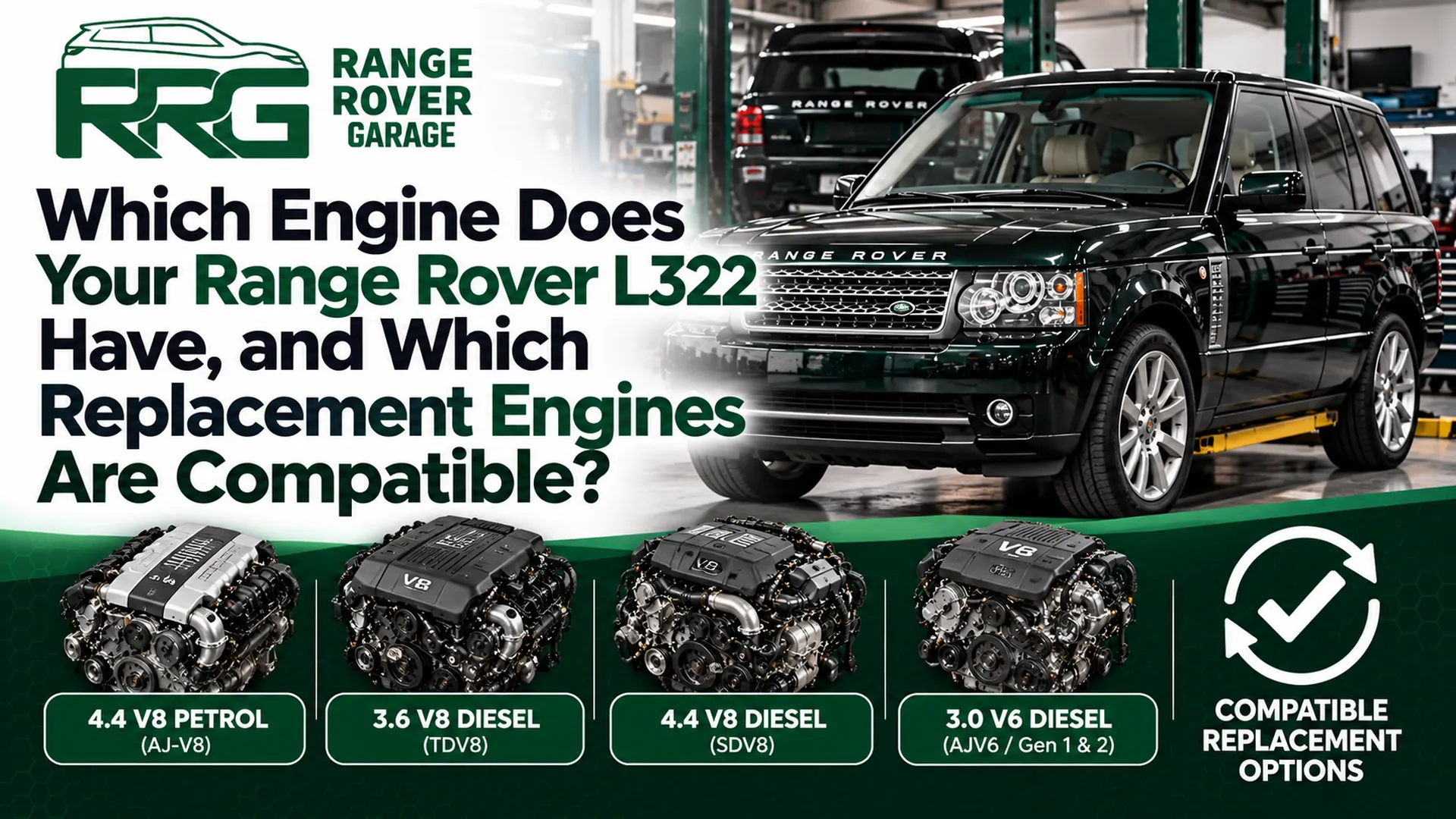
The Range Rover L322, also known as the Range Rover Vogue Mk3, was sold with several different engines over its production life. The correct replacement depends on the engine code, the VIN and the exact specification, not just the model name or the engine size.
That matters because the L322 was not built around one engine family. Across its life it used engines from different manufacturers, in petrol and diesel form, and the differences affect fitment, ancillaries and ECU compatibility.
How Do You Identify Your L322 Engine Code and Fuel Type?
These are the main engines associated with the L322. Always confirm the variant against your own car before buying anything:
Engine | Fuel | Family | Notes |
| 3.0 Td6 | Diesel | BMW M57 | Straight-six, associated with early cars |
| 4.4 V8 | Petrol | BMW M62 | Early petrol V8, distinct from the later Jaguar-derived 4.4 |
| 4.4 V8 | Petrol | Jaguar AJ-V8 | Later petrol V8, naturally aspirated |
| 4.2 V8 supercharged | Petrol | Jaguar AJ-V8 | Supercharged petrol V8 |
| 3.6 TDV8 | Diesel | Ford/Jaguar diesel V8 family | Twin-turbocharged diesel V8 |
| 4.4 TDV8 | Diesel | Ford/Jaguar diesel V8 family | Later diesel V8 |
| 5.0 V8 and 5.0 supercharged | Petrol | Jaguar-derived (AJ133) | Late-model petrol V8s |
(Verify this table against the engines you actually supply, and add engine codes you can confirm.)
Treat that table as a starting point, not a final answer. Production years overlap, and registration year alone is not enough to identify the right engine.
Here is how to confirm what you have:
- Check the V5C and service history. These may record the engine size and fuel type.
- Use your VIN. It is the best starting point for matching your car to its original specification.
- Find the engine code. It is usually stamped or labelled on the engine itself. A photo of the label helps a specialist confirm it quickly.
- Confirm fuel type and configuration. Diesel or petrol, naturally aspirated or supercharged, six cylinders or eight.
- Ask a specialist to verify it. Send your registration and we'll confirm the engine and the compatible replacement options.
A real-world example shows why this matters. Two L322s of similar age can carry completely different 4.4 V8 engines: one BMW-derived, one Jaguar-derived. The names look alike. The engines are not interchangeable.
Can You Fit a Different Engine, or an L405 Engine, Into a Range Rover L322?
In most cases, you should not assume so. Sharing a displacement or a brand name does not make two engines interchangeable.
- BMW and Jaguar 4.4 V8s. Same size, different engines, different mounting, ancillaries and management.
- Moving between diesel V8 variants. Swapping a 3.6 TDV8 for a 4.4 TDV8 involves more than bolting in a larger unit. Compatibility depends on the ECU, ancillaries and the wider vehicle systems.
- L405 engines. A newer Range Rover engine is not automatically a direct replacement for an L322. Differences in design and electronics make this a job for careful technical assessment, not guesswork.
Fitting the wrong engine can mean ECU problems, warning lights, poor running or mounting and ancillary issues. A correct compatibility check before purchase costs far less than fixing a mismatch afterwards.
Not sure which engine you have? Send your registration and we'll confirm it.
Should You Repair, Rebuild or Replace Your L322 Engine, and Which Type Is Best?
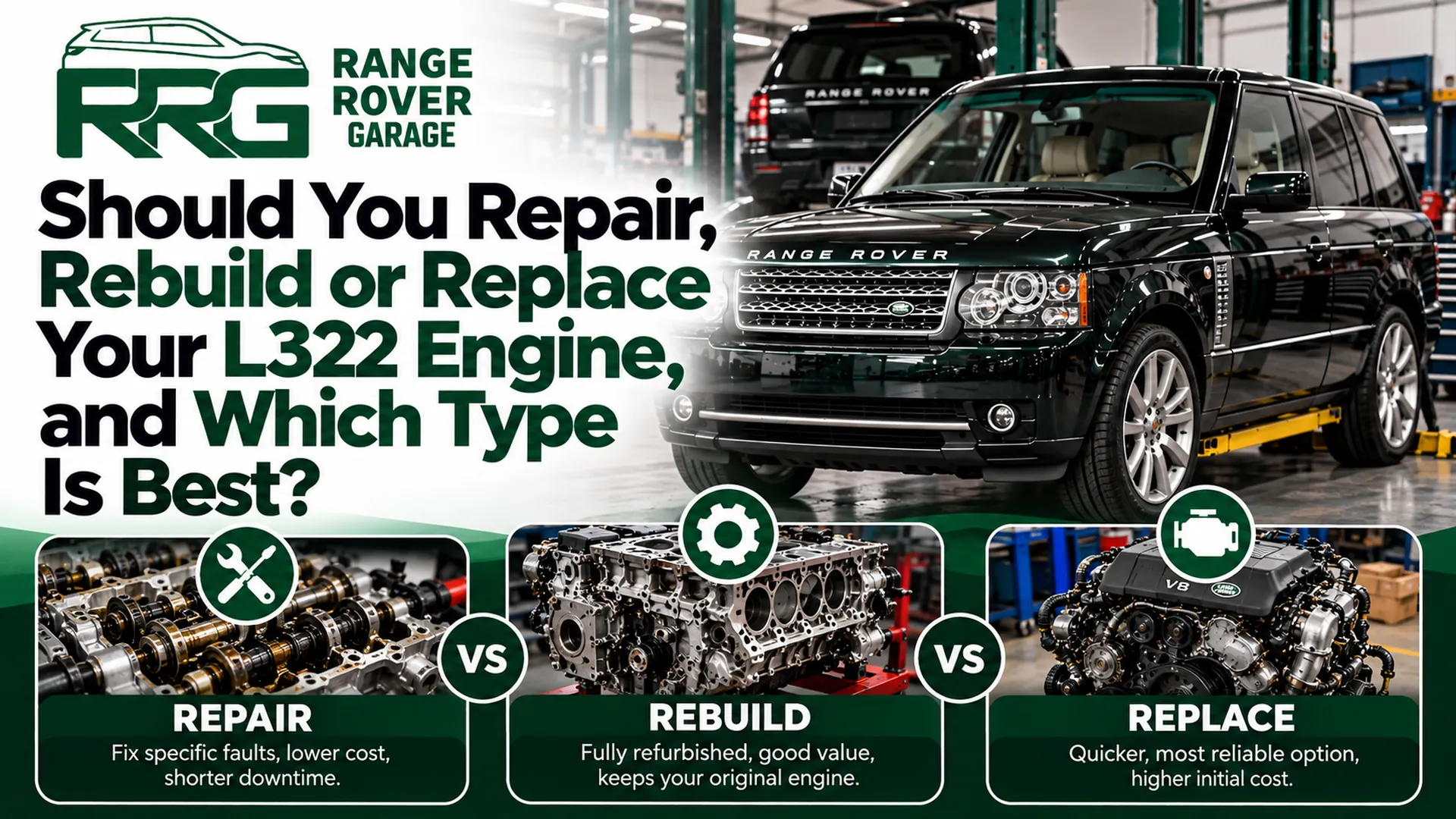
Whether to repair, rebuild or replace depends on the confirmed fault, what each route costs, the condition of the rest of the car and what the Range Rover is realistically worth. There is no single right answer, so a clear framework helps.
Used, Reconditioned or Remanufactured: Which L322 Replacement Engine Gives the Best Value?
Each type suits a different owner. This table sets out the differences:
Factor | Used engine | Reconditioned engine | Remanufactured engine |
| What it is | Taken from a donor vehicle, as-is | Overhauled, with worn parts replaced | Rebuilt to a specification, often to a higher standard |
| Testing and documentation | Varies, so ask for provenance and mileage | Should include testing and a record of work | Should include detailed rebuild records |
| Price level | Usually lowest | Middle | Usually highest |
| Warranty | Often shorter or more limited | Typically longer than used | Often the strongest cover |
| Best for | Tighter budgets, shorter-term keepers | Owners wanting a tested middle route | Long-term keepers wanting maximum confidence |
(Describe only what Range Rover Garage genuinely supplies, and remove any column you don't offer.)
A used engine can be a sensible choice, but its history is only as good as the evidence behind it. A reconditioned engine usually offers a better balance, provided the workshop explains what was replaced and tested. A remanufactured engine costs more, and suits an owner who plans to keep the car for years.
Whichever you choose, ask for evidence. The questions worth asking are:
- What is the engine's provenance? Where did it come from, and can that be shown?
- What is the mileage, and is it verified? Where it can't be verified, treat it with caution.
- What testing was done? Ask what was checked and whether there is a record.
- What exactly was replaced during reconditioning? Bearings, seals, gaskets and other wear parts should be itemised.
- What documentation comes with it? Paperwork matters for warranty and for resale.
A supplier who answers these clearly is usually one you can trust.
How Do You Know Your L322 Engine Needs Replacing Rather Than Repairing?
Not every engine fault means a new engine. These are the signs that point toward serious internal damage, and what each can mean:
- Low oil pressure. A persistent oil pressure warning can indicate bearing wear or lubrication failure. Stop driving and have it checked.
- Overheating and coolant loss. Repeated overheating can damage the head, the head gasket or the block. Coolant in the oil is a serious sign.
- Timing chain faults. Rattles, tensioner failure and chain damage can cause major damage on some engines if left unchecked.
- Crankshaft and bearing failure. Heavy knocking, metal in the oil or a sudden loss of compression can point to internal failure.
- Turbocharger problems on diesels. Turbo failure can send debris through the engine, so the wider damage needs assessing.
- Compression loss or engine seizure. These usually mean a rebuild or replacement is on the table.
These problems don't affect every L322 equally. Each is more relevant to certain engines than others, so a proper diagnosis should identify what has actually failed on your car.
A simple way to decide. Weigh four things together:
- The confirmed fault. What exactly has failed, and what else has it damaged?
- The repair estimate. Compare a repair or rebuild quote with a replacement price.
- The car's condition and history. Gearbox, suspension, bodywork and service record all matter.
- The realistic value of the vehicle. If the repair cost approaches the car's worth, think carefully.
An honest note: replacing an engine is not always worth it. If the rest of the car is tired and the engine bill is high, selling or part-exchanging may be the smarter route. We'd rather tell you that than sell you a repair that doesn't make sense.
How Much Does Range Rover L322 Engine Replacement Cost in the UK, and What Is Included?
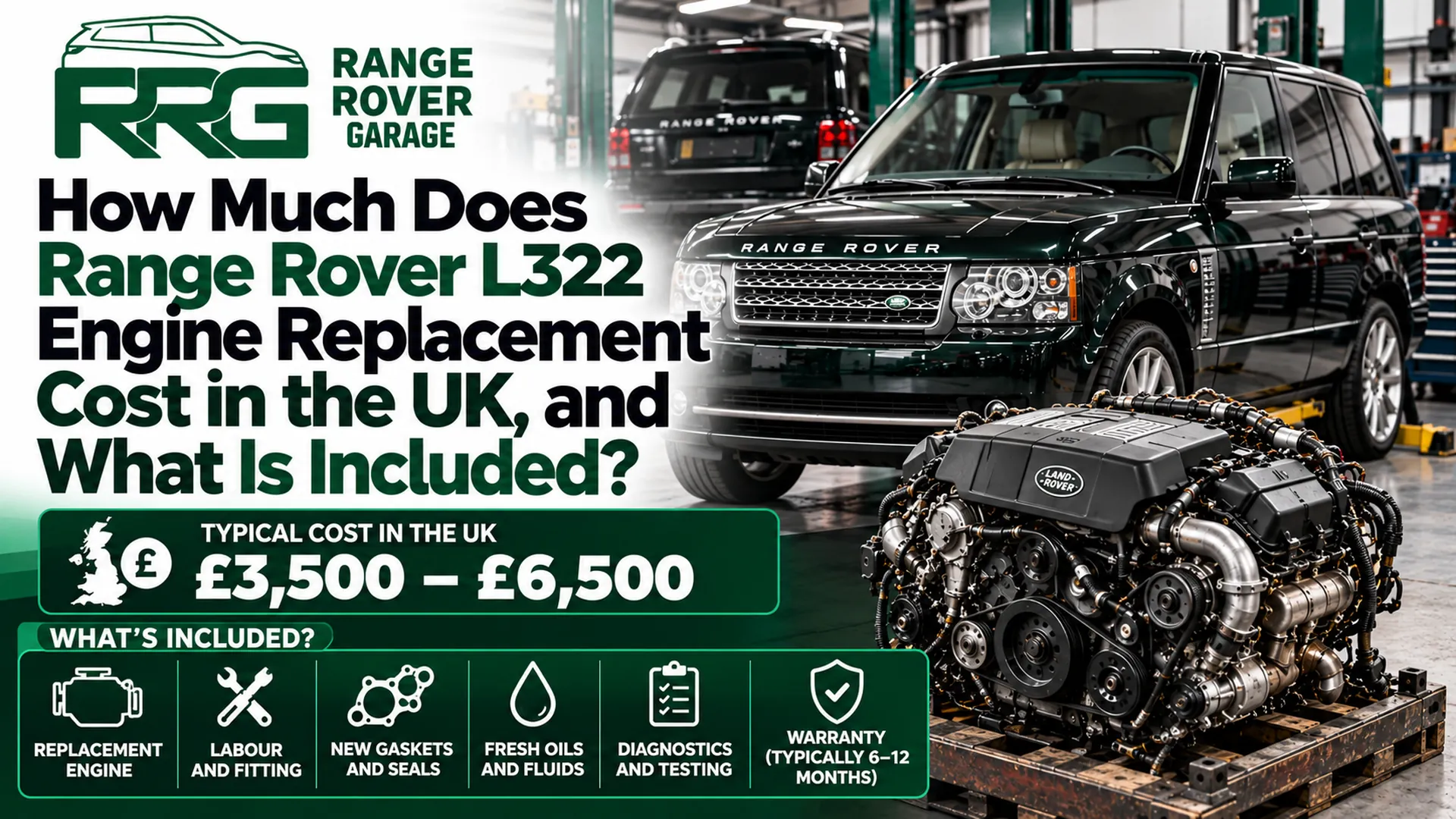
The cost depends on which engine you choose, whether you want supply only or a fully fitted job, and what the inspection finds. Rather than quote a figure that could mislead you, here is what moves the price, so you can read any quote with confidence.
What Affects the Cost of an L322 Engine Replacement?
The main cost factors are:
- Supply only versus supply and fit. Buying an engine alone costs less than a fitted job, but you then arrange and pay for installation separately.
- Engine type and variant. A rarer or supercharged engine, or a late diesel V8, can cost more than a more common unit.
- Used, reconditioned or remanufactured. The route you choose has a major effect on the price.
- Labour. Removing and refitting an engine in a large 4x4 is a substantial job.
- Fluids and consumables. Oil, coolant, filters and seals should be renewed.
- Ancillary components. Parts such as the water pump, thermostat, turbocharger, oil cooler and belts are often inspected or replaced during the job.
- Diagnostics and ECU checks. Programming and testing where required.
- Recovery and delivery. If the car isn't driveable, recovery adds cost. Engine delivery may also apply.
- VAT. Always check whether a quoted price includes it.
Extra costs after strip-down. After a catastrophic failure, the engine bay can reveal further damage. Debris from a failed engine can contaminate the cooling system, oil cooler or turbo, which then need cleaning or replacing. A good garage warns you about this at the start and explains how any extra work will be agreed with you first.
Our indicative fitted prices: (add your real "from £X" figures by engine type, or a clear explanation of how quotes are built). We don't publish made-up figures, because an honest price comes from your registration and the confirmed engine.
Here is how the two main quote types compare:
Quote type | What you get | What to check |
| Supply only | The engine, delivered | Warranty conditions, fitting requirements, who arranges installation |
| Supply and fit | Engine plus removal, installation and testing | Itemised list of what's included, labour, fluids and warranty |
Compare quotes like for like. A cheaper price often leaves something out.
Want to see your own numbers? Get your itemised fitted quote by registration.
What Is Included in an L322 Engine Supply and Fit Service?
A complete service should cover more than swapping the engine. This is how a proper job runs (adjust to your real process):
- Initial inspection and fault diagnosis. Confirm what has failed and whether replacement is the right route.
- Engine identification and sourcing. Match the replacement to your engine code, VIN and specification.
- Removal of the existing engine. The original unit is carefully taken out.
- Inspection of ancillary components. Cooling system, oil system, turbocharger where fitted, mounts and connected parts are checked.
- Installation of the replacement engine. Fitted with the correct fluids, seals and components.
- ECU checks and diagnostic testing where required. Fault codes are checked and the vehicle systems tested.
- Final checks and road testing. Fluid levels, leaks, running temperature and performance are verified before handover.
What a good quote lists. Ask that it names the engine and its source, labour, fluids, replaced ancillaries, any diagnostics, warranty terms and VAT. A vague one-line quote is a warning sign.
Our recovery and collection options: (add your real details, or remove this line if you don't offer them).
How Long Does It Take, What Warranty Applies, and How Do You Get a Quote?
Turnaround depends on engine availability, delivery and what the inspection finds. Warranty depends on who supplies the engine and the terms they offer. Both deserve clear answers before you commit.
What Warranty Should Come With a Replacement L322 Engine?
A warranty tells you how far a supplier stands behind the engine. These are the questions to ask:
- What does it cover? Parts and labour, or parts only? Many people assume both and find out too late.
- How long does it last, and are there mileage limits? Know the duration and any cap.
- What conditions apply? Servicing, oil type and correct fitting can all be conditions.
- What is excluded? Wear items, consequential damage and neglect are commonly excluded.
- How do you make a claim? Who do you call, and what do they need?
- What documents are supplied? Keep the invoice, engine records and warranty paperwork safe.
Our warranty: (add your confirmed duration, coverage, conditions and claim process).
Turnaround time. Be cautious of anyone who gives an exact completion date before seeing the car. Timing depends on whether a suitable engine is in stock, delivery time and what the strip-down reveals. Our typical turnaround: (add your confirmed range).
Trust details: Technician credentials: (add your real details). Last technically reviewed: (add date). Years in business: (add real figure).
What Information Do You Need to Get an Accurate L322 Engine Replacement Quote?
Have these ready:
- Registration number or VIN, so the engine and specification can be confirmed
- Engine type, if known, such as 3.6 TDV8 or 4.2 supercharged
- Current mileage
- The fault and any diagnosis already done, including any garage reports
- Service history, if you have it
- Whether you need recovery or delivery, and where the car is located
Here is what happens next. You send your details. We confirm the engine and compatible options, then send an itemised quote. You choose the route, and we book the work. Our reply time: (add your real reply time).
Request your Range Rover L322 engine replacement quote. Enter your registration at rangerovergarage.co.uk, call (add phone), email (add email) or use the booking link (add link). Service area and collection: (add your real coverage).
Frequently Asked Questions About Range Rover L322 Engine Replacement
How much does a Range Rover L322 engine replacement cost in the UK?
It depends on the engine type, whether it is used, reconditioned or remanufactured, labour and any extra parts. An itemised quote based on your registration is the only reliable way to get a figure.
Is a used or reconditioned L322 engine better?
A used engine costs less but varies in history and warranty. A reconditioned engine is overhauled and tested, usually with stronger cover. The right choice depends on your budget and how long you plan to keep the car.
How long does an L322 engine replacement take?
It varies with engine availability, delivery and what inspection reveals. Be wary of a firm date before the car has been assessed.
Can I replace a 3.6 TDV8 with a 4.4 TDV8?
Not as a simple swap. Compatibility depends on the ECU, ancillaries and wider vehicle systems, so get a technical assessment first.
Are L322 and L405 engines interchangeable?
Not automatically. Differences in design and electronics mean an L405 engine should not be treated as a direct replacement without careful checking.
Which engines were fitted to the Range Rover L322?
The L322 used BMW-derived engines (3.0 Td6 and an early 4.4 V8), Jaguar-derived petrol V8s (including supercharged versions) and the 3.6 and 4.4 TDV8 diesels, with later 5.0 V8s. Confirm yours with your VIN and engine code.
How do I identify my L322 engine code?
Check the engine itself for a stamped or labelled code, use your VIN and consult your service records. A specialist can confirm it from a photo or your registration.
Does a replacement engine come with a warranty?
It should. Ask what is covered, for how long, whether labour is included and what conditions apply.
Is it worth replacing the engine in an older L322?
Sometimes. It depends on the rest of the car, the repair cost and its realistic value. If the bill approaches the car's worth, think carefully before committing.
Can I buy an L322 engine without fitting?
That depends on the supplier. (Confirm whether Range Rover Garage offers supply only.) Remember that supply-only leaves installation and its warranty implications to you.
Should the turbocharger and oil cooler be checked during replacement?
Yes, where relevant. After an internal failure, debris can contaminate these parts and damage a new engine.
Does the replacement engine need ECU programming?
It can, depending on the engine and the vehicle's systems. Compatibility and programming checks should be part of the job.
What happens to my original engine after an exchange?
On an exchange arrangement, the original usually goes back as a core. Ask your supplier about their terms.
What causes low oil pressure in an L322?
Causes range from worn bearings and a failing oil pump to a blocked pickup or incorrect oil. Stop driving and have it diagnosed.
Can a timing chain failure damage the whole engine?
On some engines, yes. A failed chain or tensioner can cause serious internal damage, so rattles and warning signs deserve prompt attention.
Final Word: Choose the Right Engine, and the Right Evidence
An L322 engine replacement is a big decision, but it is a manageable one when you take it in the right order. Confirm your engine code and VIN. Decide between repair, rebuild and replacement using the real fault and the car's real value. Choose used, reconditioned or remanufactured based on evidence, not just price. And insist on an itemised quote with a clear warranty.
Done properly, a replacement engine can keep a capable, comfortable Range Rover on the road for years. Done carelessly, with the wrong unit or a vague quote, it can cost you twice.
Ready to move forward? Enter your registration at rangerovergarage.co.uk to request your Range Rover L322 engine replacement quote, and we'll confirm your engine and give you a clear fitted price.