Range Rover Restricted Performance: What It Means, What Causes It and How to Fix It
You pull away from the lights, press the accelerator, and nothing much happens. The engine feels strangled, a message appears on the dashboard, and the words "Restricted Performance" sit there like a verdict.
That is the Range Rover restricted performance warning, and it unsettles even experienced owners. The car is in limp mode, a protective state where the engine management system cuts power to stop a fault from causing further damage. Your Range Rover is telling you something is wrong, but not what.
This guide explains what the warning means, which faults commonly trigger it, how a specialist finds the real cause, and what to do next. It is written for owners of the Range Rover, Range Rover Sport, Evoque and Velar, and it covers diesel, petrol and hybrid applications where the warning behaves differently.
Why Does My Range Rover Say Restricted Performance and Is It Safe to Keep Driving?
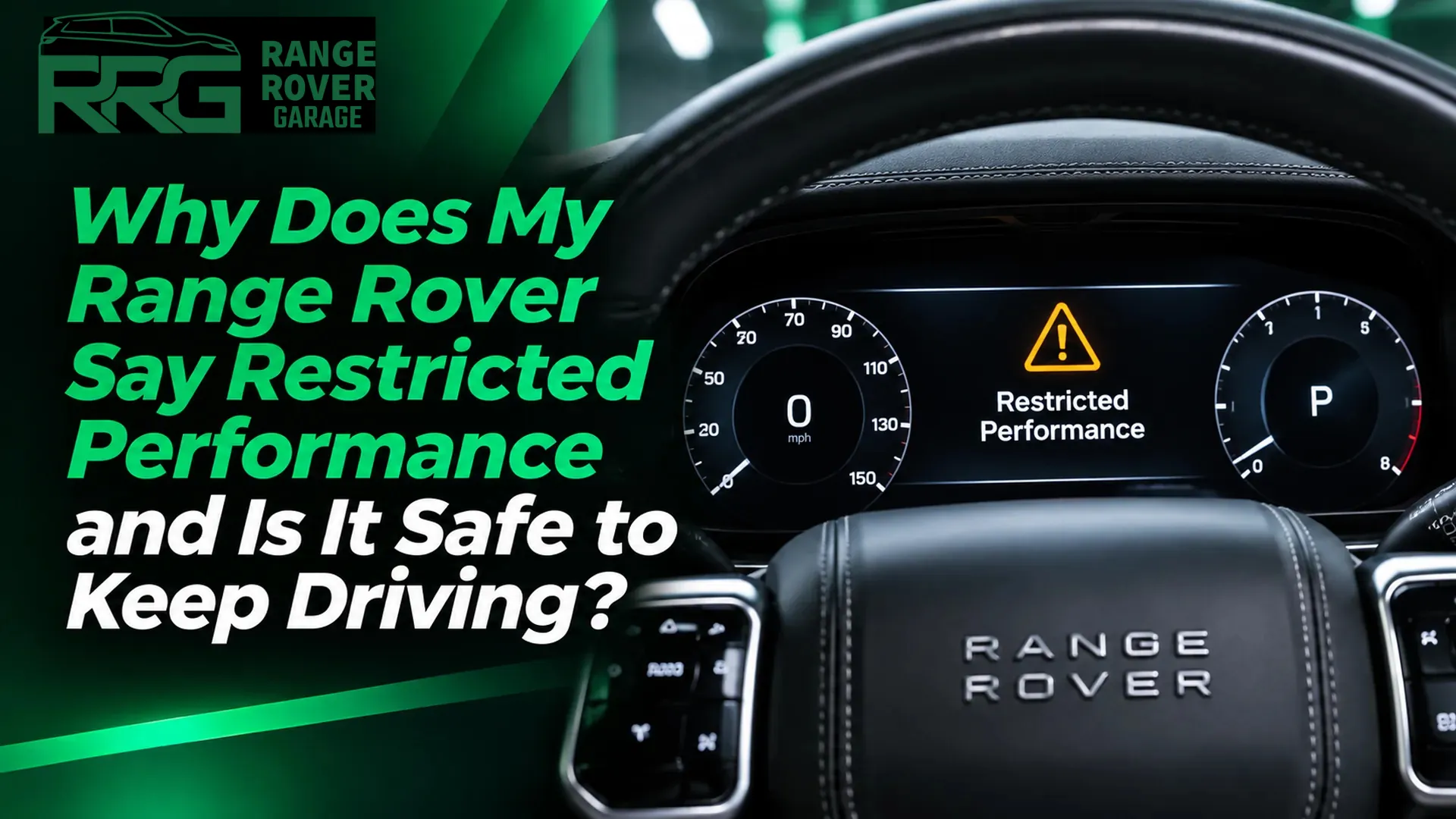
The message appears when the engine control module detects a fault that could harm the engine, the turbocharger, the exhaust system or the gearbox. Rather than let you carry on at full power, the system reduces torque, limits engine speed and sometimes restricts the throttle.
Think of it as the car protecting itself first and informing you second. The warning is a response to a problem. It is not a diagnosis, and it never points to one specific part on its own.
Can You Drive With Restricted Performance, and Will Restarting or Resetting Clear It?
Short answer: You can usually drive a short, careful distance to a safe place or a garage, but you should not treat it as a normal drive. Power will be reduced, overtaking becomes risky, and continuing to push the engine can turn a small fault into an expensive one.
Restarting the engine often makes the message vanish and brings power back. This catches many owners out. The control module clears its temporary restriction on a fresh start, but the fault that caused it has not gone anywhere. The warning usually returns, often at the worst moment, such as on a motorway slip road or halfway up a hill.
Here is how to handle it in practice:
- Move to a safe place first. If you are on a fast road, use the hard shoulder or the next exit rather than slowing in a live lane.
- Avoid hard acceleration. Keep revs moderate and load light.
- Do not keep restarting to clear the message. You may feel you are fixing it, but each cycle hides evidence the fault memory needs to hold.
- Do not disconnect the battery to reset the warning. It can wipe stored fault data that a technician needs, and it does nothing to the underlying problem.
- Book diagnostics soon. An intermittent fault is often easier to trace when the data is fresh.
Stop driving and arrange recovery if you notice any of the following:
- Smoke from the exhaust or bonnet
- A burning smell
- Red warning lamps such as oil pressure or coolant temperature
- Loud mechanical noises
- The car stalling or refusing to rev
- Severe vibration
Any of these suggests something more serious than a protective power cut. If you are unsure, you can book Range Rover engine diagnostics with us and talk through the symptoms before you drive anywhere.
Is restricted performance the same as limp mode? In practice, yes. Restricted Performance is the message Land Rover and Range Rover display, and limp mode is the common name for the reduced power state behind it. You will also hear it called emergency mode or engine protection mode.
What Causes Range Rover Restricted Performance and How Do Specialists Diagnose It?
The trouble with this warning is that it has a long list of possible triggers. Competitor pages tend to hand owners a generic list and leave them guessing. That is how people end up replacing a turbo that was fine, or cleaning a diesel particulate filter when the real problem was a split hose.
The reliable approach is to match the symptom to the system, test that system, and only then repair. Below, the main suspects are grouped the way a technician thinks about them.
Can a Faulty Turbo, Blocked DPF, EGR Valve or Throttle Body Trigger Restricted Performance?
Yes, any of them can. So can fuel system faults, sensor problems and weak electrical supply. No single component is behind every case, and anyone who tells you otherwise before testing is guessing.
The turbocharger and boost system
A turbo that cannot build the boost pressure the engine management expects causes a classic underboost fault. The cause is not always the turbocharger itself. Split intercooler pipes, loose charge air cooler hoses, a failed turbo actuator, a sticking variable geometry mechanism or a leaking vacuum line can all produce the same result. Owners often notice a loss of power when accelerating, a whistling or hissing sound under load, and a warning that appears on hills but not at idle.
The diesel particulate filter and EGR system
When soot builds up in the DPF faster than regeneration can burn it off, exhaust back pressure rises and the engine management restricts power. Short journeys, stop-start town driving and interrupted regeneration cycles are the usual background. A sticking or clogged EGR valve works differently. It upsets how exhaust gas is recirculated, which affects combustion and can set fault codes that trigger limp mode.
The throttle body and intake system
Carbon build-up, a failing throttle body, a cracked inlet manifold or a leaking rocker cover seal can disturb the air entering the engine. On the 3.0 diesel V6 engines, throttle body and inlet manifold faults are well documented in independent workshop experience and in manufacturer technical information.
The fuel system
Low fuel rail pressure, a weak fuel pump, worn injectors or a faulty pressure sensor can make the engine management cut power. These faults often show up under heavy load, when fuel demand is at its highest.
Sensors, wiring and electrical supply
The mass airflow sensor, manifold absolute pressure sensor, boost pressure sensor and throttle position sensor all feed data to the engine control module. If a reading looks implausible, the module may restrict performance. A weak battery or failing alternator can cause low voltage that upsets sensors and module communication, producing a warning that seems to have no mechanical cause at all.
The table below links common symptoms to the systems worth checking first. Treat it as a starting point for diagnosis, not a substitute for testing.
What you notice | Systems worth checking first | Why it matters |
| Power loss on hills or under load | Turbo, boost leaks, intercooler hoses, fuel pressure | High load exposes boost and fuel delivery weaknesses |
| Warning appears only when accelerating | Boost control, throttle body, airflow sensors | Demand for air and torque is highest here |
| Warning clears after restart | Intermittent sensor, actuator or electrical fault | Restart resets the restriction, not the fault |
| Rough running with a flashing or steady engine light | Misfire, fuelling, EGR, injectors | The ECU may cut torque to protect the catalyst and engine |
| Poor regeneration, higher fuel use, short journeys | DPF, exhaust pressure sensors, EGR | Soot loading raises back pressure |
| Warning with no obvious mechanical fault | Battery, alternator, wiring, module communication | Voltage and signal faults mimic mechanical failures |
| Hissing or whistling under acceleration | Boost leak, split hose, loose clip | Air escaping the pressurised intake path |
Model and engine notes
Range Rover and Range Rover Sport owners often ask whether their car is more prone to certain faults. Applications differ, so it helps to think by platform rather than assume every model shares the same weak points.
Model and platform | Engines commonly encountered | Points worth noting |
| Range Rover L405 | 3.0 TDV6, 3.0 SDV6, V8 petrol | Throttle body, inlet manifold and rocker cover leaks are known areas on the diesel V6 |
| Range Rover Sport L494 | 3.0 TDV6, 3.0 SDV6, V8 petrol | Boost system, DPF and EGR faults are worth testing on diesels |
| Range Rover L460 | Petrol, diesel and hybrid powertrains | Electrified systems add software and electrical checks to the process |
| Range Rover Evoque | Ingenium petrol and diesel | Documented cases include exhaust control and EGR related complaints on specific applications |
| Range Rover Velar | Ingenium petrol and diesel | Diagnosis follows the engine fitted, year and software level |
Some of this is also acknowledged by the manufacturer. Jaguar Land Rover has published technical communications describing Restricted Performance complaints linked to turbocharger underboost and bypass valve faults, to throttle body and intake tube issues, and to EGR related diagnostic codes on specified vehicles. That is useful evidence for one point above all others: the same message can come from entirely different systems.
Which Fault Codes, Such as P0299, Point to Which Problem?
Fault codes narrow the search, but they do not finish it. A code tells a technician which circuit or system reported a problem. It does not say which part has failed, and it does not always reveal the original cause.
The codes below appear frequently in Restricted Performance cases. They are not universal, and meanings and procedures vary with the engine, model year and software, so they should always be checked against Jaguar Land Rover documentation for the vehicle in question.
Fault code | What it generally relates to | Common areas to investigate |
| P0299 | Turbocharger underboost | Boost leaks, vacuum lines, turbo actuator, turbo condition |
| P2261 | Turbocharger bypass valve mechanical fault | Bypass valve operation, actuator connections, vacuum supply |
| P0087 | Fuel rail pressure too low | Fuel pump, filter, pressure regulator, injectors, supply side leaks |
| P0191 | Fuel rail pressure sensor range or performance | Sensor, wiring, connector, rail pressure behaviour |
| P0401 | Insufficient EGR flow | EGR valve, passages, intake restrictions |
| P042E | EGR control stuck open | EGR valve, actuator, control circuit |
| P042F | EGR control stuck closed | EGR valve, carbon build-up, control circuit |
| P2002 | DPF efficiency below threshold | Filter condition, sensors, exhaust leaks |
| P2463 | DPF soot accumulation | Failed regeneration, driving pattern, upstream engine faults |
| P2170 | Application specific, varies by vehicle | Check manufacturer data; on some Evoque and Discovery Sport applications it relates to exhaust control |
Pay particular attention to the P2170 entry. It should not be treated as a general exhaust fault across all Range Rover models, because its meaning depends on the application.
A code is the start of the investigation. It is not a shopping list.
How Do Range Rover Specialists Confirm the Real Fault Before Replacing Parts?
A proper diagnosis is a sequence, not a single scan. Here is how we approach a Range Rover engine fault investigation, and why each step exists.
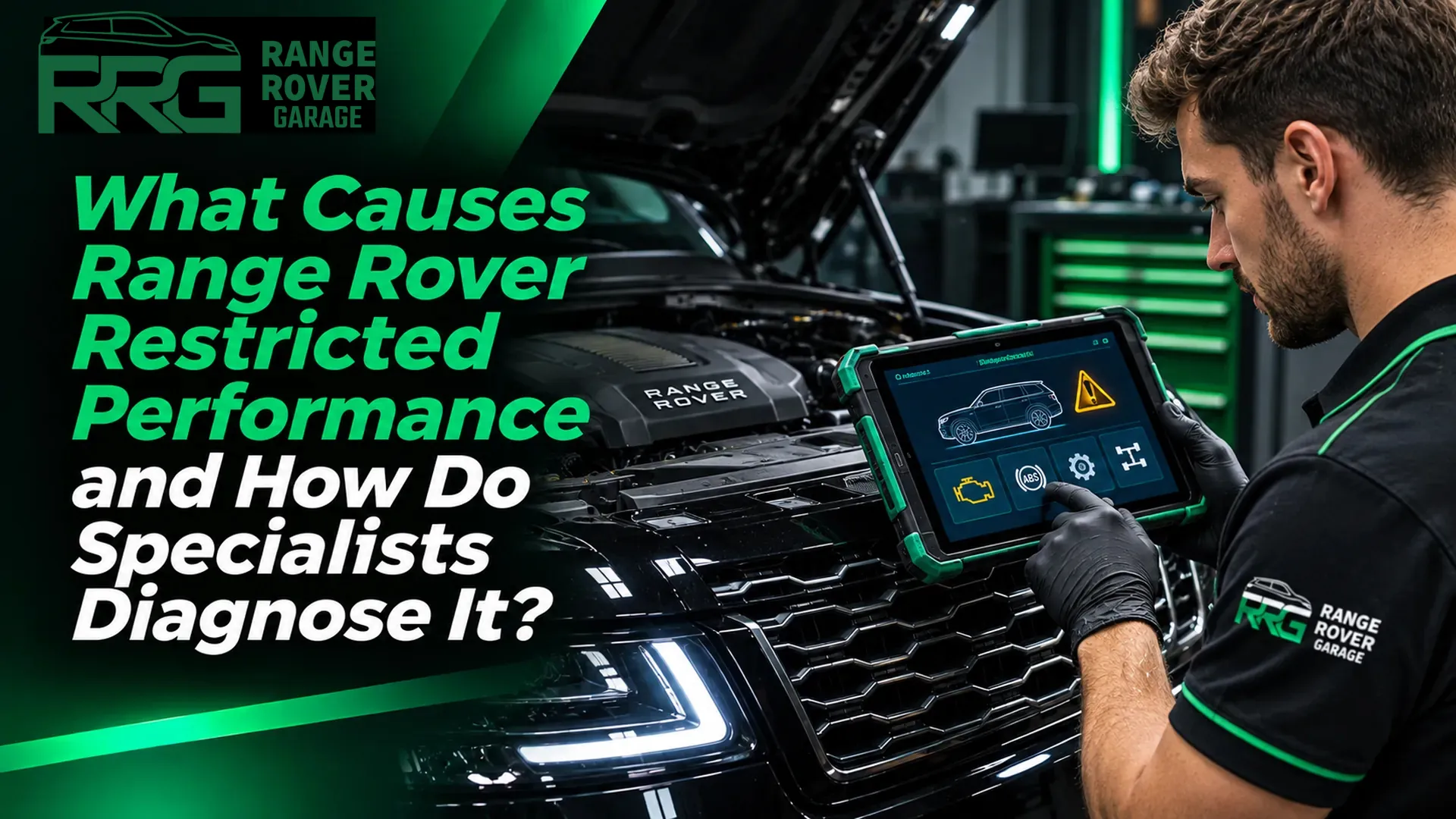
- Read stored diagnostic trouble codes and fault memory. This shows what the engine control module has recorded, including freeze-frame data that captures conditions when the fault happened. Manufacturer-level diagnostic equipment gives deeper access than a basic code reader.
- Review live engine data. We watch requested boost against actual boost, airflow readings, fuel rail pressure, throttle position and DPF pressure readings while the engine runs.
- Test the vacuum system. Turbo actuators often depend on vacuum control, so a small leak can cause large symptoms.
- Run a boost and smoke test. Pressurising the intake path with smoke reveals split hoses, loose connections and manifold leaks that cannot be seen by eye.
- Check the DPF and EGR operation. Differential pressure readings and EGR valve behaviour show whether the filter or valve is the problem or the victim of something upstream.
- Check fuel rail pressure. We compare commanded and actual pressure under different loads.
- Inspect sensors, connectors and wiring. Corroded pins, chafed looms and poor earths cause faults that look like failed parts.
- Check battery and charging health. Voltage problems are easy to test and easy to miss.
- Finish with a controlled road test. Some faults appear only under load, so we recreate the conditions that trigger the warning and confirm the findings with data.
Here is an example of why this order matters. Picture a Range Rover Sport that arrives with Restricted Performance on the motorway and a stored underboost code. The obvious assumption is a failing turbo. A smoke test, though, reveals a split charge air hose that was leaking under pressure. Replacing the hose solves the problem. Replacing the turbo would have cost far more and fixed nothing.
The same logic runs the other way. Sometimes the smoke test is clean, the vacuum system holds, and live data shows the actuator failing to respond. Then the actuator or turbo becomes the confirmed repair, and you can replace it with confidence.
That is the difference between fault finding and parts swapping.
How Much Does Range Rover Restricted Performance Repair Cost and Where Can You Get It Fixed in the UK?
The honest answer is that it depends on the confirmed fault. A split hose, a loose clamp or a failed sensor sits at one end of the scale. A turbocharger replacement, an intake manifold replacement or a DPF replacement sits at the other. Anyone who quotes a single figure before diagnosis is either guessing or planning to replace parts until the warning stops.
How Much Does It Cost to Diagnose and Repair a Range Rover Restricted Performance Warning in the UK?
Cost has two parts: the diagnostic inspection and the repair that follows. We recommend keeping them separate, because diagnosis tells you what you are actually paying to fix.
Several factors shape the final bill:
- The confirmed fault. Boost leaks, sensor faults and cleaning work are usually less involved than turbo, manifold or DPF replacement.
- The engine and model. Access, parts availability and labour time differ between a 3.0 diesel V6, an Ingenium engine and a hybrid powertrain.
- Whether other faults are linked. A blocked DPF sometimes traces back to a fuelling or EGR issue. Fixing only the filter would invite the problem back.
- Parts quality. Genuine, OEM and aftermarket parts vary in fit, durability and warranty cover. We explain the options so you can decide.
- Labour time. Some repairs need components removed to reach the fault, which adds time.
This table shows how typical repair routes relate to the faults behind the warning, without pretending a single number fits every car.
Repair route | When it applies | What usually happens |
| Diagnostic inspection | Any Restricted Performance warning | Fault memory, live data, testing and a clear findings report |
| Boost and hose repair | Underboost with a confirmed leak | Replace split or loose hoses, reseal connections, retest |
| Turbo actuator or turbo repair | Confirmed actuator or turbo fault | Repair or replace the failed component and recheck boost |
| DPF cleaning or replacement | Confirmed soot loading or filter fault | Remove root cause, clean or replace, run regeneration |
| EGR valve repair | Confirmed valve or passage fault | Clean or replace the valve, check related codes |
| Throttle body or intake repair | Confirmed throttle or manifold fault | Clean, repair or replace and recalibrate where needed |
| Fuel system repair | Confirmed pressure or injector fault | Correct the supply fault, test pressure under load |
| Sensor, wiring or electrical repair | Confirmed signal or voltage fault | Repair the circuit, replace only what has failed |
Why a specialist is often better value than guessing
Many owners start with a cheap code read and a part swap. Sometimes it works. Often it does not, and the second and third attempts cost more than a proper diagnosis would have. A specialist who knows how these engines behave can shorten the path to the real fault.
A specialist also differs from a main dealer in an important way. A dealer follows its process and charges its rates. An independent Range Rover specialist with the right diagnostic equipment can offer the same depth of fault finding, often with more flexibility on repair options and parts choices. The right choice depends on the car, its age, and whether it is still under any warranty. If your vehicle is under a manufacturer or approved warranty, check the terms before arranging independent work.
What to do next
If your Range Rover is showing the warning now, or it has appeared and cleared, the sensible move is to book a diagnostic inspection before the fault gets worse. Contact Range Rover Garage through our website to arrange Range Rover engine diagnostics, request a repair quotation, or talk through your symptoms with a specialist. Ask about turnaround time and the warranty on parts and labour when you book, so you know what to expect before work begins.
You can also read our related guides on Range Rover turbocharger problems, Range Rover DPF problems and Range Rover EGR valve problems for a deeper look at each system.
Frequently asked questions about Range Rover restricted performance
What does Restricted Performance mean on a Range Rover?
It means the engine management system has detected a fault and cut engine power to protect the engine, turbo, exhaust or transmission. It is a protective response to a problem, not a diagnosis.
Why is my Range Rover showing Restricted Performance?
The cause could be a turbo or boost fault, a blocked DPF, an EGR problem, a throttle body or intake fault, low fuel pressure, a sensor problem or an electrical supply issue. Only diagnostic testing identifies which.
Can I drive my Range Rover with Restricted Performance?
You can usually drive a short distance to somewhere safe or to a garage, but power is reduced and the fault may worsen. Stop and arrange recovery if you see smoke, red warning lamps, a burning smell or hear mechanical noises.
Does restarting the engine fix Restricted Performance?
A restart often clears the message and restores power temporarily. The underlying fault remains, so the warning commonly returns.
How do I reset the Restricted Performance warning?
Resetting only clears the message. If the fault is still present, the warning comes back. Disconnecting the battery can erase stored fault data that a technician needs and is not recommended as a fix.
Is Restricted Performance the same as limp mode?
Yes, in everyday use. Limp mode, emergency mode and engine protection mode all describe the reduced power state the message announces.
Can a faulty turbo cause Restricted Performance?
It can, but a turbo is only one possibility. Boost leaks, split hoses, vacuum faults and actuator problems often cause the same underboost symptoms, so testing should come before replacement.
Can a blocked DPF trigger Restricted Performance?
Yes. Heavy soot loading raises exhaust back pressure and can prompt the engine to limit power. The cause behind the blockage should also be investigated so it does not return.
Can a weak battery cause Range Rover engine warnings?
It can. Low or unstable voltage affects sensors and module communication, and can set faults that appear mechanical.
Can Restricted Performance appear without a check engine light?
Yes, in some cases the message and reduced power appear without a separate engine lamp, and the fault is found only through diagnostic data.
Why does Restricted Performance appear when accelerating or going uphill?
Acceleration and hills place the highest demand on boost, fuel delivery and airflow. Weak components or small leaks show up under that load, even if the engine seems fine at idle.
Will a DPF clean or turbo replacement always fix it?
Only if that component was the confirmed cause. Replacing a part without testing risks leaving the real fault in place.
Final thoughts
A Range Rover restricted performance warning is stressful, but it is also a useful early signal. Caught early, many causes are straightforward to repair. Left alone, a small leak or sensor fault can become a damaged turbo or blocked filter.
At Range Rover Garage, we focus on finding the true cause before recommending any repair, so you pay for what the car needs and nothing it does not. If your Range Rover has lost power, shown the warning or gone into limp mode, book your Range Rover engine diagnostics today and get a clear answer on what is wrong and how to fix it.