Range Rover Sport Oil Leak: Causes, Symptoms, Diagnosis and Repair in the UK
You spot a dark patch on the driveway, or catch a sharp burning smell after a motorway run, and the same question lands: is this a small seep or the start of something expensive?
A Range Rover Sport oil leak is rarely as simple as it looks. Oil runs along the engine, drips off the lowest point and pools somewhere that has nothing to do with the real fault. That is why so many owners pay for one repair, see the leak return and pay again.
This guide explains what causes an engine oil leak on the Range Rover Sport, how a specialist traces the true source, what shapes the final bill and when you should stop driving altogether. If you would rather have the car looked at straight away, you can book a Range Rover Sport oil leak inspection with Range Rover Garage at rangerovergarage.co.uk.
Why Is My Range Rover Sport Leaking Oil, and Is It Safe to Drive?
The short answer: a Range Rover Sport usually leaks oil because a gasket, seal, pipe or housing has aged, hardened or cracked. Heat cycles, mileage and high engine temperatures wear these parts out. A small seep can often be monitored for a short time. A visible drip, a falling oil level or any warning light means the car needs inspecting before further driving.
Most owners notice the problem in one of these ways:
- Oil patches underneath the vehicle. Dark brown or black spots on the driveway, or oil on the driveway after the car has been parked overnight.
- A burning oil smell after driving. Oil dripping onto a hot exhaust or manifold burns off with a distinctive acrid smell.
- A dropping oil level. You top up more often than the service schedule suggests, and there is no smoke from the exhaust to explain the loss.
- Smoke from the engine bay. Thin blue-grey wisps after a long run usually mean oil is landing on something very hot.
- A low oil or oil pressure warning. This is the most serious sign on the list.
These symptoms point to different problems. An oil leak when parked often suggests a slow seep from a gasket, because oil drains downward once the engine stops. A leak that appears when the engine is hot, or after motorway driving, tends to involve components under pressure, such as the oil cooler, the filter housing or turbo pipes.
What Causes Oil Leaks in a Range Rover Sport, from the L320 to the L461?
Oil leaks follow the design of each generation and engine. The table below shows how the picture changes across the Range Rover Sport range.
Generation | Years | Engines commonly seen | Leak points owners most often ask about |
| L320 | 2005 to 2013 | 2.7 and 3.0 TDV6, 3.6 TDV8, 4.4 petrol V8, 5.0 Supercharged V8 | Rocker and camshaft cover gaskets, oil cooler connections, sump gasket, rear main seal, turbo oil pipes |
| L494 | 2013 to 2022 | 3.0 TDV6, 3.0 SDV6, 4.4 SDV8, 5.0 Supercharged V8, 2.0 and 3.0 Ingenium | Oil cooler and filter housing area, turbo oil return hose, camshaft cover gasket, differential seals |
| L461 | 2022 onwards | 3.0 Ingenium inline-six petrol and diesel, 4.4 V8, plug-in hybrid | Newer engines with a different leak profile, checked against current manufacturer information |
Not every engine fails in the same place, so any specialist who treats them all alike is guessing. These are the main causes we see.
Oil cooler seal and housing failure. The oil cooler passes engine oil through a heat exchanger to keep temperatures stable. Its seals and gaskets stop oil escaping around the housing and connections. Once they harden, oil weeps down the engine and often gets mistaken for a sump leak. On the 3.0 diesel engines, an oil cooler gasket leak is one of the most common reasons owners search for help. If oil and coolant start to mix, stop driving the car immediately.
Turbocharger oil feed and return pipes. The turbocharger depends on a constant oil supply through the feed pipe, while the return pipe carries oil back to the engine. A failing connection or a perished return hose lets oil escape near the turbo, which explains oil leaking around the turbocharger or near the exhaust manifold. A turbo oil leak should never be ignored, because oil starvation can destroy a turbo quickly.
Rocker cover and camshaft cover gaskets. These sit at the top of the engine, and over time the rubber hardens and loses its seal. The oil runs down the sides of the engine block and may only appear lower down, far from the real problem.
Sump gasket leakage. The sump holds the oil, and its gasket seals the join with the engine. A sump gasket leak is real, but it is also the most over-diagnosed fault on these cars, for reasons covered in the next section.
Rear main seal and crankshaft seals. The rear main seal stops oil escaping around the crankshaft where it meets the gearbox. A leak at the back of the engine, between the engine and gearbox, often points here. This repair demands heavy access work, so confirming the diagnosis first matters a great deal.
Timing cover and front crankshaft seal leaks. Oil at the front of the engine can come from the timing cover gasket or the front crankshaft seal.
Oil filter housing damage. A cracked housing or a worn seal lets oil escape and can also cause oil pressure problems.
One safety point deserves attention. Land Rover issued a safety recall, N763, covering certain 2019 to 2023 Range Rover Sport models with the 3.0-litre Ingenium petrol engine. It concerns oil accumulating and leaking externally, with a potential fire risk. Whether your vehicle is included depends on its VIN, so check the number with an authorised dealer or the official recall lookup before assuming anything either way.
Can a Suspected Sump Gasket Leak Really Be a Turbo Oil Return Hose or Camshaft Cover Leak?
Yes, and manufacturer documentation confirms it. For the 3.0 TDV6, Jaguar Land Rover's technical bulletin SSM72983 warns that a suspected sump gasket leak may actually come from the turbocharger oil return hose or the camshaft cover gasket. A separate bulletin, SSM72381, covers external oil leaks on the secondary turbo. It points to oil tracking from the camshaft cover gasket, the turbo oil return hose and the area around the secondary turbo V-clamp.
Here is why this happens. Oil leaks from a high point, runs down the engine along the path of least resistance, collects at the lowest point and drips from the sump area. The sump looks guilty, but it is only where the oil ends up.
Consider this common scenario. An owner sees oil under the car and a garage replaces the sump gasket. The oil keeps coming, because the real source was a perished turbo return hose higher up. The owner pays twice and the fault stays. A proper diagnosis prevents exactly that.
When you must stop driving. Oil leaking onto hot exhaust components is a genuine fire risk. Low oil also starves the engine bearings and the turbocharger of lubrication. Do not carry on if:
- The oil pressure warning light comes on.
- You see smoke or smell burning oil that keeps getting stronger.
- The oil level drops below the minimum mark on the dipstick or display.
- You see oil dripping steadily, not just spotting.
- Oil and coolant look mixed, with a milky residue on the filler cap or in the expansion tank.
In any of those cases, arrange recovery instead of driving. A recovery fee is small compared with a damaged engine or a failed turbo.
Not sure where your leak is coming from? Book a diagnostic inspection with Range Rover Garage and get a clear answer before you spend money on parts.
How Do You Find Where a Range Rover Sport Oil Leak Is Coming From?
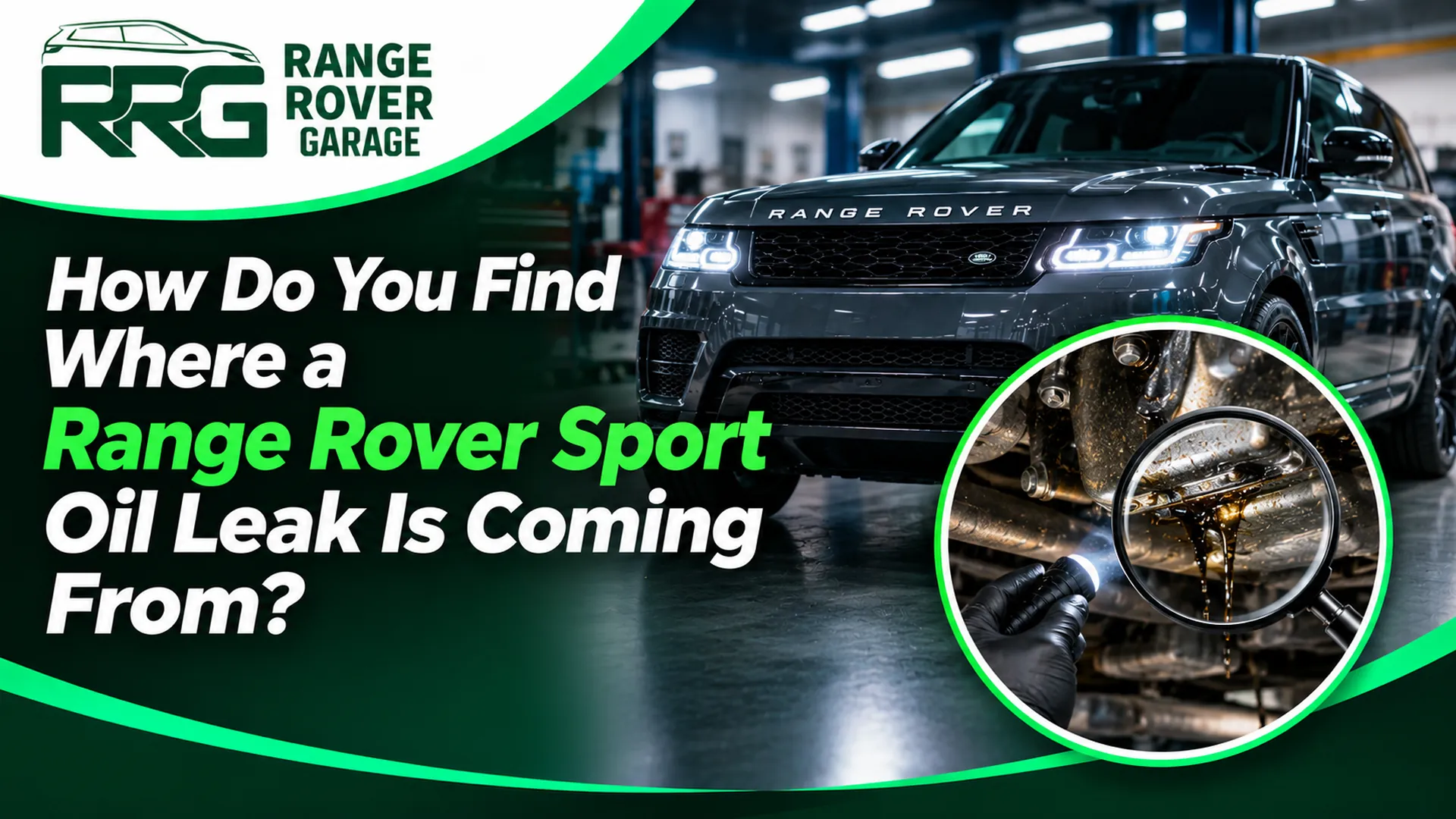
Finding the source is the most important part of the whole job. Replacing parts without confirming the origin is the single biggest reason repairs fail. A reliable diagnosis combines a visual inspection, a clean engine, the right tools and a road test.
How Do Mechanics Diagnose a Range Rover Sport Oil Leak Step by Step?
A specialist works through the car in a set order, so nothing gets missed:
- Inspect the vehicle underneath. The underbody shows where oil has travelled and which areas are wet or dry.
- Check the engine oil level. This tells the technician how serious the loss is.
- Clean the oil-contaminated areas. Degreasing the engine removes old residue, so only fresh oil shows up.
- Inspect the oil cooler and filter housing. These are frequent culprits on the 3.0 diesel engines.
- Examine the turbo oil feed and return pipes. Connections, clamps and hoses are checked for seepage.
- Use UV dye or leak tracing powder where needed. This highlights the exact point where oil escapes.
- Identify the original leak source. Evidence decides this, not assumption.
- Repair the defective component. Only the confirmed fault is replaced.
- Clean the affected area. This leaves a clear baseline for rechecking.
- Road-test and recheck for leakage. The car runs under real conditions, then is inspected again.
Skipping the cleaning step is a common shortcut, and it is a costly one. If old oil stays on the engine, nobody can tell where the new oil is coming from.
Diagnostic tools back up the inspection. An OBD scanner reads fault codes related to oil pressure or engine performance, and pressure testing checks for hidden leaks in the lubrication system.
How Can You Tell Engine Oil From Gearbox, Differential, Coolant or Power Steering Fluid?
Plenty of owners blame the engine for a leak that comes from somewhere else. The fluid itself tells a lot, as this comparison shows.
Fluid | Typical colour and feel | Where it usually appears | Common source |
| Engine oil | Amber when fresh, dark brown or black when used | Under the engine, around the sump, front or rear of the engine | Gaskets, oil cooler, filter housing, turbo pipes, rear main seal |
| Gearbox fluid | Red or pink, thinner, with a sweeter smell | Mid-car, under the gearbox | Gearbox seals, pan gasket or cooler lines |
| Differential oil | Thick, dark and with a strong smell | Rear or front axle area | Pinion seal or housing seals |
| Transfer case fluid | Dark and thick | Centre of the vehicle | Transfer case seals |
| Coolant | Green, pink or blue, thin and slightly sweet | Front of the engine, under the radiator | Hoses, radiator or water pump |
| Power steering fluid | Clear, amber or red, thin | Near the front axle or steering rack | Pipes, pump or rack seals |
Look at the position as well as the colour. A thick, dark leak near the rear axle suggests a differential pinion seal, which prevents differential lubricant escaping from the drivetrain, not an engine fault. If you are unsure, place a clean piece of cardboard under the car overnight. The size, colour and spot position give a specialist a lot to work with.
Can UV Dye Detect an Engine Oil Leak That a Visual Check Misses?
Yes. UV leak detection dye mixes with the engine oil, and under a UV lamp the exact escape point glows brightly. It works well for slow seeps and for leaks that only appear when the engine is hot or under load. Leak tracing powder does a similar job by showing fresh oil tracks on a dry surface.
Both methods only work properly on a clean engine. That is why degreasing always comes first, and why guessing from a messy engine bay so often points the wrong way.
How Much Does Range Rover Sport Oil Leak Repair Cost in the UK, and Who Should Fix It?
There is no single figure for a Range Rover Sport oil leak repair, because the leak could be anything from a small seal to a heavy engine-out job. What you can know in advance is what pushes the bill up or down. Giving a fair quote needs a diagnosis first, and anyone quoting a fixed amount over the phone without seeing the car is guessing.
What Affects the Cost of Range Rover Sport Oil Leak Repair, and Why Use a Land Rover Specialist?
Seven factors decide the final bill:
- Diagnostic time. Tracing the source takes skilled labour, but it prevents wasted repairs.
- Replacement parts. A seal and a complete oil cooler or filter housing are very different jobs.
- Labour time. Some leaks need the engine bay stripped down, while others are reached quickly.
- Engine access difficulty. Tight packaging on the 3.0 diesel engines and V8 models makes certain gaskets slow to reach. A rear main seal repair is usually a longer job than a rocker cover gasket.
- Seal versus component replacement. Sometimes a new seal solves it, and sometimes the housing itself has cracked.
- Genuine versus OEM-quality parts. Genuine Land Rover parts and quality-matched alternatives differ in fit, longevity and warranty terms.
- Additional damage. If oil has contaminated belts, hoses, wiring or a turbo, those items may need attention as well.
Different repairs behave differently, and these notes help set expectations:
- Oil cooler seal replacement. Moderate labour, but it often pays to renew related seals at the same time.
- Rocker cover gasket replacement. Straightforward on some engines, more involved where components sit above it.
- Turbo oil pipe repair. Needs careful access and new seals or hoses to prevent a repeat.
- Sump gasket replacement. Often heavy work because of the surrounding components.
- Rear main seal replacement. Usually the most labour-intensive of the group.
Why a specialist saves money. Land Rover engines have known weak points and traps like the sump gasket mix-up described earlier. A garage that works on these vehicles every day knows which component to suspect first. That means fewer wasted parts, fewer repeat visits and access to the correct manufacturer service information. Cheaper at the till is not always cheaper over a year.
At Range Rover Garage, the process is simple. We diagnose first, explain what we found and quote the confirmed repair before any work begins. You see the evidence, and you decide. We also advise on engine repair, engine diagnostics, turbo replacement and wider Land Rover engine specialist work when a leak turns out to be part of a bigger problem.
Ready to find out what your car needs? Request a Range Rover Sport oil leak quote through rangerovergarage.co.uk, or call the workshop to book an inspection.
Frequently Asked Questions About Range Rover Sport Oil Leaks
What is the most common cause of a Range Rover Sport oil leak?
It depends on the engine, but ageing gaskets and seals are the usual starting point. On the 3.0 diesel models, the oil cooler area, the camshaft cover gasket and the turbo oil return hose come up most often. Dealing with the real source, not the place where oil collects, makes the difference.
Is it safe to drive a Range Rover Sport with an oil leak?
A very small seep may allow short, careful journeys if you check the oil level often, but it should still be inspected soon. Stop driving if the oil pressure warning appears, if you smell burning oil, if you see smoke or if the level falls quickly. Oil on a hot exhaust can ignite, and low oil damages the engine and turbo.
How much does it cost to fix an oil leak on a Range Rover Sport?
The final figure depends on diagnosis time, the failed part, labour hours and how hard the engine is to reach. A small seal costs far less to fix than a leak that needs significant strip-down. A proper inspection gives you a real quote, not an estimate based on guesswork.
Can a faulty oil cooler cause a Range Rover Sport to leak oil?
Yes. A worn oil cooler gasket or housing seal is a well-known cause of oil leaks, particularly on the 3.0 diesel engines. If you notice oil mixing with coolant, treat it as urgent and stop driving.
Why does my Range Rover Sport smell of burning oil?
Oil is almost certainly reaching a hot surface, such as the exhaust manifold, turbo or exhaust pipe. The leak could be from a rocker cover gasket, turbo oil pipe or oil cooler seal. Get it checked promptly, because the smell signals both a leak and a fire risk.
How do mechanics diagnose an oil leak on a Range Rover Sport?
A technician inspects underneath, checks the oil level, cleans the engine, examines the oil cooler, filter housing and turbo pipes, then uses UV dye or tracing powder where needed. After repairing the confirmed fault, they road-test the car and recheck for leaks.
Final Thoughts: Fix the Cause, Not Just the Drip
A Range Rover Sport oil leak is a warning worth taking seriously, but it does not have to turn into a major repair. Catch it early, find the real source and fix that one component properly, and most leaks stay small and manageable. Ignore it, and a slow seep can become a failed turbo, a damaged engine or a fire risk.
If you have spotted oil on the driveway, smelled something burning or watched your oil level drop, now is the time to act. Range Rover Garage specialises in tracing and repairing Range Rover Sport oil leaks, from oil cooler and turbo faults to gasket and seal failures.
Book your Range Rover Sport oil leak inspection today at rangerovergarage.co.uk and get a clear diagnosis, an honest explanation and a quote you can trust.