Range Rover 5.0 Timing Chain Replacement Cost: UK Quotes, Warning Signs and Repair Options
That sharp metallic rattle for a few seconds after you start the engine is easy to dismiss. Most owners do. Then a garage mentions the words "timing chain" and the question changes from "what is that noise?" to "what is this going to cost me?"
If you own a Range Rover with the 5.0 litre V8, you are asking the right question at the right time. The Range Rover 5.0 timing chain replacement cost depends almost entirely on how early the problem is caught and how thoroughly the repair is carried out. A tensioner repair on a healthy engine and a rebuild after a jumped chain are very different jobs, with very different bills.
At Range Rover Garage, we work on the AJ133 engine and see the same pattern again and again: owners who act at the first rattle usually keep the repair simple. Owners who wait often end up with a much larger repair. This page explains what drives the cost, what the warning signs look like, and how a proper AJ133 timing chain replacement is carried out, so you can get an accurate quotation and make a confident decision.
Want to skip ahead? Send us your registration, model year and a short description of the noise, and we will come back with an itemised quotation for your exact vehicle.
How Much Does Range Rover 5.0 Timing Chain Replacement Cost in the UK?
There is no single honest figure for Range Rover timing chain replacement cost UK owners can rely on, and any garage quoting one without seeing your engine is guessing. The final cost of an AJ133 timing chain replacement is set by the scope of the work, and the scope is only confirmed after inspection.
Here is how the repair levels compare in practice.
Repair level | What it involves | Best suited to |
| Early tensioner repair | Replacing worn hydraulic tensioners and related components after a confirmed fault | Engines caught early with healthy chains and guides |
| Full timing chain replacement | Primary and secondary chains, tensioners, guides, blades and associated seals | Engines with a confirmed rattle, wear or stretch |
| Engine rebuild after failure | Dismantling, machining, new internal components and full reassembly | Engines with valve contact or internal damage |
| Replacement engine | Fitting a reconditioned or replacement 5.0 V8 | Cases where the repair is no longer practical |
The pattern is simple. Each step down that table adds labour, parts and risk. The cheapest outcome is almost always the earliest intervention.
Whatever the level, ask for the quotation to be itemised. A proper quote separates parts, labour, diagnostics, seals and gaskets, oil and filter, and any contingency for damage found once the engine is opened. That makes quotes from different garages genuinely comparable.
What Affects the Cost of Replacing a Range Rover 5.0 Timing Chain?
Five factors do most of the work in shaping a final quotation.
- Engine variant and generation. The supercharged AJ133 and the naturally aspirated version share the same architecture, but access and component details differ between models and years.
- Condition of the chains, tensioners and guides. Worn guides and stretched chains mean more parts than a tensioner-only job.
- Parts specification. Genuine and revised components carry a different cost from budget alternatives, and as we explain further down, the revised design matters on this engine.
- Labour time and accessibility. The timing system sits at the front of the engine. Reaching it means removing the cooling pack and often the supercharger, plus careful setting of camshaft timing with locking tools.
- Additional repairs found during inspection. Leaking timing cover seals, tired VVT components or oil-related wear are far better dealt with while the engine is already open.
One honest warning from the workshop floor: the lowest quote on the table often leaves something out. Guides, revised tensioners, seals or the oil service are the usual casualties. A low figure that excludes them is not a saving. It is a second repair waiting to happen.
Is a Specialist Cheaper Than a Land Rover Dealer for AJ133 Timing Chain Repair?
Often, yes, but price is not the only reason owners move to an independent specialist. Here is how the two options usually compare.
Factor | Main dealer | Independent AJ133 specialist |
| Labour rates | Generally higher | Generally more competitive |
| Engine-specific experience | Broad, across the whole range | Focused on V8 timing and engine work |
| Repair approach | Often component replacement only | Can inspect, repair, rebuild or recondition |
| Parts choice | Genuine parts | Genuine or revised parts, explained to you |
| Warranty | Manufacturer-backed terms | Workshop warranty, so read what it covers |
The real advantage of a specialist is the range of options. A dealer may only be able to offer replacement. A specialist who also rebuilds engines can tell you honestly when a repair makes sense and when it does not.
Whoever you choose, check what the warranty covers. A sound warranty should include both the parts and the labour on the timing system work, state its duration clearly, and be provided in writing.
Ready to compare properly? Request an itemised AJ133 quotation from Range Rover Garage and see exactly where every line of the repair goes.
What Are the Signs of Range Rover 5.0 Timing Chain Failure, and Can You Keep Driving?
Timing chain problems on the 5.0 V8 rarely arrive without warning. The engine usually tells you something is wrong well before the damage becomes serious. The trick is knowing which sounds and symptotiming chain replacement ms matter.
The short version: a metallic rattle on a cold start is the classic first sign of AJ133 timing chain tensioner failure, and it deserves inspection rather than hope.
Watch for these symptoms.
- Metallic rattle on cold start. A brief burst of chain noise in the first seconds after starting, often described as a rattle from the front of the engine.
- Rattle that continues after starting. If the noise lingers, the chain is not being held under proper tension even once oil pressure has built.
- Timing-related fault codes. Camshaft and crankshaft correlation faults stored by the engine management system point directly at timing deviation.
- Rough idle and misfires. Incorrect valve timing disrupts combustion.
- Loss of performance. The engine feels flat, hesitant or down on power.
- Hard starting. Extended cranking can follow when chain slack throws timing out.
Not every symptom means the same level of urgency. A short cold-start rattle that has just appeared is a warning. A persistent rattle with fault codes and a rough running engine is a problem that needs attention now. In both cases, the sensible next step is a proper diagnostic check, not a guess.
Can You Drive a Range Rover 5.0 With a Rattling Timing Chain?
Technically the engine may keep running. Practically, you are gambling.
The hydraulic tensioners rely on engine oil pressure to keep the chain tight. On a cold start there is a brief moment before pressure builds, and that is exactly when worn tensioners let the chain slap against its guides. Each time, the guides wear a little more and the chain stretches a little more.
A brief rattle that disappears in seconds gives you some time, but not unlimited time. A rattle that persists, comes with warning lights or appears alongside rough running is a sign to stop driving the vehicle and book an inspection.
Our advice, without scare tactics: do not wait for the noise to get louder. The difference between a tensioner repair and an engine rebuild is frequently just a matter of weeks of continued driving.
What Happens If the Range Rover Timing Chain Snaps or Jumps?
When a timing chain fails completely, or jumps a tooth on a sprocket, the relationship between the crankshaft and camshafts is lost. On an interference engine like the 5.0 V8, that is where the real damage begins.
The progression typically runs like this.
- Tensioner wear lets the chain develop slack.
- Slack chain movement damages the plastic guides.
- Broken guide material can disrupt the chain and the oil system.
- Camshaft timing moves out of position.
- The chain jumps teeth or breaks.
- Valves make contact with pistons.
- Valves bend and internal damage spreads, sometimes to the cylinder head.
- The engine needs a rebuild or replacement.
There is a second danger that owners rarely hear about. Fragments from worn guides can reach the oil pickup, restricting oil flow. Low oil pressure then affects the hydraulic tensioners themselves, and can lead to bearing damage and further wear. One failing component can start a chain reaction through the engine.
That is why we tell owners that the cost of acting early is almost always lower than the cost of waiting.
What Is LTB00474, and Why Do Revised AJ133 Tensioners Matter?
This is the technical detail that separates a specialist repair from a generic one.
LTB00474 is a Land Rover technical bulletin dealing with a rattle or click noise from the front of the 5.0 V8 engine. It addresses insufficient tension on the primary timing chain and points to revised tensioner components designed to hold the chain more securely.
A later service message, SSM71893, stresses an important point: the revised tensioners and blades should be fitted as a complete matching set. Mixing old and revised parts defeats the purpose of the update and can leave the original weakness in place.
What does that mean for you?
- Ask which components your quote includes. Confirm whether revised tensioners and blades are part of the job.
- Ask whether the set is complete. A partial update is not the same as a corrected system.
- Ask about the guides. Worn guides cause the same symptoms and need replacing alongside the tensioners.
A workshop that can explain LTB00474 and SSM71893 clearly is a workshop that understands the AJ133. It is a very good question to put to any garage you are considering.
How Is an AJ133 Timing Chain Replaced, and How Long Does It Take?
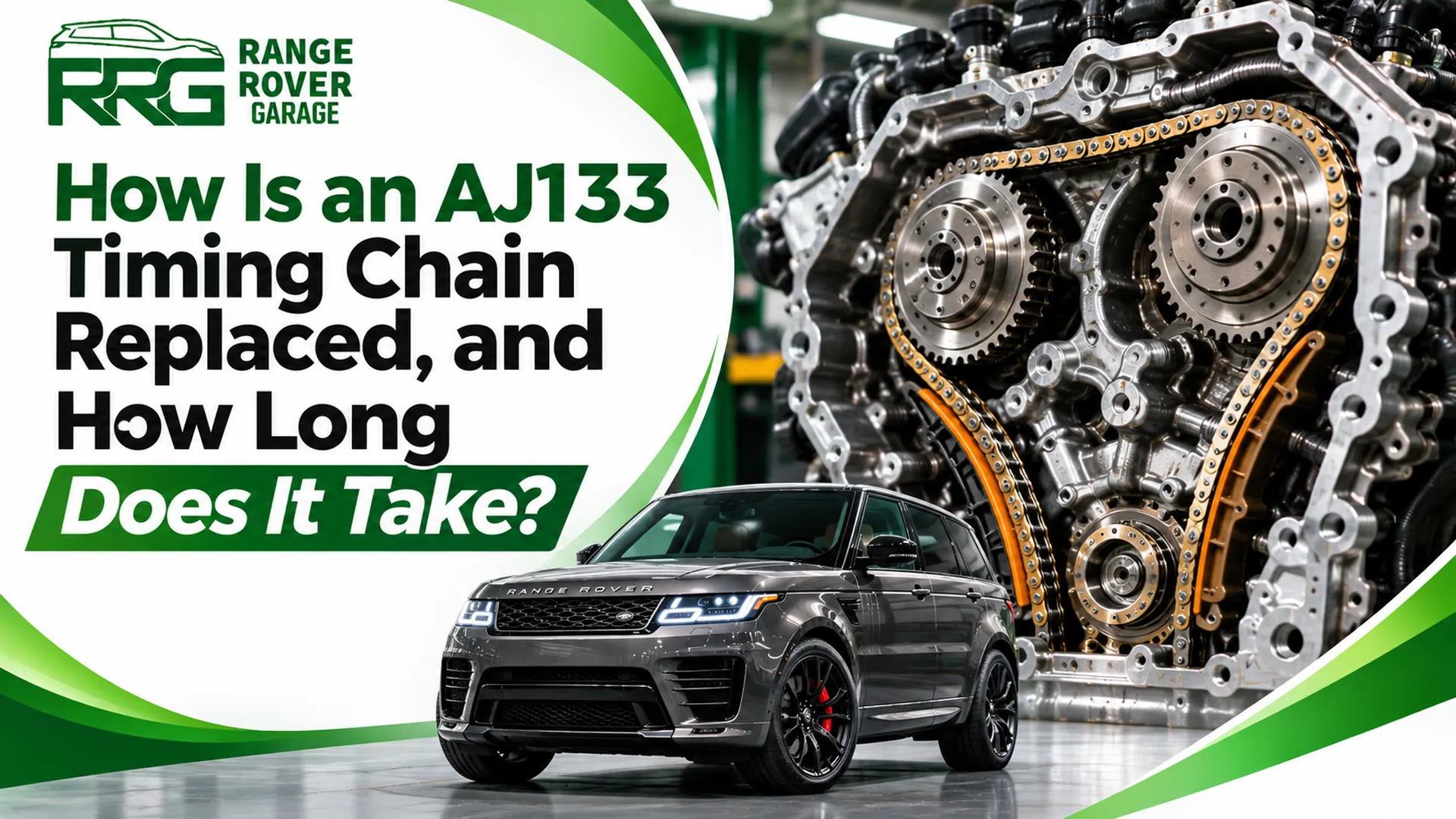
A proper AJ133 timing chain replacement is a methodical job, not a quick swap. The front of the engine has to be stripped, timing has to be locked and verified, and everything has to be reassembled to exact tolerances.
As a guide, owners should expect the vehicle to be in the workshop for several working days. The precise time depends on inspection findings, parts availability and whether additional repairs are needed. We will give you a realistic timescale with your quotation, not a vague promise.
What Is Included in a Complete Range Rover 5.0 Timing Chain Replacement?
A thorough job covers far more than the chain itself. Here is what a complete AJ133 repair should include.
- Primary and secondary timing chains. Both sets, replaced together.
- Hydraulic timing chain tensioners. Revised components where specified, fitted as a matching set.
- Timing chain guides and tensioner blades. Replaced to remove the worn plastic that causes slack and debris.
- Sprockets and VVT components. Inspected for wear and replaced where needed.
- Timing cover seals and gaskets. Renewed so the front of the engine goes back together oil-tight.
- Engine oil and filter. Fresh oil matters because the tensioners depend on clean, correctly specified lubricant.
Before any of that begins, a good specialist diagnoses first. That means a cold-start noise check, a read of stored fault codes, a camshaft and crankshaft correlation check, an oil pressure assessment and a mechanical inspection of the timing system. Each step confirms or rules out the suspected fault, so you only pay for work the engine actually needs.
This is also where an honest conversation about the repair path happens. A tensioner-only repair is not right for every engine, and inspection decides. If the chains are stretched and the guides are broken, replacing tensioners alone would be a false economy.
A typical scenario. An owner contacts us about a short rattle on cold mornings, with no warning lights. Inspection shows early tensioner wear and guides in acceptable condition. That engine is a candidate for a focused repair. Compare it with a vehicle that arrives after weeks of ignored noise, now misfiring with timing fault codes. The same symptom began both journeys, but the outcomes differ hugely.
Repair, rebuild or reconditioned engine?
- Repair is the right path when inspection finds wear but no internal damage.
- Rebuild suits engines where valve contact or bearing damage has occurred but the block is sound.
- Reconditioned engine makes sense when the rebuild would be uneconomic or the engine has deeper problems.
We will explain the options plainly and recommend the one that makes sense for your vehicle, not the one that is easiest for us.
Keeping the timing system healthy afterwards. Use the correct oil specification, keep to regular oil and filter changes, and never ignore a cold-start rattle. Those three habits protect a freshly repaired system better than anything else.
Which Range Rover Models Use the 5.0 AJ133 Engine?
The AJ133 appears across several Range Rover and wider Jaguar Land Rover models, including the Range Rover L322 and L405, the Range Rover Sport L320 and L494, the SVR, the Land Rover Discovery 4 and LR4, and Jaguar models such as the F-Type, XFR, XKR and XJ. Engine variant and model year matter, so we always verify your vehicle before quoting. Diesel engines, including the 3.0 TDV6 and SDV6, use a different timing arrangement and are not covered by this guidance.
Why Owners Choose Range Rover Garage for AJ133 Timing Chain Repair
Choosing who repairs your engine is as important as the repair itself. Here is what you can expect from us.
- Engine-focused experience. We work on Range Rover V8 timing systems, so the symptoms and failure patterns are familiar.
- Diagnosis before work. You pay for what your engine needs, confirmed by inspection.
- Clear, itemised quotations. Parts, labour and extras, laid out so you can compare.
- Honest advice on repair, rebuild or replacement. Including when the answer is the less profitable one for us.
- Workshop warranty in writing. Clear terms on the parts and labour we fit.
If your Range Rover is rattling, misfiring or showing timing-related fault codes, do not wait for the next cold morning to find out how serious it is.
Request your itemised AJ133 timing chain quotation today. Send your registration, model year and symptoms through our quote form, or call us to speak to a specialist directly. We will tell you what the engine needs, what it does not, and what to expect from start to finish.
Frequently Asked Questions About Range Rover 5.0 Timing Chain Replacement
How much does Range Rover 5.0 timing chain replacement cost in the UK?
It depends on the scope of work, which is confirmed after inspection. A tensioner repair on a healthy engine, a full timing chain replacement and an engine rebuild after failure are three very different jobs. Ask for an itemised quotation covering parts, labour, diagnostics, seals and oil, so you can compare like with like.
What are the common symptoms of AJ133 timing chain failure?
The most common sign is a metallic rattle on cold start. Others include a rattle that continues after starting, timing-related fault codes, rough idle, misfires, loss of power and hard starting.
Does the Range Rover 5.0 Supercharged engine have a timing chain or a belt?
It has timing chains, not a belt. The AJ133 uses primary and secondary chains with hydraulic tensioners and guides. Chains do not follow a fixed replacement interval, but they do need attention when symptoms appear.
How long does a Range Rover 5.0 timing chain last?
There is no guaranteed lifespan. Condition depends on oil quality, service history, tensioner wear and the engine's age. Many chains last well, but the AJ133's tensioners and guides are known wear items, which is why cold-start rattles should never be ignored.
Can I drive my Range Rover with a rattling timing chain?
It may run, but continued driving risks guide damage, chain stretch and eventually engine damage. A brief, new cold-start rattle should be inspected soon. A persistent rattle with warning lights or rough running means you should stop driving and arrange an inspection.
What is included in a complete AJ133 timing chain replacement?
A complete job covers primary and secondary chains, hydraulic tensioners, guides and blades, an inspection of sprockets and VVT components, replacement seals and gaskets, and fresh engine oil and filter.
What is the LTB00474 timing chain bulletin?
It is a Land Rover technical bulletin addressing a rattle from the front of the 5.0 V8 engine, linked to insufficient primary chain tension. It introduced revised tensioner components. A later service message confirms that revised tensioners and blades should be fitted as a complete matching set.
Is it better to repair or replace a Range Rover 5.0 V8 engine after timing chain failure?
It depends on the damage. If the block and major components are sound, a rebuild is often the sensible route. If damage is extensive, a reconditioned engine can be the better option. Inspection gives the answer.