Range Rover DPF Replacement Cost in the UK: Prices, Repairs and Options
The warning light comes on. Then the engine feels flat, the dashboard says the exhaust filter is full, and the car drops into limp mode on a dual carriageway. Before you have even pulled over, one question lands: how much is this going to cost?
That question is fair, and it deserves a straight answer. The Range Rover DPF replacement cost depends on your model, your engine, the part fitted and the labour involved. It also depends on something many owners never hear about until they have already paid: whether the filter is actually the problem. A faulty pressure sensor, a sticking EGR valve or a leaking injector can all make a healthy diesel particulate filter look blocked.
This guide breaks down what drives the price on each Range Rover model, when cleaning is enough, when a new filter is the only sensible fix and how to stop the same fault returning. If you already know you need an answer, you can get a Range Rover DPF replacement quote from Range Rover Garage at rangerovergarage.co.uk.
How Much Does Range Rover DPF Replacement Cost in the UK, and What Affects the Price?
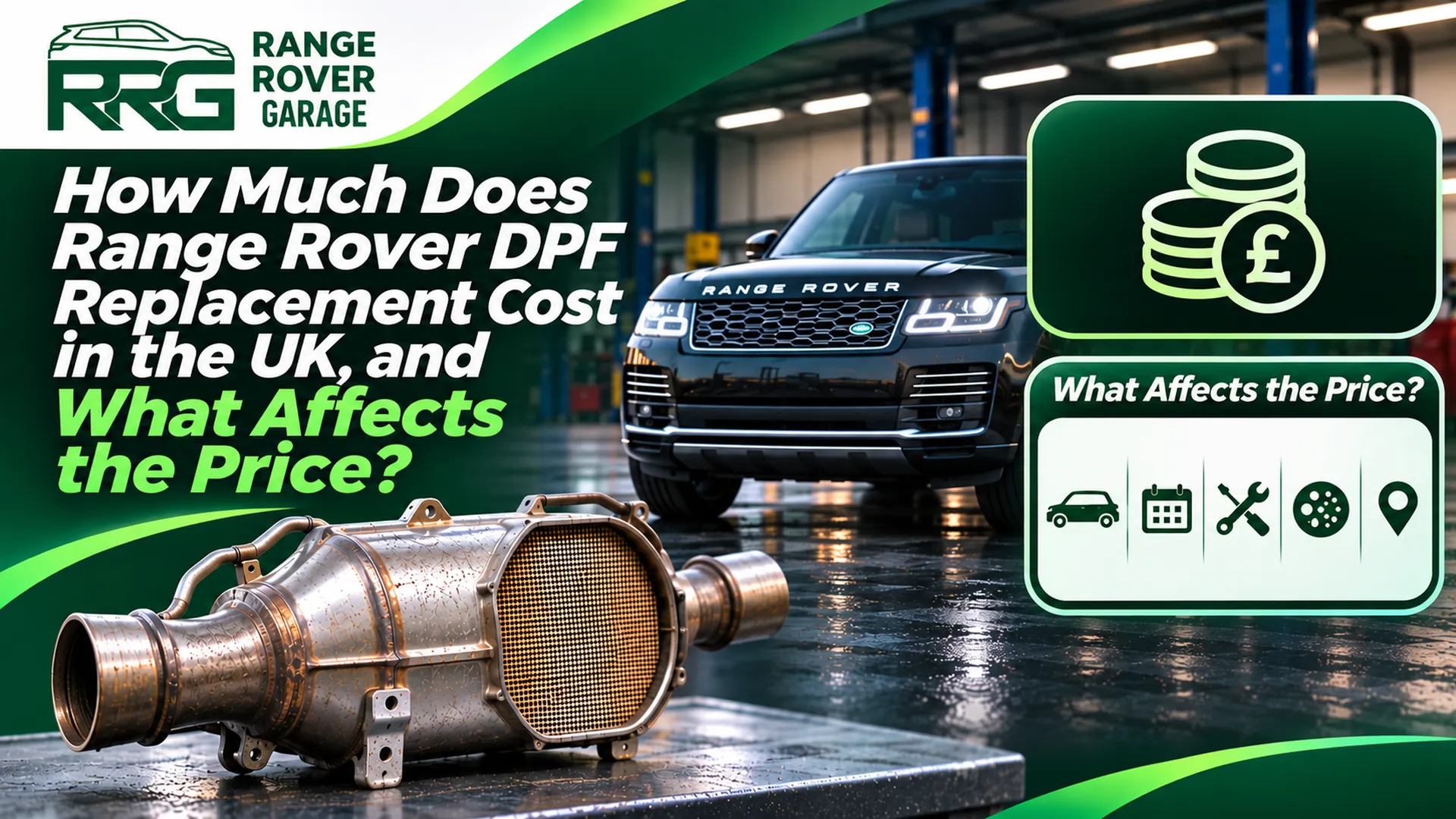
The short answer: there is no single price for Range Rover DPF replacement, because the job changes with the vehicle. The model, engine, filter type, labour time, extra faults and whether coding is needed all move the final bill. A fair figure comes only after a diagnosis, so be wary of anyone who quotes a fixed amount over the phone without checking the car.
Land Rover DPF replacement cost also varies more than it does on a typical family diesel. Premium vehicles use larger, more complex exhaust assemblies. Parts are often matched to a specific model year and engine, and access can be tight. The same warning light can mean a straightforward job on one car and a long one on another.
Here is how the main cost factors work:
- The filter itself. The part is usually the largest single item on the quote. Price depends on fitment, brand and whether it is genuine or aftermarket.
- Labour time. Some models let a technician reach the filter fairly directly. Others need heat shields, pipework and sections of the exhaust moved first.
- Sensors and fixings. Gaskets, clamps and sensors are often renewed at the same time. Reusing tired fixings can cause exhaust leaks later.
- Diagnostic time. Tracing the real fault takes skilled time, and it protects you from paying for parts you did not need.
- Coding and adaptation. Many fitments need the engine control unit reset or adapted so the car recognises the new filter.
- Related faults. If an EGR valve, turbocharger or injector caused the blockage, it must be fixed as well, or the new filter will suffer the same fate.
What Does a DPF Replacement Cost on a Range Rover Sport, Evoque, Velar and Full-Size Range Rover?
Each model has its own engine range and packaging, which is why a one-size-fits-all price means very little. This table shows why costs differ across the family. We have deliberately left figures out, because honest pricing depends on the exact vehicle in front of us.
Model | Common diesel engines | Why the cost differs | Typical complexity |
| Range Rover Sport L320 | 2.7 and 3.0 TDV6, 3.6 TDV8 | Older exhaust layout, ageing sensors and fixings, higher mileage cars | Medium to high, as corroded fixings often add time |
| Range Rover Sport L494 | 3.0 TDV6, 3.0 SDV6, 4.4 SDV8, 2.0 Ingenium | Several engine options, so part numbers vary by engine and year | Medium to high |
| Range Rover Evoque | 2.2 diesel, 2.0 Ingenium diesel, including TD4 and SD4 variants | Compact engine bay, tighter access, different filter specifications between generations | Medium |
| Range Rover Velar | 2.0 Ingenium diesel, 3.0 diesel | Newer systems with more sensors and software involvement | Medium to high |
| Full-size Range Rover L405 | 3.0 TDV6, 3.0 SDV6, 4.4 SDV8 | Large, premium exhaust assemblies and heavier components | High |
| Full-size Range Rover L460 | 3.0 Ingenium diesel | Newer emissions technology and tighter software integration | High |
Fitment matters more than most owners realise. A filter listed for one 2.0 Ingenium application may not suit another, even within the same model. Always confirm the exact part against your vehicle identification number before a single bolt is turned.
Many owners search for the Range Rover Sport DPF replacement cost first, because the Sport covers such a wide spread of engines. Evoque owners tend to look for Evoque DPF problems linked to the 2.0 Ingenium. Velar and Vogue owners often want to know whether a dealer or independent garage is the better route. All of that comes down to the same principle: diagnose first, then price the confirmed job.
What Is Included in a Range Rover DPF Replacement Quote, and Should You Choose a Genuine or Aftermarket Filter?
A good quote lists every line, so you can compare it fairly. A weak quote gives you one number and no detail. Before you agree to anything, check that it covers:
- The diesel particulate filter and its part number
- Labour for removal and fitting
- New gaskets, clamps and fixings where needed
- Sensor checks, and sensor replacement if the diagnosis supports it
- ECU adaptation or reset
- Diagnostic time
- A road test and final fault-code scan
- Warranty terms on parts and labour, in writing
Each line tells you something. If coding is missing from a quote, ask why. If sensors are not mentioned, ask whether they were tested. Clear answers are a good sign.
Next comes the choice of part. Here is how genuine and aftermarket filters compare.
Factor | Genuine Land Rover DPF | Aftermarket DPF |
| Fit | Made to the manufacturer specification for your exact vehicle | Quality varies by brand, so fitment needs checking carefully |
| Durability | Designed around the original emissions strategy | Can be good from reputable makers, but can disappoint from cheap sources |
| Warranty | Usually backed by the supplier and fitting garage | Depends on the brand and the garage |
| Price | Generally higher | Generally lower |
| Best for | Newer vehicles, cars under warranty, owners who want zero compromise | Older, higher-mileage vehicles where budget matters |
Neither choice is automatically right. A reputable aftermarket filter from a known manufacturer can be a sensible choice on an older car. A very cheap unbranded unit often costs more in the end, because it can clog early, trigger fault codes or fail to regenerate properly.
The dealer versus independent question works the same way. A main dealer gives you manufacturer-backed procedures and parts, and the labour rates reflect that. A Land Rover specialist gives you the same depth of model knowledge, often with more flexibility on parts and a more personal explanation of the fault. The best test for either is whether they explain the diagnosis before asking for payment.
Want a quote that itemises every line? Request one from Range Rover Garage and see exactly what you are paying for.
Can a Range Rover DPF Be Cleaned Instead of Replaced, and How Do You Know Which You Need?
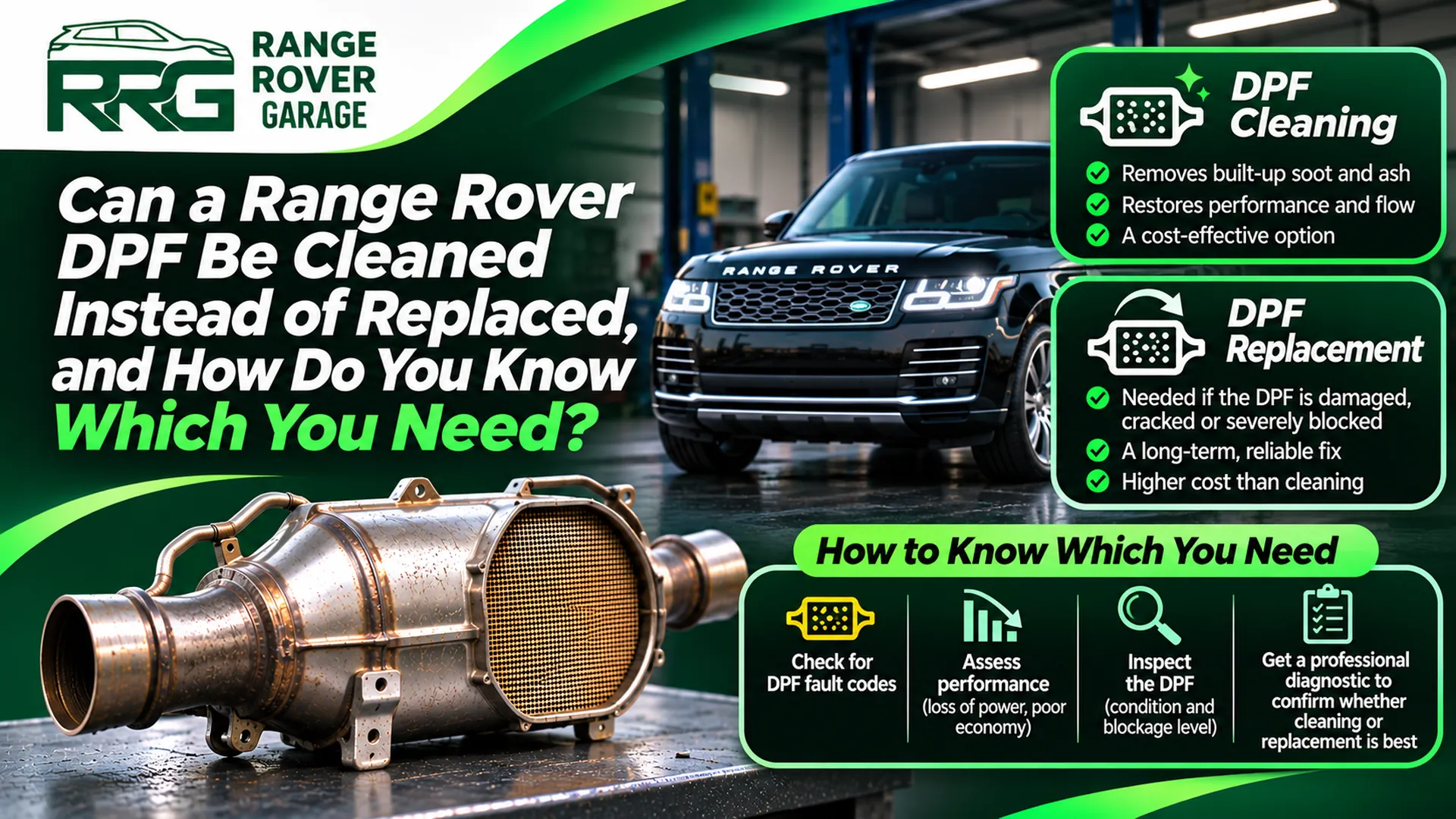
The short answer: often, yes. Many blocked filters can be cleared by forced regeneration or professional off-car cleaning, as long as the ceramic substrate inside is intact. Replacement becomes necessary when the filter is cracked, melted, badly contaminated or too full of ash for cleaning to restore flow. The only reliable way to tell is to measure, not guess.
Cleaning costs less than replacement in nearly every case, so it is the first option worth testing. That said, cleaning a filter that is already damaged, or one that is blocking because of another fault, wastes money. This is where a proper diagnosis earns its keep.
What Are the Signs of a Blocked Range Rover DPF, and What Does the Warning Light Mean?
To understand the symptoms, it helps to know what the filter does. The DPF sits in the exhaust and traps soot from diesel combustion. When it fills, the engine control unit raises exhaust temperature to burn the soot away. This is called regeneration. Ash, which is the leftover residue from burnt oil additives, cannot be burned off and slowly builds up over the life of the filter.
When regeneration cannot finish, soot and ash accumulate, and exhaust flow becomes restricted. The back pressure rises and the engine starts to complain. Typical signs include:
- A DPF warning light on the dashboard. This is usually the first alert. It may be amber, and it often appears with a message.
- An exhaust filter full message. The car is telling you regeneration is overdue or incomplete.
- Reduced engine power or limp mode. The control unit limits performance to protect the engine.
- Poorer fuel economy. More fuel is injected during regeneration attempts, and a restricted exhaust makes the engine work harder.
- Failed or frequent regeneration. You may notice the fans running, a rise in idle speed or a hot smell after you switch off.
- A rising engine oil level. Unburnt diesel can reach the oil during interrupted regeneration, thinning it and raising the level on the dipstick.
- Excess exhaust smoke. Dark or white smoke can point to combustion or filter trouble.
Think of a typical case. A driver does short school-run journeys all week, the DPF never gets hot enough to regenerate, and the light eventually appears. A long motorway run might clear it, and sometimes it does. But if the car has been struggling for months, the soot load may be too high for a motorway drive to fix, and forced regeneration or cleaning is needed.
It is usually fine to drive a short distance with a DPF warning light, as long as the car runs normally. Do not keep driving if the car goes into limp mode, if you notice a burning smell, if smoke appears or if the oil level climbs noticeably. Ignoring a blocked DPF can lead to turbocharger strain, oil dilution and, eventually, a much bigger repair.
When Does Forced Regeneration or Professional Cleaning Work, and When Is a New DPF Necessary?
Each option suits a different level of blockage. This table helps you see where your car might sit.
Option | What it does | Best suited to | Limits |
| Forced DPF regeneration | A diagnostic tool commands the car to run a regeneration cycle while stationary | Moderate soot loading where the filter and sensors are healthy | Does not remove ash, and will not fix a damaged filter |
| Professional off-car DPF cleaning | The filter is removed and cleaned to clear soot and ash | Heavily loaded filters with an intact substrate | Cannot repair cracks or melted sections, and needs refitting |
| Sensor or related repair | Replaces a faulty differential pressure sensor, temperature sensor or related part | Cases where the filter is healthy but the readings are wrong | Only useful when testing confirms the sensor is at fault |
| DPF replacement | Fits a new filter | Cracked, melted or contaminated substrate, or ash loading beyond what cleaning can restore | Highest cost, and pointless if the root cause is not fixed |
So what points to replacement? A technician looks for evidence. Pressure readings that stay high even after cleaning suggest permanent blockage. Soot and ash load figures that remain extreme tell the same story. Physical inspection can reveal a cracked or melted ceramic honeycomb, usually caused by an uncontrolled burn. When the substrate is damaged, cleaning cannot rebuild it.
Ash is the key limitation. Over time, every DPF collects ash that regeneration cannot remove. Cleaning can clear a lot of it, but a filter near the end of its life may not respond. That is why age, mileage and driving history matter in the decision.
Compare long-term costs, too. A cheaper clean on a filter that blocks again within weeks is false economy. A well-fitted replacement, with the root cause fixed, can be the cheaper path over the next few years.
Can a Faulty Pressure Sensor, EGR Valve or Injector Cause DPF Problems and Fake a Blocked Filter?
Yes, and this is the part many articles skip. A DPF does not fail in isolation. Several components feed into it, and when one misbehaves, the filter pays the price.
- Differential pressure sensor. It measures the pressure difference across the filter, which tells the control unit how loaded it is. A faulty sensor or a blocked pipe to it can trigger warnings on a perfectly healthy filter.
- Exhaust temperature sensors. If they read wrongly, regeneration may start late, stop early or never complete.
- EGR valve. A sticking or clogged EGR valve disrupts combustion and raises soot output, so the filter loads faster.
- Fuel injectors. A leaking or poorly atomising injector produces extra soot and can wash diesel into the oil.
- Turbocharger. Boost problems affect combustion and exhaust temperature, and oil passing a worn turbo can contaminate the filter.
- Engine oil. The wrong oil leaves more ash. Diesels fitted with a DPF need low SAPS oil that meets the manufacturer specification.
- AdBlue and NOx systems. Faults in related emissions equipment can also upset regeneration behaviour.
Fault codes help point the way. Codes such as P2002, P2452, P2453, P2463, P244A and P244B all relate to DPF efficiency, pressure sensing or soot loading. But these meanings must be checked against the manufacturer diagnostic information for your specific vehicle, because the same code can have different causes on different engines. No single code means the filter must be replaced. Sensor faults, wiring problems, exhaust leaks and software issues can produce the same symptoms.
Here is a common scenario. An owner has a filter cleaned, and the warning light returns within a few weeks. The garage replaces the filter. The light comes back again. The real culprit was a leaking injector pushing diesel into the oil and sooting the exhaust. Without finding that, no filter, however new, stays clean.
That is why asking "why does my DPF keep blocking?" matters more than asking only about price. Fix the cause, and the filter lasts. Skip it, and you may pay twice.
What Happens During a Range Rover DPF Replacement, and Why Choose a Land Rover DPF Specialist?
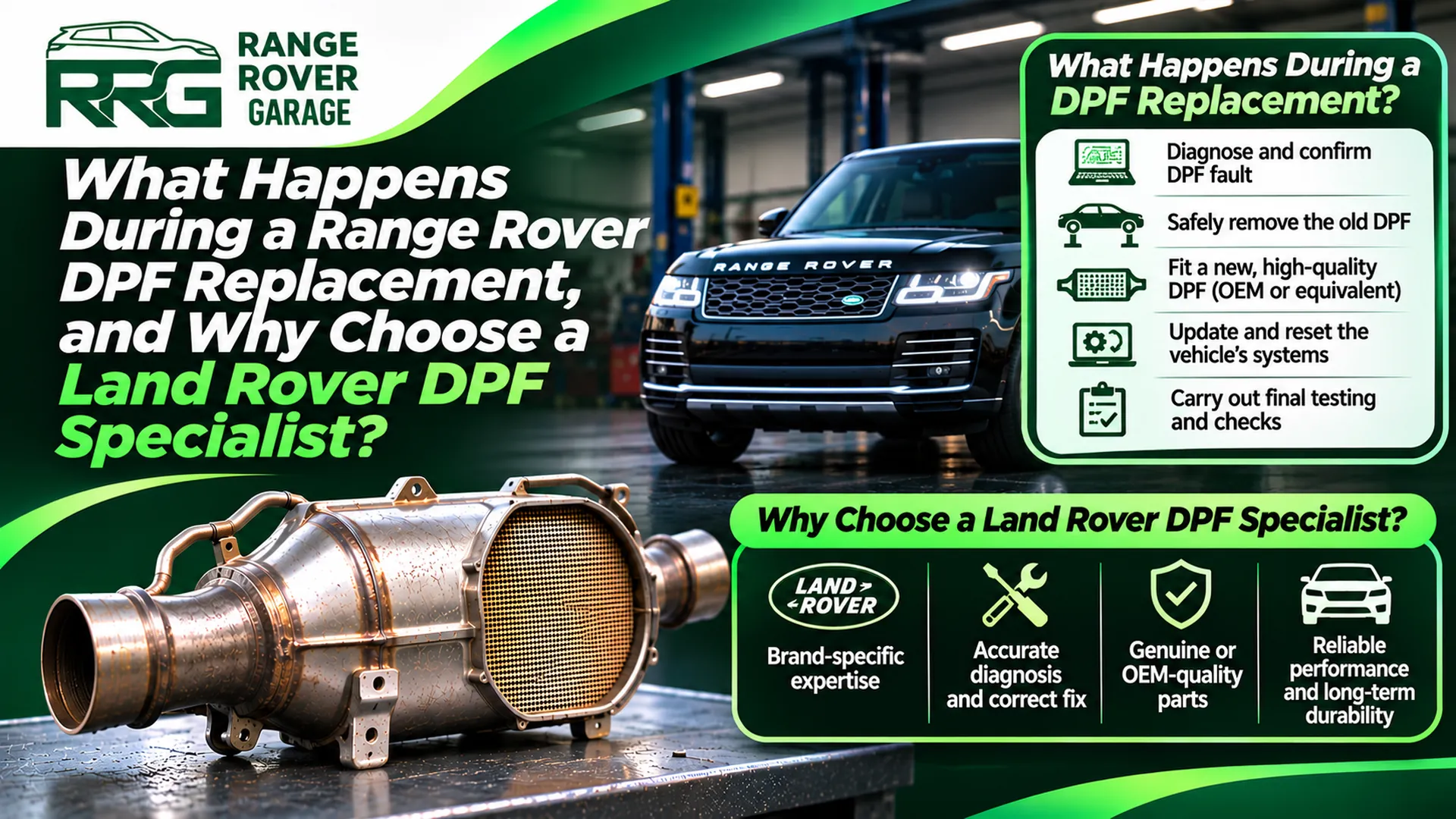
The short answer: a proper replacement starts with diagnosis and ends with a road test. The filter is removed, the new one is fitted with fresh seals and fixings, and the car's software is adapted so it reads the new filter correctly. Done well, the job is a clean, controlled process that leaves nothing to chance.
How Long Does a Range Rover DPF Replacement Take, and What Does the Process Involve?
Most replacements take a working day or part of one, though the exact time depends on the model, access and any extra faults found along the way. A full-size Range Rover with seized fixings takes longer than a straightforward fitment. If related repairs are needed, such as an EGR valve or sensor, allow extra time.
Here is how a specialist typically works through it:
- Initial diagnostic inspection. The technician scans for fault codes, reviews live data and checks for related faults.
- Checking DPF pressure readings. Differential pressure and soot and ash load figures show whether the filter itself is the problem.
- Removing the damaged filter. Heat shields, clamps and sensors are carefully removed, and the filter is inspected for damage.
- Installing the replacement filter. A correct, fitment-checked filter goes in with new gaskets and fixings.
- Checking sensors and connections. Pressure pipes, temperature sensors and wiring are tested so the new filter is not undermined by an old fault.
- ECU reset and adaptation. The control unit is reset and, where required, adapted so the new filter is recognised and regeneration works properly.
- Final testing and road test. The car is driven under real conditions, then scanned again to confirm no faults return.
Not every car needs coding, but many do. If a garage fits a filter without checking whether adaptation is needed, the warning light can come straight back. Ask directly: will the ECU be reset and adapted after fitting?
Warranty deserves the same direct question. Ask what is covered on the part and on the labour, how long it lasts and what conditions apply. Get the answer in writing. A confident garage will not hesitate.
There is also the MOT to think about. A diesel with a DPF fitted by the manufacturer is expected to keep it. A missing or tampered filter can result in an MOT failure, and so can excessive smoke. Removing a DPF for road use is illegal, so a delete is never a safe way to avoid replacement cost. A genuine fix keeps you legal and keeps the car running as designed.
Why a specialist often saves money. Land Rover diesels have their own habits, and a garage that works on them every day knows which fault to suspect first. That means fewer wasted parts, fewer repeat visits and correct coding on the first attempt. A cheaper hourly rate means little if the job has to be done twice.
Range Rover Garage works on diesel emissions faults as part of its wider Range Rover engine diagnostics and Land Rover engine specialist service. If your DPF problem turns out to involve a turbocharger, EGR valve or deeper engine fault, the same team can handle it, without sending you elsewhere. Our Range Rover turbo replacement and Range Rover engine repair services cover the related work.
How to stop it happening again. Whichever route you take, these habits protect a clean or new filter:
- Take regular longer drives. A sustained run at steady speed gives passive and active regeneration the heat they need.
- Use the correct low SAPS oil. The wrong oil leaves more ash and shortens filter life.
- Keep to service intervals. Fresh oil and filters reduce contamination and keep combustion clean.
- Act on warning lights early. A light caught early is often a cheap fix. A light ignored for months is not.
- Avoid interrupting regeneration. If you notice the fans running and a hot smell after parking, let the cycle finish where it is safe to do so.
- Fix related faults promptly. EGR, injector and turbo issues feed straight into the DPF.
Ready to find out what your car really needs? Request a Range Rover DPF replacement quote through rangerovergarage.co.uk, or call the workshop to book a diagnostic check.
Frequently Asked Questions About Range Rover DPF Replacement
How much does a Range Rover DPF replacement cost in the UK?
It varies with the model, engine, filter type, labour and any related repairs. A small sensor fault costs far less than a full replacement on a larger model. A proper diagnosis lets a garage give you a real, itemised quote instead of an estimate.
Can a Range Rover DPF be cleaned instead of replaced?
Often, yes. Forced regeneration or professional off-car cleaning can clear many blocked filters, provided the internal substrate is not cracked or melted. If cleaning does not restore normal pressure readings, replacement is the next step.
Can I drive my Range Rover with the DPF warning light on?
Short, gentle journeys may be possible if the car drives normally, but you should get it checked soon. Stop driving if the car enters limp mode, if you smell burning or see smoke, or if the oil level keeps rising. Ignoring the warning can lead to turbo damage and a much larger repair.
Why does my Range Rover DPF keep blocking?
Repeated blockage usually points to a root cause. Short journeys, a faulty EGR valve, leaking injectors, a failing pressure sensor, a worn turbo or the wrong engine oil are the usual suspects. Fixing the cause matters as much as clearing the filter.
Is a genuine Land Rover DPF better than an aftermarket one?
Genuine filters are made to the manufacturer specification and offer a precise fit. A good aftermarket filter from a reputable brand can be a sensible choice for an older car. Very cheap unbranded filters often cause problems, so quality and warranty matter more than the logo.
Does a new DPF need programming or an ECU reset?
On many Range Rover models, yes. The control unit usually needs a reset or adaptation so it recognises the new filter and manages regeneration correctly. Always ask whether this is included in the quote.
How long does a Range Rover DPF last?
There is no fixed lifespan. Driving habits, oil quality, mileage and related engine health all play a part. A filter on a well-maintained car that sees regular longer drives can last many years, while one on a car doing only short trips may struggle much sooner.
Can a faulty pressure sensor cause a DPF warning light?
Yes. The differential pressure sensor tells the control unit how loaded the filter is, so a faulty sensor or blocked sensor pipe can trigger warnings on a healthy filter. Testing the sensor before replacing the filter can save a lot of money.
Final Thoughts: Pay for the Right Repair, Once
The Range Rover DPF replacement cost is not one number, and chasing the cheapest quote is rarely the smartest move. The real saving comes from a correct diagnosis, the right repair for your car and a fix for whatever caused the blockage in the first place.
Sometimes that means a forced regeneration. Sometimes it means a sensor, an EGR valve or an injector. And sometimes a new filter is the only honest answer. A good specialist tells you which, shows you the evidence and quotes the confirmed job before any work begins.
If your DPF warning light is on, your car is losing power or your last repair did not hold, now is the time to act. Range Rover Garage can diagnose the fault, explain your options and give you a clear quote you can trust.
Request your Range Rover DPF replacement quote today at rangerovergarage.co.uk, or book a diagnostic inspection to find out exactly what your Range Rover needs.