Range Rover NOx Sensor Fault: Symptoms, Causes and How to Fix It
The engine management light came on this morning. Maybe the dashboard is also showing an AdBlue or emissions message, or the car feels flat and a little restricted. A quick search tells you it could be a NOx sensor, and now you're wondering whether to order a part or book a garage.
A Range Rover NOx sensor fault means the diesel emissions system is receiving a bad, implausible or missing reading from one of its nitrogen oxide sensors. The sensor itself can be to blame. So can its wiring, a corroded connector, an AdBlue dosing problem or a tired SCR catalyst. All of them can trigger similar warnings, which is why guessing at the cause gets expensive.
This guide explains the symptoms, the causes, what the main fault codes mean, how a specialist confirms the problem, and what shapes the cost of putting it right. It also answers the question most owners ask first: can I keep driving?
Key takeaways
- A NOx sensor fault does not always mean the sensor has failed.
- Fault codes point to a circuit or performance problem, not automatically to a confirmed part.
- AdBlue warnings and NOx sensor faults overlap, but they are not the same fault.
- Replacing a sensor without diagnosis is one of the most common ways owners spend money without fixing the problem.
- Warning light on? Book an emissions diagnostic with Range Rover Garage and get the cause confirmed before you buy anything.
What Are the Symptoms and Causes of a Range Rover NOx Sensor Fault?
Diesel engines produce nitrogen oxides, known as NOx, during combustion. Modern Range Rover diesel engines, including the TDV6, SDV6, SDV8 and Ingenium units, treat those gases in an exhaust after-treatment system. The system uses AdBlue, a diesel exhaust fluid, and a selective catalytic reduction catalyst, usually shortened to SCR, to convert harmful NOx into harmless nitrogen and water.
The NOx sensor is how the engine control unit knows whether that treatment is working. Many vehicles use two sensors. The upstream NOx sensor measures the gases before they reach the SCR catalyst. The downstream NOx sensor measures what is left afterwards. The control unit compares the two readings to judge how efficiently the system is cleaning the exhaust. Sensor layouts vary by model and engine, so a specialist should confirm yours by VIN and engine code.
Each sensor has a small internal heating element and its own control electronics. It must reach a high operating temperature before it reads properly, and it sits in one of the harshest places on the car: the underside of the exhaust, exposed to heat, vibration, road spray and salt.
Why Is My Range Rover Showing an Engine Warning or Incorrect AdBlue Quality Message?
When the control unit decides a NOx reading is missing, slow, out of range or implausible, it logs a fault and often warns you. These are the signs owners and technicians see most often.
- Engine management light. The most common first sign, often with no change in how the car drives.
- AdBlue or incorrect diesel exhaust fluid quality message. The system assumes the treatment is not working properly because the NOx readings do not make sense.
- Emissions system warning. A general message that the exhaust after-treatment system has detected a fault.
- Restricted performance or limp mode. Some vehicles limit power to protect the emissions system and reduce output.
- A fault that returns after being reset. The message disappears, then comes back days or weeks later.
- Slightly higher fuel consumption. Not guaranteed, but it can happen when the engine runs a conservative strategy.
- Failed emissions readiness checks. Monitors fail to complete, which can matter at test time.
Some cars show a warning and drive perfectly normally. That does not mean the fault is harmless. It means the system has spotted a problem before it affects the way the car feels.
Here is how the main causes break down.
- Internal sensor failure. The sensing element or electronics wear out with age, heat cycling and mileage.
- Sensor heater circuit fault. If the heater cannot bring the sensor up to temperature, it cannot read correctly.
- Damaged wiring or corroded connector. Water ingress, salt and heat attack the electrical connection and cause intermittent, misleading signals.
- SCR catalyst efficiency problems. The sensors may be reading correctly while the catalyst underperforms.
- AdBlue dosing or fluid quality problems. A blocked or crystallised injector, contaminated fluid or poor dosing changes what the downstream sensor sees.
- Exhaust leaks. Air or gas escaping near a sensor distorts its readings.
Short journeys make matters worse. If the exhaust rarely reaches full working temperature, the system struggles to complete its checks, and borderline components show up as faults.
Is it a NOx sensor fault or an AdBlue fault? They are related, but they are not interchangeable. A NOx sensor fault is about the reading. An AdBlue fault is about the fluid, the dosing hardware or the way the treatment is delivered. One can cause the other to appear, so a careful diagnosis tests both rather than assuming. Our guide to Range Rover AdBlue system faults covers the fluid side in more depth.
Recognise these signs? Book an emissions diagnostic and we will find out which part of the system is really at fault.
What Do NOx Sensor Fault Codes P2200, P2201, P229F and P22FE Mean?
Fault codes are a starting point, not a verdict. The table below explains what these codes are commonly associated with, in plain English. Exact wording and sensor position vary by model, engine and software, so the full code, including its suffix, should always be checked against correct Land Rover diagnostic information.
Fault code | Commonly associated meaning | Typical areas to check |
| P2200 | Upstream NOx sensor circuit open | Connector, wiring continuity, supply and ground, sensor control module |
| P2201 | NOx sensor range or performance problem | Sensor condition, exhaust leaks, SCR and dosing behaviour, live readings |
| P2202 | Sensor circuit reading low | Wiring short to ground, damaged harness, connector corrosion |
| P2203 | Sensor circuit reading high | Wiring short to voltage, connector damage, sensor electronics |
| P229F | Downstream sensor range or performance | Sensor condition, SCR efficiency, AdBlue dosing, exhaust leaks |
| P22FE | Downstream sensor performance | Sensor response, heater function, catalyst and fluid quality |
Notice how many of these codes point to the circuit and not to the sensor. A circuit code often leads to a connector or a length of wiring. A performance code can lead to the sensor, but it can also lead to the catalyst or the AdBlue system sitting behind it.
Different models handle the system differently, so treat this table as a guide only.
Model | Diesel engines you may see | What to remember |
| Range Rover Sport | 3.0 TDV6, 3.0 SDV6 | Sensor positions and module types depend on year and engine code |
| Range Rover L405 | 3.0 TDV6, 3.0 SDV6, 4.4 SDV8 | Emissions hardware changed across the production run |
| Range Rover Evoque | 2.0 Ingenium diesel | Compact packaging makes connector inspection important |
| Range Rover Velar | 2.0 and 3.0 diesel | Check software and part supersessions before ordering |
| Range Rover L460 | Ingenium six-cylinder diesel | Newer system, so use current manufacturer diagnostic information |
Whatever the model, confirm the exact part against the VIN before anything is ordered.
How Is a Range Rover NOx Sensor Fault Diagnosed?
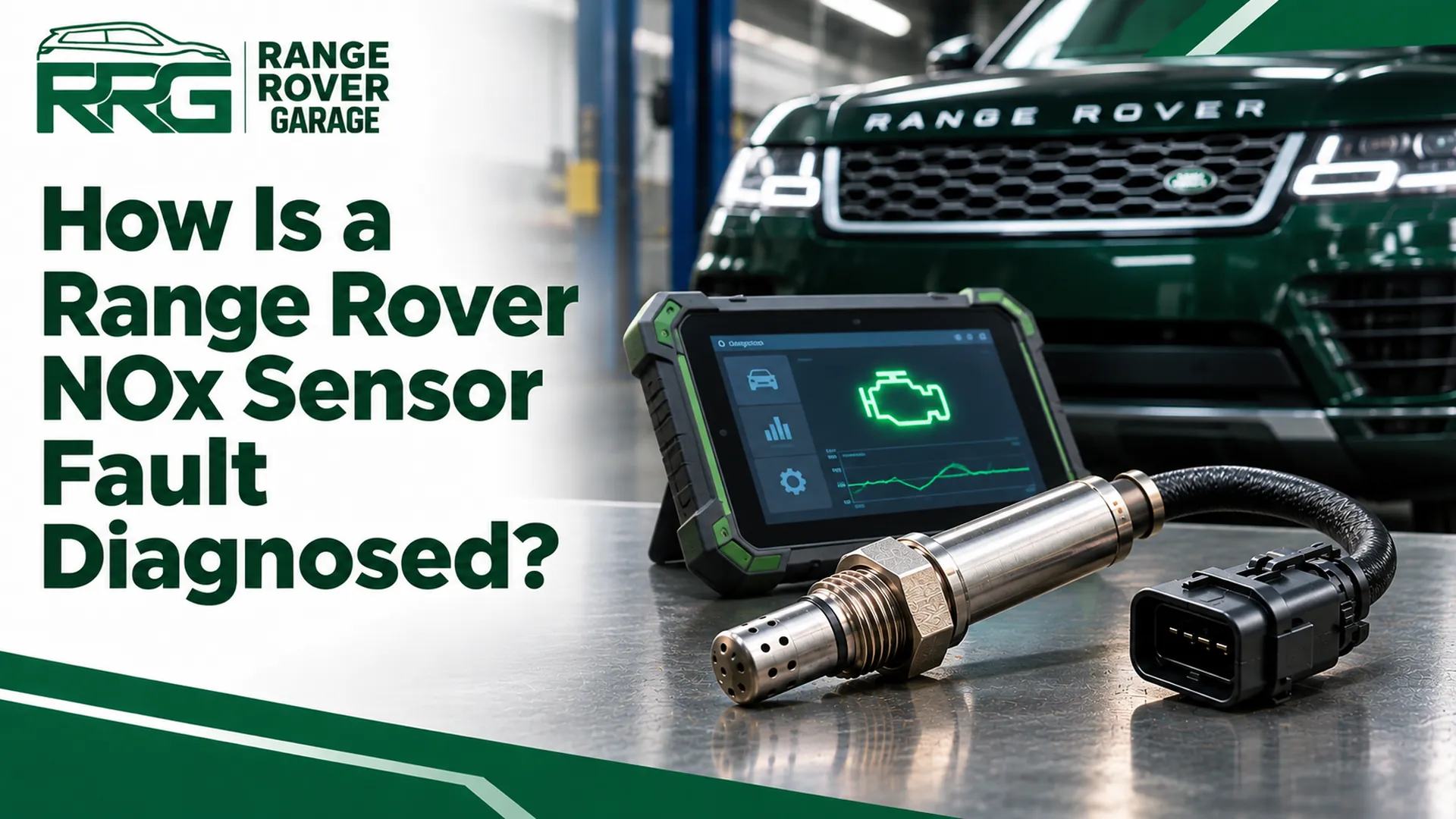
A reliable diagnosis never rests on one reading. Code reading, live data and electrical testing each show a different part of the picture, and a good technician uses all three. That is how you avoid replacing a perfectly good sensor while the real problem, often a connector or a dosing issue, keeps triggering the same warning.
Is It the NOx Sensor, the Wiring or an AdBlue and SCR Problem?
A thorough diagnostic normally follows this order.
- Read the fault codes and the stored data. The technician records every code, including its suffix, and notes the conditions when it was set.
- Compare upstream and downstream live readings. Both sensors are monitored while the engine runs. The downstream reading should behave in a way that makes sense against the upstream one once the system is warm and dosing.
- Inspect connectors for corrosion and water ingress. Green or white deposits, damp terminals and pin damage are common finds.
- Test wiring, supply voltage and communication. The sensor talks to the engine control unit over a network, so continuity, supply and signal integrity all matter.
- Check AdBlue dosing and fluid quality. Contaminated or incorrect fluid and a poorly performing injector can both distort readings.
- Assess SCR catalyst efficiency. A catalyst that is not converting NOx properly can mimic a sensor fault.
- Confirm the fault before replacing anything. Only when the evidence points to the sensor does the part change hands.
The table below shows how the three main possibilities usually differ.
Possible cause | Typical signs | What testing usually shows | Usual fix |
| Failed NOx sensor | Consistent performance or heater codes, implausible live readings | Readings that do not respond sensibly, heater circuit faults | Replace the sensor, then verify |
| Wiring or connector fault | Intermittent warnings, circuit codes, faults after wet weather | Poor continuity, resistance, corrosion at the plug | Repair the wiring or connector |
| AdBlue or SCR problem | Fluid quality messages, performance codes on the downstream sensor | Weak dosing, poor catalyst conversion, contaminated fluid | Repair dosing hardware or treat the catalyst issue |
Here is a typical scenario. A diesel Range Rover shows an emissions warning, the owner clears it with a cheap scanner, and the car runs normally for a fortnight. Then the warning returns after a wet motorway drive. Testing shows the sensor itself responds well, but its connector has taken in moisture and the pins are corroded. Cleaning and repairing the connection fixes it, and no new sensor is needed. It is a common pattern, which is exactly why testing comes before parts.
A workshop that uses manufacturer-level diagnostic equipment and follows current Land Rover procedures can read live data far more accurately than a generic code reader. That difference often decides whether the first repair is the right one.
Why Does the NOx Sensor Fault Keep Coming Back After Clearing the Code?
Because clearing a code removes the message, not the cause.
Here are the usual reasons a fault returns.
- An intermittent wiring or connector fault. It only appears when heat, vibration or moisture disturb the connection.
- A failing sensor heater. The sensor works for a while, then fails to reach temperature.
- An SCR efficiency or dosing issue. The sensors report accurately, and the system keeps finding that the exhaust is not clean enough.
- Short journeys. The exhaust never gets hot enough for the system to complete its checks, so borderline faults keep reappearing.
- A part that was replaced without diagnosis. If the original cause was never found, the new sensor inherits the same problem.
If your warning keeps coming back, stop clearing it and get it properly tested. Each repeat gives you more evidence about the real cause, but only if someone reads it correctly.
Can You Drive a Range Rover With a Faulty NOx Sensor?
Sometimes, for a short time. It is not a fault to ignore.
A car with a NOx sensor warning will often still run, but the risks build up.
- Restricted performance. The car may limit power without warning, which is unwelcome when overtaking or towing.
- AdBlue related escalation. On some vehicles, a persistent emissions fault linked to the treatment system can eventually lead to a countdown warning, and in the worst case a refusal to restart once the countdown ends. Check how your own car behaves before relying on it.
- Higher emissions. The system may not be treating exhaust gases as it should.
- Possible MOT trouble. An illuminated engine management warning, or an emissions system that is not working properly, can lead to a failed test.
- A bigger bill later. A small wiring problem is cheap to fix. Left alone, it can leave you with a failed sensor, a damaged control module or an unhappy catalyst.
If the car goes into limp mode, a countdown appears or the engine starts running badly, stop somewhere safe and arrange help.
Not sure what is behind your warning? Book a diagnostic with our Range Rover specialists and get a clear answer before it affects how you drive.
How Much Does Range Rover NOx Sensor Replacement Cost in the UK?
There is no honest single figure, because the cost depends on your car and what the diagnosis uncovers. A single sensor on one engine is a very different job from a replacement that also needs wiring repair or SCR work. A reliable quote always follows an inspection, not a guess over the phone.
These are the factors that shape the final bill.
Cost factor | Why it changes the total |
| Upstream or downstream sensor | The two positions can use different parts and have different access |
| Model and engine | Sensor type, location and module arrangement vary across Sport, Evoque, Velar and the L405 and L460 |
| Genuine or aftermarket part | Fit, long-term reliability and warranty can differ |
| Labour and access | A sensor mounted high on the exhaust is easier to reach than one hidden near the catalyst |
| Diagnostic time | Proper testing takes time, but it prevents unnecessary parts |
| Adaptation and coding | Some systems need the new sensor recognised and checked by the control unit |
| Related repairs | Wiring, connectors, AdBlue components or the SCR catalyst may need attention too |
The cheapest-looking quote is not always the cheapest repair. If a job skips diagnostics, ignores a damaged connector or leaves a returning fault unexplained, you can end up paying twice. Ask what the quote includes, which part is being fitted, and what warranty covers the work.
Does a New NOx Sensor Need Coding, and Can the Old One Be Repaired Instead?
A sensor that has failed internally cannot normally be cleaned or repaired, so replacement is the only reliable fix. A damaged connector or a section of wiring is a different matter, and these can often be repaired properly without changing the sensor.
On many systems, a new sensor needs to be checked and confirmed by the control unit after fitting. Whether it needs formal coding or adaptation depends on the model, engine and software, so a specialist with the right diagnostic equipment should confirm this for your car.
A proper repair does not finish when the new part goes in. A thorough workshop will follow a checklist like this one.
- Inspect the connectors and wiring around the affected sensor.
- Fit the correct part for the VIN and engine code.
- Clear the fault codes and scan the system again.
- Check live readings against expected behaviour.
- Confirm AdBlue dosing and SCR operation.
- Complete a road test under realistic conditions.
- Recheck for returning faults once the car has been driven again.
Skipping any of these steps is how repeat faults happen. A sensor can be perfect while the connector next to it quietly causes the same warning.
On genuine versus aftermarket parts, a balanced view helps. Genuine Land Rover parts offer the most certain fit and match to the vehicle. Some aftermarket sensors perform well when they come from a reputable supplier, but quality varies. Ask your specialist which they recommend for your engine and what warranty applies.
Choosing the right garage matters as much as choosing the right part. Range Rover Garage works on Range Rover and Land Rover diesel emissions systems, from the first scan through to the final road test. We explain what we find and why, confirm the work and warranty before we begin, and test before we recommend replacing anything.
Ready to find out what is behind your warning? Book your Range Rover NOx sensor diagnostic today and speak to a specialist who will test properly, explain clearly and fix it once.
Frequently Asked Questions About Range Rover NOx Sensor Faults
Where is the NOx sensor located on a Range Rover?
NOx sensors sit in the exhaust system, usually under the car, with one before the SCR catalyst and one after it. The exact position, and the number of sensors, depends on the model, engine and year. Your specialist can confirm the layout for your car using the VIN.
Can a faulty NOx sensor cause an AdBlue warning?
Yes. The control unit uses NOx readings to judge whether the AdBlue treatment is working. If a reading looks wrong, the system can display an AdBlue or fluid quality message even when the fluid is fine. The reverse can also happen, so both need testing.
Can a NOx sensor fault cause limp mode?
It can. Some vehicles reduce power when the emissions system reports a fault it cannot resolve. Not every car does this, and many show only a warning light, but restricted performance should always be taken seriously.
How long does NOx sensor replacement take?
It depends on the sensor, the model and how easily it can be reached. A straightforward replacement can be quick, while a job involving stubborn fixings, wiring repair or extra testing takes longer. A specialist can give a realistic timeframe after inspecting the car.
Can a NOx sensor fault cause an MOT failure?
It can. An illuminated engine management warning or a faulty emissions system can be a reason for failure. Getting the fault diagnosed and repaired before the test avoids a retest and gives you time to fix it properly.
Does a diagnostic scanner identify a faulty NOx sensor?
A scanner shows fault codes and live data, but a code alone does not prove the sensor has failed. Wiring, connectors, AdBlue dosing and the catalyst can all set the same codes, so further testing is needed to confirm.
Can a NOx sensor be cleaned instead of replaced?
A sensor that has failed internally cannot be cleaned back to health. A corroded or contaminated connector can often be cleaned and repaired, and that is sometimes the whole fix.
How can I prevent NOx sensor problems?
Use good quality diesel and correct AdBlue, and keep the AdBlue system topped up and serviced. Fit in some longer drives so the exhaust reaches full working temperature, and have any warning checked promptly. Regular diagnostics catch small electrical problems before they become expensive ones.
Final word
A Range Rover NOx sensor fault rarely starts as a crisis. It begins with a light on the dashboard, a message about the emissions system, or a warning that disappears and then returns. The cost comes from guessing. Replacing a sensor that was never the problem, or ignoring a small connector fault until it grows, turns a simple repair into a long one.
If your Range Rover is showing an engine warning, an AdBlue message or restricted performance, do not wait for it to get worse. Contact Range Rover Garage to book a NOx sensor diagnostic, and get a specialist who will find the real cause, explain it in plain English and put it right.