Range Rover Sport Turbo Replacement Cost UK: What Affects the Bill, What's Included and Your Options
Your Range Rover Sport has dropped into limp mode, or it feels flat when you ask for power. A garage has mentioned the turbo, and now you want to know what the repair will cost before you agree to anything.
That is a fair question, and it is harder to answer than it looks. Range Rover Sport turbo replacement cost depends on the engine, the type of unit fitted, the condition of the oil system and what the original fault turns out to be. Two quotes for the same car can look miles apart simply because one covers the part alone and the other covers the whole job.
This guide explains what drives the final bill, how the cost differs from one engine to the next, and how to compare quotes properly. It also covers when a repair makes sense, and what a good turbo replacement should include so the new unit does not fail again. If you would rather talk it through with a specialist, you can request a quote for your exact engine at any point.
How Much Does a Range Rover Sport Turbo Replacement Cost in the UK?
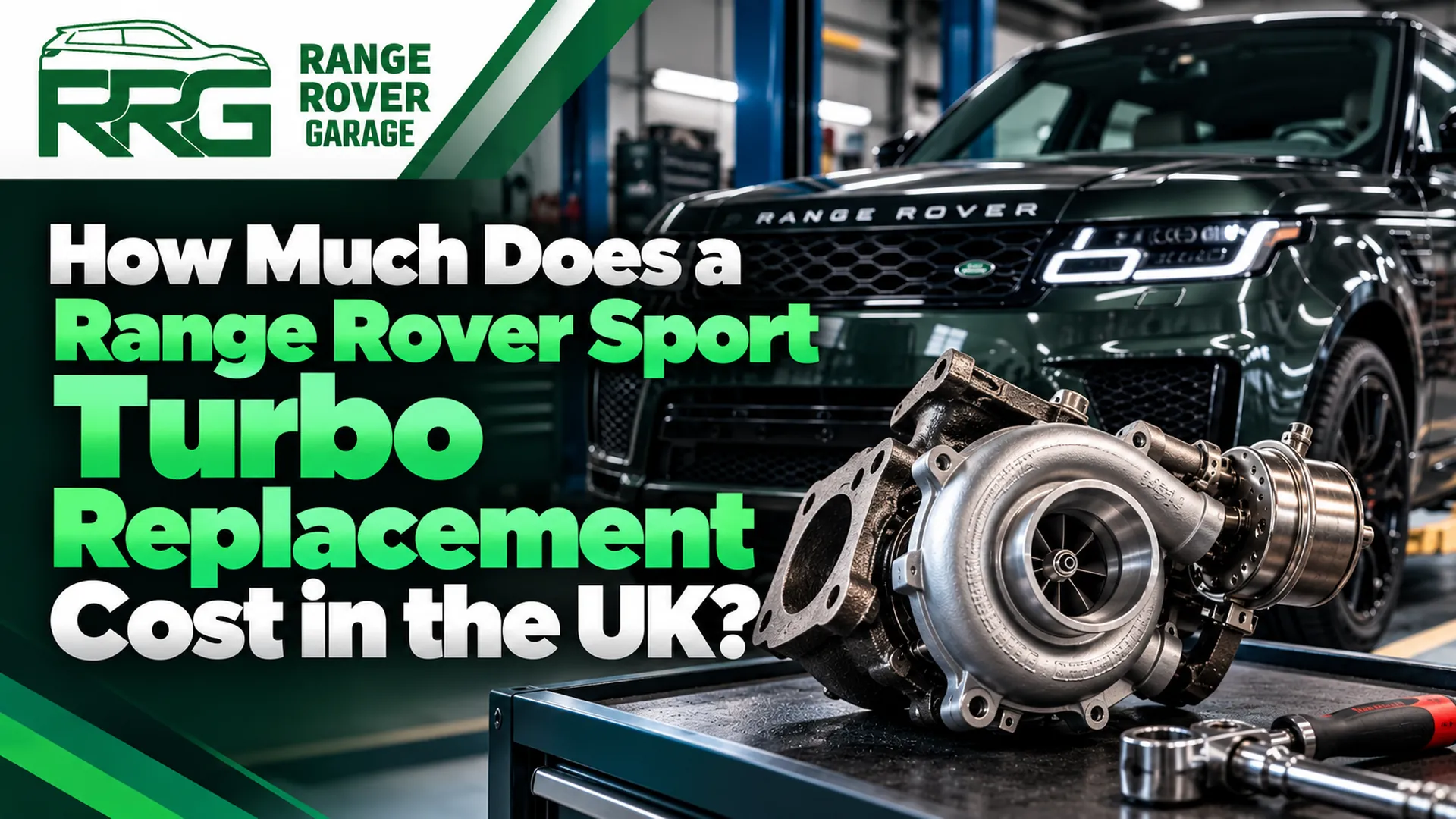
The cost of replacing a Range Rover Sport turbo in the UK is made up of the turbocharger unit, the labour to remove and fit it, the supporting parts that should be renewed with it, and any extra work the diagnosis uncovers. The engine in your car and the type of turbo you choose have the biggest effect on the total.
That is why we do not publish one fixed figure for every car. A single number would be wrong for most owners, and it would hide the things that matter most. What you can do is understand each part of the bill, so you know what a fair quote should look like.
Here is how a full turbo replacement is built up.
Cost element | What it covers | Why it moves the total |
| Turbocharger unit | New, reconditioned or used turbo | Depends on the engine, part number and unit type |
| Labour | Removal, fitting and setting up | Varies with engine layout and access |
| Gaskets and seals | Exhaust seals, oil seals, fixings | Should always be renewed, never reused |
| Oil feed and return pipes | Inspection and replacement where needed | A restricted pipe is a common reason turbos fail |
| Engine oil and filter | Fresh oil to the correct specification | Protects the new bearings from day one |
| Intercooler | Inspection and cleaning if contaminated | Oil in the intercooler can damage the replacement |
| Diagnostics | Fault codes, live boost data, road test | Confirms the turbo was the real fault |
| VAT | Whether it is included in the quote | Makes quotes hard to compare if unclear |
| Warranty | Parts and labour protection | Reflects the quality of the unit and the work |
Notice how many of those lines sit outside the turbo itself. Owners who compare only the unit price often end up surprised when the final invoice arrives. A quote that lists every line above is a quote you can trust.
Another point worth knowing is who does the work. A main dealer and an independent Land Rover specialist both do this job, but their labour rates, parts policies and willingness to recondition rather than only replace can differ. A specialist who handles Land Rover engines every week tends to know the common failure patterns and can often resolve the root cause in the same visit.
What Is the Difference in Cost Between a New and a Reconditioned Range Rover Sport Turbo?
A new turbo and a reconditioned turbo sit at different points on the price scale, and the gap can influence your decision. A reconditioned exchange unit is generally the more economical route. A new original-quality unit generally costs more but suits certain situations better. A used turbo usually has the lowest purchase cost and the most uncertainty.
This table sets out how the three compare in practice.
Option | What it is | Best suited to | Main consideration |
| New OEM turbocharger | Brand new, original specification | Severe damage, owners who want a new original-quality part | Higher purchase cost |
| Reconditioned turbo | Existing core rebuilt with new internals, balanced and tested | Most everyday repairs, good balance of value and reliability | Quality depends entirely on who rebuilt it |
| Used turbo | Taken from another vehicle | Short-term fixes on older cars | Unknown history and wear |
A well-made reconditioned turbo is not a compromise. Done properly, it involves stripping the unit, replacing the bearings, seals and worn parts, and balancing the rotating assembly, which includes the compressor wheel, turbine wheel and shaft. Many reputable turbo makers, including Garrett and BorgWarner, supply or support remanufactured units too.
What matters is the warranty and who stands behind the work. Always ask what the warranty covers and for how long before you choose either route.
How Much Does Turbo Replacement Cost on a TDV6, SDV6, TDV8 or Ingenium Range Rover Sport?
Turbo replacement cost differs between engines because the turbo layout, the packaging around the engine and the labour involved all change from one version to the next. Treat any quote that ignores your engine code with caution.
Here is a general guide to what changes between the common Range Rover Sport engines.
Engine | Typical turbo set-up | What to know |
| 2.7 TDV6 | Single variable geometry turbo | Simpler layout, but vane sticking and oil system problems are common |
| 3.0 TDV6 | Sequential twin turbo on many versions | Two units to consider, so correct diagnosis matters |
| 3.0 SDV6 | Sequential twin turbo, electronic actuators | Diagnosis decides whether one or both units need attention |
| 3.6 TDV8 | Twin turbo layout | More components and more labour around the engine bay |
| 4.4 TDV8 and SDV8 | Twin turbo layout | Heavier job with greater access demands |
| 2.0 Ingenium and newer D300 and D350 | Modern electronic control | Tighter packaging and more reliance on sensor data |
Layouts vary by model year, so we confirm the exact unit from the engine code and chassis number before quoting.
Twin turbo and sequential systems deserve a closer look. In a sequential layout, a smaller primary turbo handles low-speed response and a larger secondary turbo takes over as the revs build. When one fails, the symptoms can look like a general loss of power rather than a clear single-unit fault. A proper diagnosis, using live boost data and a physical inspection, tells us whether one or both units need replacing. Replacing the wrong one wastes money and leaves the original fault in place.
Labour also changes with the vehicle generation. On the earlier L320 cars, the turbo sits in a tighter position on some engines, and access can add to the hours. Later cars have their own challenges. This is why a quote for a TDV6 cannot simply be copied across to an SDV6 or a TDV8.
Does the Quoted Price Include Labour, VAT, Oil Pipes and Warranty?
Before you accept any quote, check it against this list. A trustworthy written quote should state:
- The exact turbo unit, and whether it is new, reconditioned or used
- Labour for removal and fitting
- Gaskets, seals and fixings
- Oil feed and return pipe inspection or replacement
- Fresh engine oil and filter
- Intercooler inspection and cleaning if needed
- Diagnostic checks and a road test
- Whether VAT is included
- The length and terms of the warranty
An unusually low quote often leaves out the oil pipes, the oil change or the diagnostics. Those omissions cost nothing today and can cost a great deal if the new turbo fails within weeks. If you have a quote and are not sure what it covers, send it to us and we will tell you what is missing.
Should You Repair, Rebuild or Replace a Range Rover Sport Turbo?
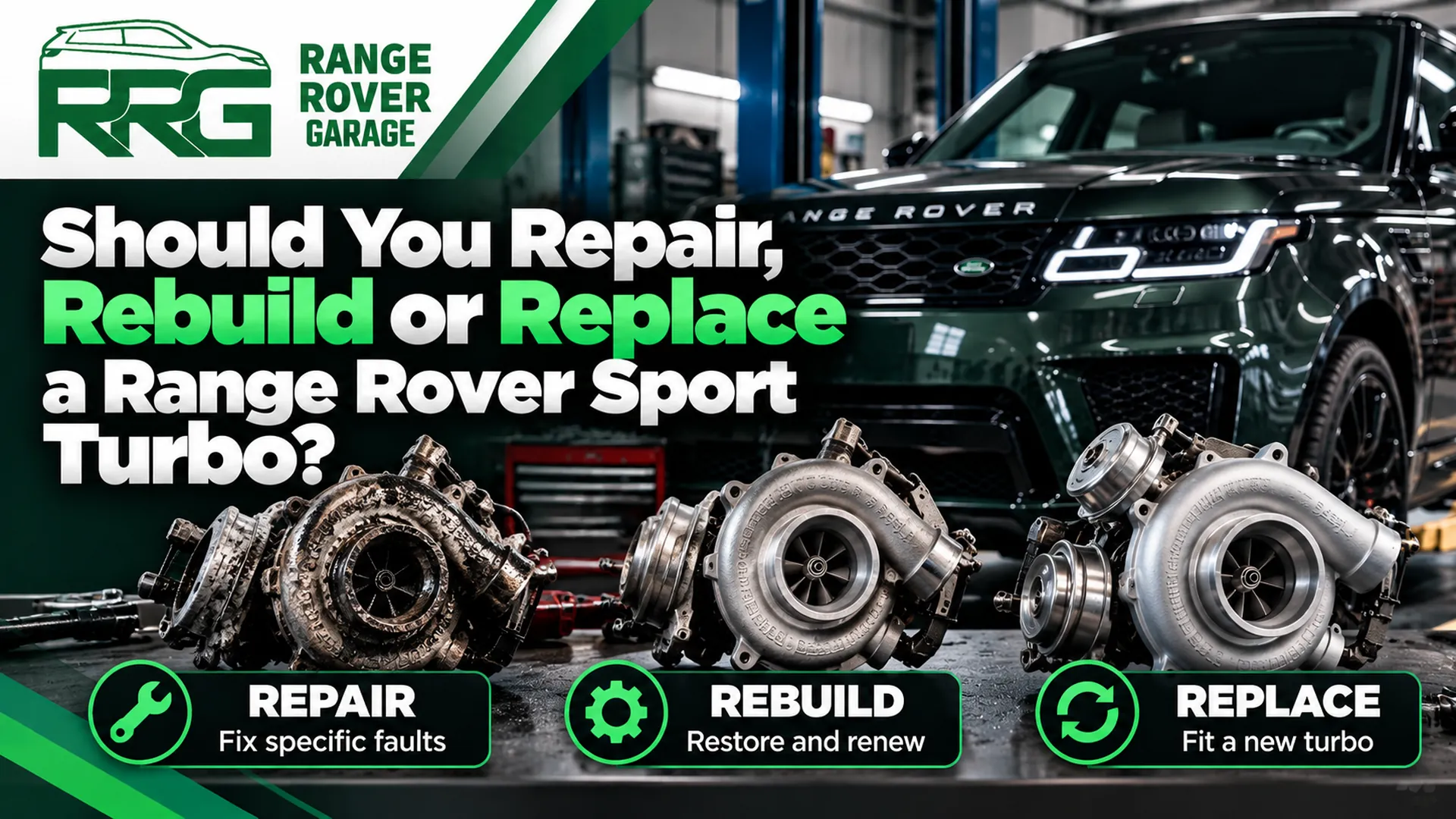
The right choice depends on what has failed and how badly. Minor faults can sometimes be repaired, worn internals can be rebuilt, and heavy damage calls for a full replacement unit. A specialist can only advise properly after inspecting the turbo and the oil system around it.
This table shows how the options compare.
Option | When it suits | Risk |
| Turbo repair | Minor faults, such as an actuator or sticking vanes with sound internals | Low, if the core is healthy |
| Turbo rebuild | Worn bearings or seals with serviceable housings | Moderate, depends on the quality of the rebuild |
| Reconditioned turbo | Complete replacement with a professionally remanufactured unit | Low when backed by a solid warranty |
| New OEM turbo | Severe damage, or preference for a new original part | Low, with the highest upfront outlay |
| Used turbo | Short-term fix with a limited budget | High, because the condition is unknown |
One of the most overlooked points is the actuator. The actuator controls how the turbo regulates boost, and on a variable geometry turbocharger it moves the vanes that shape airflow. A faulty electronic actuator, a sticking vane mechanism or a wastegate problem can produce the same symptoms as a failed turbo: low boost, limp mode and poor acceleration. In these cases the turbo itself may be perfectly sound, and replacing only the actuator, followed by correct calibration, can solve the problem for far less than a full turbo.
Here is a scenario we see regularly. An owner arrives with an SDV6 stuck in limp mode and a fault code pointing at low boost. They have been told the turbo has failed. On inspection, the shaft has no play and the bearings are healthy, but the actuator is not moving the vanes correctly. Fixing the actuator and recalibrating restores normal boost. The owner avoids a major repair, and the diagnosis made the difference.
The reverse also happens. Shaft play, oil in the compressor housing or damaged compressor and turbine wheels all point to a unit that cannot be saved. Pushing a repair in those cases only delays the bigger job.
How Do You Know If Your Range Rover Sport Turbo Is Failing, and Can You Keep Driving?
A failing turbo usually gives warning signs before it gives up completely. Catching them early can limit the damage and the final bill.
Watch for these symptoms:
- Loss of power and slow acceleration, especially when overtaking or going uphill
- Blue or grey smoke, which often points to oil passing through worn turbo seals
- Black smoke under acceleration, which can indicate low boost and over-fuelling
- Whining, whistling or grinding noises that rise and fall with engine speed
- Higher oil consumption, with no obvious external leak
- Engine warning light or limp mode, often with underboost or overboost fault codes stored in the ECU
- Low or erratic boost pressure on diagnostic readings
Each of these has other possible causes, including a split intercooler hose, a boost leak, a faulty MAP sensor or a blocked DPF. That is why reading the fault codes is only the first step. A proper check looks at boost pressure data, inspects the pipework and checks the turbo for shaft play.
Can you keep driving? We would advise against it. A turbo that is losing oil, making metallic noises or producing heavy smoke can shed debris into the engine, and a turbo that has run dry can cause wider damage. If the engine is in limp mode, it is protecting itself, so the safest step is to have the car checked promptly. If you cannot drive it safely, arrange recovery rather than risking the engine.
What Happens During a Turbo Replacement, and How Do You Stop It Failing Again?
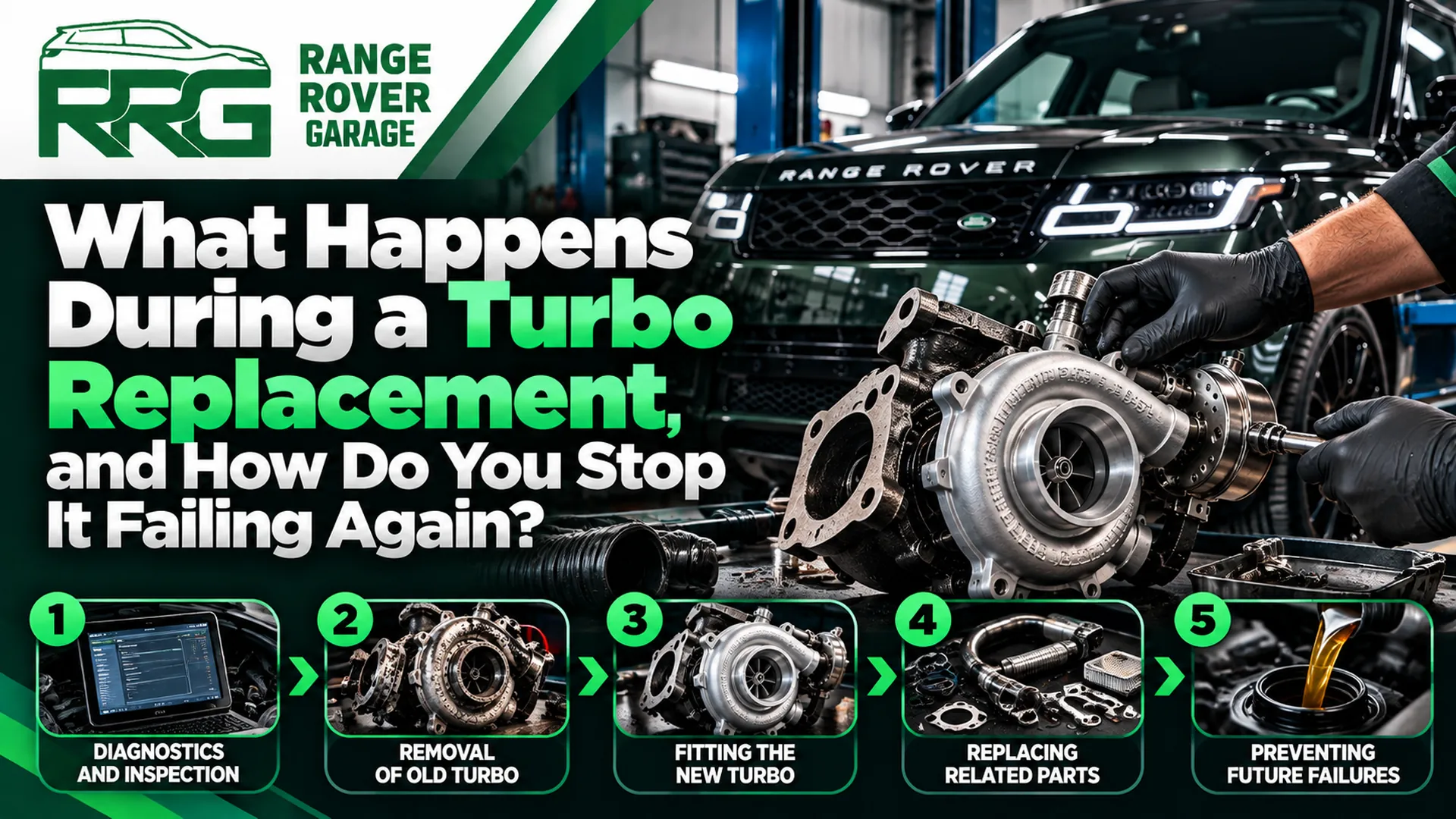
A turbo does not usually fail on its own. It fails because something around it went wrong, and fitting a new unit without finding that cause often means the same failure repeats. A thorough replacement follows a clear process.
Here is what a proper job involves, in order:
- Diagnosis and fault code reading, including live boost data, to confirm the turbo is the real fault
- Removal of the turbo, with careful inspection of the failed unit for clues about why it failed
- Oil system inspection, checking the feed pipe for restriction and the return line for blockage
- Intercooler and intake inspection, with cleaning if oil or debris has travelled downstream
- Fitting the replacement unit with new gaskets, seals and fixings
- Fresh engine oil and filter to the correct manufacturer specification
- Priming the turbo with oil before the engine runs, following the correct procedure
- Boost leak checks across the pipework and connections
- Fault code clearing and actuator calibration where required
- Road test to confirm boost, response and a clean data log
The steps people skip are the ones that protect the new turbo. Priming matters because a turbo spins at very high speed, and a dry start can damage the bearings in seconds. The oil pipe check matters because a partly blocked feed line starves the bearings, and oil starvation is one of the most common causes of turbo failure on these engines.
Understanding the causes helps you avoid a repeat:
- Oil starvation and poor lubrication, often from a restricted feed pipe or a neglected service
- Contaminated engine oil, which wears the bearings and shaft
- Blocked or restricted oil return lines, which cause oil to back up and leak past the seals
- DPF blockage, which raises exhaust back pressure and puts extra strain on the turbine
- Excessive exhaust temperatures, often linked to fuelling or EGR problems
- Foreign object damage, where debris from the intake or exhaust damages the wheels
Once the job is done, the aftercare is simple but important. Use the correct oil specification and keep to regular oil and filter changes, because clean oil is the single biggest protection for any turbo. Investigate warning lights early rather than driving on them, and keep the DPF and exhaust system in good order.
Warranty deserves a proper conversation too. Ask what the parts warranty covers, whether labour is included and what conditions apply. Skipped services or ignored warning lights can affect warranty cover, so read the terms before you commit.
How Long Does a Range Rover Sport Turbo Replacement Take, and What Should You Ask Before Booking?
The time depends on the engine, how accessible the turbo is, whether the right unit is available and what the inspection finds. Many jobs can be completed within a working day or two once the parts are ready. Twin turbo engines and cases where the oil system or intercooler needs extra attention can take longer. A specialist should give you a realistic timescale after assessing the car, rather than a vague promise.
Before you book with any garage, ask these questions:
- Is the quote for the turbo only, or for a complete supply and fitting job?
- Is the unit new, reconditioned or used, and who rebuilt it?
- Will the oil feed and return pipes be inspected or replaced?
- Will the intercooler be checked for contamination?
- Is VAT included in the quote?
- What warranty covers the parts and the labour?
- Will you receive a written breakdown of everything done?
The answers tell you a lot about the quality of the garage. A good specialist answers them clearly and without hesitation.
Frequently Asked Questions About range rover sport turbo replacement cost
How much does a Range Rover Sport turbo replacement cost in the UK?
It depends on the engine, the type of unit and the work needed around it. The total combines the turbo, labour, seals, oil pipes, oil and filter, diagnostics and VAT. The only reliable way to get an accurate figure is to request a quote based on your engine code and a proper inspection.
How much does it cost to replace a Range Rover Sport SDV6 turbo?
SDV6 engines use a sequential twin turbo layout with electronic actuators, so the cost depends on whether one or both units need attention and whether the actuator is at fault. A diagnosis comes first, and the quote follows from it.
Can a Range Rover Sport turbo be reconditioned?
Yes, in many cases. If the housings are in serviceable condition, a specialist can fit new internals, balance the rotating assembly and test the unit. Severe housing damage or heavy contamination may mean replacement is the safer route.
Is it better to repair or replace a Range Rover Sport turbo?’
It depends on what has failed. An actuator fault or sticking vanes can sometimes be repaired, while shaft play, damaged wheels and bearing failure usually point to a rebuilt or replacement unit.
Does a turbo replacement include new oil pipes and gaskets?
It should include new gaskets and seals, and it should include inspection of the oil feed and return pipes. Pipes are replaced where they are restricted or damaged. Always confirm this is in your written quote.
Can I drive my Range Rover Sport with a faulty turbo?
We advise against it. Driving with a failing turbo risks oil loss, debris entering the engine and wider damage. If the car is in limp mode or making unusual noises, have it checked as soon as you can.
What causes turbocharger failure on a Range Rover Sport?
The usual causes are oil starvation, blocked oil feed pipes, contaminated oil, restricted return lines, DPF blockage and foreign object damage. Worn bearings are often the result of one of these rather than the starting point.
How long does a replacement Range Rover turbo last?
A properly fitted unit, with a healthy oil system and regular servicing, can last for many years. Longevity depends on fixing the original cause of failure, using the correct oil and servicing on time.
Does a main dealer charge more than an independent specialist?
Main dealers and independent specialists differ in labour rates and parts policies, so the totals can differ. An independent Land Rover specialist can often offer reconditioned options and a more flexible approach to the repair.
Why do new turbos sometimes fail shortly after fitting?
Almost always because the original cause was not fixed. A blocked oil pipe, contaminated intercooler or poor-quality oil will damage a new unit just as it damaged the old one.
Conclusion
A turbo problem is easier to solve when you understand it, and cheaper when you catch it early. The cost of a Range Rover Sport turbo replacement is not one number. It is a combination of the unit, the labour, the supporting parts and the diagnosis that proves what actually went wrong. The best protection against a repeat failure is a specialist who checks the oil system, the intercooler and the actuator, not just the turbo.
At Range Rover Garage, we handle Range Rover Sport turbo repair, reconditioning and supply and fitting for owners across the UK. We start with a proper diagnosis, explain every line of the quote and stand behind the work with a clear warranty.
Ready to find out what your Range Rover Sport needs? Request a turbo replacement quote today, send us your existing quote for a second opinion, or speak to our team about the right option for your engine.