Range Rover White Smoke From Exhaust: Causes, Safety and How to Fix It
You start the engine on a cold morning, glance in the mirror, and see a cloud trailing behind your Range Rover. Is it harmless steam, or the first sign of an expensive engine problem?
That uncertainty is exactly why Range Rover white smoke from exhaust is such a common worry. Sometimes it is nothing more than condensation burning off. Other times, Range Rover white exhaust smoke points to coolant entering the engine, unburnt diesel, or a turbocharger fault that needs attention before it causes real damage.
This guide helps you tell the difference. You will learn what the smoke pattern reveals, which faults cause it, how specialists confirm the cause, when to stop driving, and what influences the cost of putting it right. It applies to the Range Rover, Range Rover Sport, Evoque, Velar and wider Land Rover diesel range, with extra detail for TDV6, SDV6, TDV8 and Ingenium engines.
Is White Smoke From a Range Rover Exhaust Normal, or Is It a Warning Sign?
Sometimes it is normal. Often it is not. The deciding factors are how long the smoke lasts, how thick it looks, what it smells like, and what else the car is doing at the same time.
Every engine produces water vapour as a by-product of combustion. On a cold or damp day, that vapour condenses inside the exhaust system. When you start the engine, it comes out as thin white mist, which usually disappears within a minute or two as the exhaust warms up.
A fault looks different. The smoke is thicker, it lingers, it keeps coming once the engine is warm, and it may smell sweet or sharp. It may arrive alongside coolant loss, overheating, a rough idle or a drop in power.
Why Does My Range Rover Blow White Smoke on Startup, When Accelerating or Once the Engine Is Warm?
Short answer: Thin white vapour that fades within a minute or two after a cold start is usually condensation. Thick, persistent white smoke, especially once the engine is warm or under acceleration, usually points to a real fault such as coolant entering the combustion chamber, an injector problem or a turbocharger issue.
The pattern matters more than the smoke itself. This table shows how the most common patterns are usually read:
Smoke pattern | Most likely meaning | Urgency |
| Thin mist on cold start that fades quickly | Normal condensation in the exhaust | Low |
| Thin smoke on damp days only | Condensation and weather | Low |
| Thick white smoke on cold start that lingers | Coolant or fuel entering combustion | Medium to high |
| White smoke at idle once warm | Possible internal coolant leak or injector fault | High |
| White smoke when accelerating | Coolant leak, injector fault or turbo and boost issue | High |
| Continuous white smoke with a sweet smell | Coolant burning in the cylinders | Very high |
| White smoke with overheating or falling coolant | Head gasket, cylinder head or EGR cooler fault | Stop driving |
Owners often search for Range Rover white smoke when starting because cold-start smoke is the version they notice first. A quick test helps. Hold your hand near, not in, the exhaust tailpipe on a warm engine. Plain condensation looks like steam and has little smell. Burning coolant leaves a sweet smell and a slightly oily or sticky residue on the tailpipe.
How white smoke compares with other smoke colours
Smoke colour gives you the first clue to what is happening inside the engine. White is only one of several signals.
Smoke colour | What it usually indicates | Typical causes |
| White | Condensation, coolant or unburnt fuel | Head gasket, EGR cooler, injectors, cold weather |
| Blue | Burning engine oil | Worn piston rings, valve seals, turbo oil seals |
| Black | Too much fuel or too little air | Blocked air intake, faulty injectors, DPF or EGR faults |
| Grey | Oil or fuel related combustion problems | Turbo faults, crankcase ventilation problems, DPF issues |
Black smoke is not always a sign that the diesel particulate filter is cleaning itself, and white smoke does not automatically mean a head gasket. Each colour needs its cause confirmed.
When to stop driving
Here is the practical part. Some warning signs mean you should pull over safely and arrange recovery rather than drive on. Continuing can turn a repairable fault into a damaged engine.
Stop driving if you notice any of these:
- The temperature gauge climbs or a coolant warning appears
- The coolant level drops quickly between checks
- A strong sweet smell comes from the exhaust or bonnet
- The engine knocks, misfires or runs very roughly
- You lose significant power or the car goes into limp mode
- White smoke continues in thick clouds after the engine has warmed up
Each of these suggests coolant, fuel or oil is reaching places it should not. Overheating in particular can warp a cylinder head and turn a gasket repair into something far more involved.
If the smoke is light, brief and your engine temperature is normal, you can usually drive a short distance carefully to a garage. If you are unsure, it is safer to talk it through first. You can book Range Rover engine diagnostics and get advice before you decide whether to drive the car at all.
What Causes White Smoke From a Range Rover Exhaust, and How Do Specialists Diagnose It?
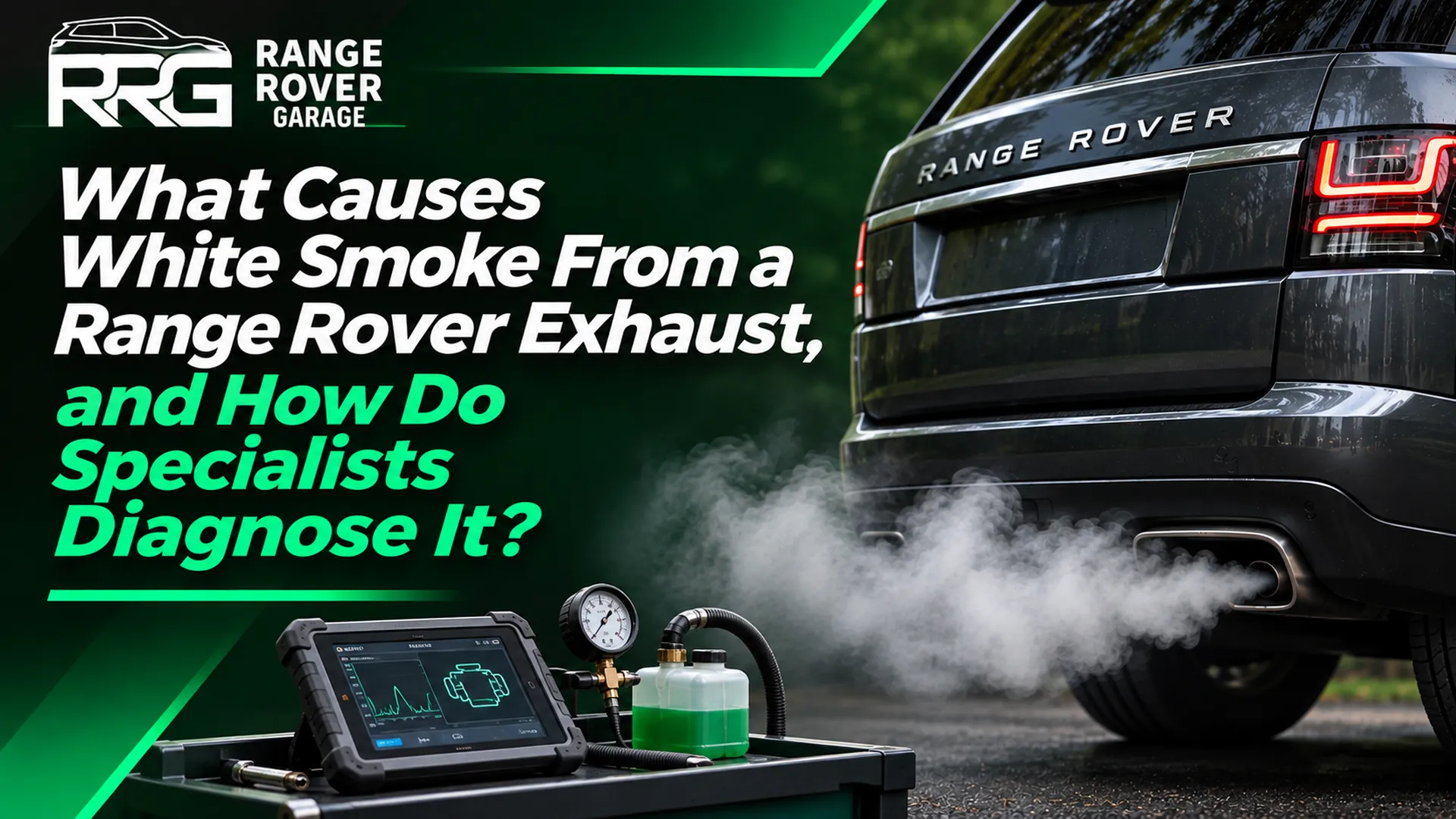
The problem with white smoke is that several different faults can produce it. Generic articles tend to jump straight to the head gasket. That is how owners end up paying for a gasket repair when the real fault was a leaking EGR cooler, or replacing a turbo that was never the problem.
A sound diagnosis works the other way around. Identify the smoke pattern, match it to the likely system, test that system, and repair only what the tests confirm.
Can a Blown Head Gasket, Leaking EGR Cooler, Faulty Injector or Failing Turbo Cause White Smoke?
Yes, any of them can. So can a cracked cylinder head, a damaged engine block or a problem elsewhere in the cooling system. No single fault explains every case, and anyone who names the cause without testing is guessing.
Blown or leaking head gasket
The head gasket seals the combustion chamber between the cylinder head and engine block. When it fails, coolant can leak into the cylinders and leave as white smoke, often with a sweet smell. Other signs include falling coolant levels with no visible leak, overheating, bubbles in the coolant reservoir, misfires and a milky or contaminated look to the engine oil. A cracked cylinder head or engine block produces similar symptoms and is more serious still.
Leaking EGR cooler
Many modern diesel Range Rovers use an exhaust gas recirculation cooler to lower combustion temperatures. The cooler uses engine coolant. If it develops an internal leak, coolant can pass into the exhaust or intake and burn off as white smoke. Owners notice coolant loss without a puddle on the drive, which makes it easy to mistake for a head gasket fault.
Faulty diesel injectors
A worn or leaking injector can deliver fuel poorly, creating unburnt diesel that leaves the exhaust as pale smoke. You may notice a rough idle, a strong diesel smell, misfires, reduced power and heavier fuel consumption. Fuel rail pressure problems can add to this picture.
Turbocharger and breather problems
Turbo seals can fail and allow oil into the intake or exhaust. A restricted turbo oil drain or blocked crankcase breather can force oil where it should not go. Charge air system leaks can also play a part. Manufacturer workshop guidance for the 3.0 TDV6 covers excessive smoke diagnosis and highlights checks of the oil level, turbo oil drainage and the charge air system. That is a useful reminder that smoke diagnosis should follow a process rather than a hunch. Oil-related smoke often appears blue or grey, but a mixed fault can confuse the colour.
Condensation, which is normal
Condensation is a genuine, harmless cause. It should be brief and clear as the exhaust warms. If it does not, treat it as a fault.
Use this table to match symptoms with likely causes:
What you notice | Possible cause | What to check first |
| Sweet smell and falling coolant | Head gasket, EGR cooler or cracked cylinder head | Cooling system pressure test, combustion gas test |
| Overheating plus white smoke | Head gasket or cylinder head damage | Stop driving, pressure test and compression test |
| Rough idle and diesel smell | Faulty injectors or fuel delivery fault | Injector testing, fuel pressure and fault codes |
| Smoke with power loss | Turbo, boost leak or injector problem | Boost and charge air inspection, turbo inspection |
| Milky oil on the dipstick | Coolant mixing with oil | Immediate inspection, avoid driving |
| Smoke after DPF regeneration | Normal regeneration or related fault | Fault code scan and regeneration check |
| Coolant bubbling in the reservoir | Combustion gases entering cooling system | Combustion gas test and compression test |
Engine notes for Range Rover owners
Faults vary by engine, year, mileage and maintenance history, so no engine should be assumed to suffer one specific problem. These notes simply show where a technician tends to look first.
Engine | Where diagnosis often focuses |
| 3.0 TDV6 | Turbo oil drainage, breather and charge air checks, coolant system integrity |
| 3.0 SDV6 | Cooling system, EGR cooler, boost system and injector condition |
| 4.4 TDV8 and SDV8 | Injectors, turbo condition and coolant loss patterns |
| 2.0 and 3.0 Ingenium diesel | EGR cooler, coolant system, injectors and DPF behaviour |
| Petrol Range Rover engines | Coolant leaks, head gasket and condensation, since diesel faults do not apply |
An older L322 or L405 with high mileage may show wear-related faults, while a newer Evoque or Velar is more likely to need its Ingenium engine and software checked alongside the mechanical side.
How Do You Tell an EGR Cooler Leak From a Head Gasket Failure?
This is the comparison owners search for most, because both faults can produce white smoke, coolant loss and a sweet smell. The tests separate them.
Feature | Leaking EGR cooler | Failed head gasket |
| Coolant loss | Yes, often without a visible leak | Yes, can be gradual or sudden |
| White smoke | Often on start or under load | Often persistent once warm |
| Overheating | Possible, usually later | More common and more serious |
| Oil contamination | Less likely | More likely in advanced cases |
| Compression loss | Usually normal | May be affected |
| Bubbles in coolant | Possible | Common |
| Typical test route | Cooler pressure test, coolant and exhaust checks | Combustion gas test, compression and leak-down tests |
| Repair route | Replace or repair the cooler | Head gasket work, possible cylinder head repair |
A leaking EGR cooler is typically less involved than head gasket and cylinder head work, which is why correct diagnosis protects owners from unnecessary expense. The reverse also applies. Replacing a cooler when the head gasket has failed wastes time and leaves the real fault in place.
Which Tests Confirm the Real Cause Before Any Repair Starts?
A proper diagnosis is a sequence. Each test either points to a cause or rules one out. Here is the workflow we follow on a Range Rover with white exhaust smoke:
- Inspect coolant level and condition. We check for loss, contamination, oil traces and signs of combustion gases.
- Check engine oil condition. Milky, thin or fuel-smelling oil tells us a lot about what is mixing where it should not.
- Run a cooling system pressure test. The system is pressurised to expose external and internal leaks.
- Carry out a combustion gas test. This detects exhaust gases in the coolant, a strong indicator of head gasket or cylinder head failure.
- Perform an engine compression test. Uneven compression between cylinders reveals mechanical damage.
- Complete a cylinder leak-down test. This shows where pressure is escaping, such as valves, rings or the gasket.
- Test the diesel injectors. We check spray pattern, leak-off and fuel delivery, and review fuel rail pressure.
- Inspect the turbocharger and charge air system. We look at seals, oil drainage, breather restriction and boost leaks.
- Read the ECU fault codes and live data. Stored fault memory and OBD data show misfires, pressure faults and temperature behaviour.
Consider a typical scenario. A Range Rover Sport TDV6 arrives with white smoke on warm idle and a coolant level that keeps dropping, though nothing is dripping underneath. The owner assumes a head gasket. A pressure test reveals the system holds, but the combustion gas test is clear. Further checking finds coolant escaping inside the EGR cooler. Replacing the cooler solves it, and the owner avoids a major engine job.
Now picture the opposite. A different car overheats, the coolant reservoir bubbles, and the gas test comes back positive. Here the evidence points firmly to the head gasket or cylinder head, and the engine needs deeper work. Same smoke, different answer. That is why we test first.
How Much Does It Cost to Fix Range Rover White Smoke, and Who Can Repair It in the UK?
There is no honest single answer, because the cost depends on what is actually wrong. A minor fault found early sits at one end. Internal engine damage after the car has overheated sits at the other. Anyone quoting a firm figure before diagnosis is either guessing or planning to replace parts until the smoke stops.
Should You Repair or Rebuild a Range Rover Engine With White Smoke, and What Affects the Cost?
The answer comes from the diagnosis. A repair is sensible when the fault is isolated and the engine is otherwise healthy. A rebuild or replacement becomes worth considering when there is widespread internal damage, such as a cracked cylinder head, a damaged block or severe overheating.
Several factors shape the final cost:
- The confirmed fault. A leaking EGR cooler, a set of injectors, a turbo repair and a head gasket job all involve different parts and labour.
- The engine and model. Access and parts differ between a TDV6, SDV6, TDV8 and an Ingenium diesel.
- The extent of damage. An engine that overheated badly may need cylinder head machining or more.
- Parts choice. Genuine, reconditioned and aftermarket parts vary in fit, longevity and warranty.
- Labour time. Some repairs need major components removed to reach the fault.
- Linked faults. A coolant leak may have damaged other components, which should be repaired together.
The table below shows when each repair route typically applies:
Repair route | When it applies | What usually happens |
| Diagnostic inspection | Any persistent white smoke | Pressure, gas, compression and fault code testing, then a clear findings report |
| EGR cooler replacement | Confirmed internal cooler leak | Replace the cooler, flush and refill coolant, retest |
| Head gasket repair | Confirmed gasket failure with sound cylinder head | Remove the head, inspect, resurface if needed, rebuild and test |
| Injector repair or replacement | Confirmed injector or fuel delivery fault | Test, repair or replace, then check fuel pressure and running |
| Turbo repair or replacement | Confirmed turbo seal or bearing fault | Address the cause first, such as oil drain or breather, then repair the turbo |
| Engine rebuild | Widespread internal wear or damage | Strip, inspect, machine and rebuild, then test |
| Engine replacement | Engine beyond sensible repair | Fit a reconditioned or replacement unit and recalibrate |
Why choose an independent Range Rover specialist
Many owners start with a quick code read and a guess. Sometimes it works, but often the second and third attempts cost more than a proper diagnosis would have. A specialist who regularly works on Range Rover and Land Rover engines knows what these engines tend to do, which shortens the route to the real fault.
An independent specialist can also offer the same depth of fault finding as a main dealer, often with more flexibility on repair options and parts choices. If your car is still under a manufacturer or approved warranty, check its terms before arranging independent work.
Your next step
If your Range Rover is producing white smoke now, or it has appeared and faded, do not wait for it to get worse. Contact Range Rover Garage through our website to arrange Range Rover engine diagnostics, request a repair quotation, or talk through your symptoms with a specialist. When you book, ask about turnaround time and the warranty on parts and labour, so you know what to expect before any work begins.
You can also read our related guides on Range Rover head gasket problems, EGR cooler failure symptoms, Range Rover turbocharger problems and diesel injector problems, or learn more about our Range Rover engine rebuild and engine repair services.
Frequently asked questions about Range Rover white smoke from exhaust
Why is my Range Rover blowing white smoke from the exhaust?
It may be harmless condensation, especially on a cold start. If the smoke is thick, persistent or comes with coolant loss, a sweet smell or overheating, it could be coolant, unburnt diesel or a turbo-related fault. Testing is needed to confirm which.
Is white smoke from a Range Rover exhaust normal?
Thin white vapour that clears within a minute or two of starting is normal. Smoke that continues after warm-up, looks thick or smells sweet is not.
Does white smoke always mean a blown head gasket?
No. A leaking EGR cooler, faulty injectors, turbo faults and condensation can all cause white smoke. A head gasket is only one possibility, and tests such as a combustion gas test confirm it.
Can I drive my Range Rover with white smoke coming from the exhaust?
You can usually drive a short distance carefully if the smoke is light and the engine temperature is normal. Stop driving if the engine overheats, coolant drops quickly, the engine knocks or you lose major power.
Why does my Range Rover smoke when cold but not when hot?
Cold-start smoke is often condensation burning off. If it is thick or lingers, an injector fault or early coolant leak may be responsible.
Why does my Range Rover produce white smoke when accelerating?
Acceleration places more load on the engine, which can expose coolant leaks, injector faults or boost problems that stay hidden at idle.
Why is my Range Rover losing coolant but not leaking?
Coolant can disappear internally, through a head gasket, cracked cylinder head or leaking EGR cooler, and leave as white smoke without any puddle on the ground.
Can an EGR cooler cause white smoke?
Yes. An internal EGR cooler leak lets coolant enter the exhaust or intake system, where it burns off as white smoke and causes coolant loss.
Can a faulty turbo cause white smoke?
It can contribute, especially through oil seal failure, a restricted oil drain or blocked breather. Oil-related smoke often looks blue or grey, though mixed faults can blur the colour.
Can faulty diesel injectors cause white smoke?
Yes. Worn or leaking injectors can create unburnt diesel, which can leave the exhaust as pale smoke, often with a rough idle and a diesel smell.
How do mechanics test for an internal coolant leak?
Typical tests include a cooling system pressure test, a combustion gas test, a compression test and a cylinder leak-down test, along with a fault code scan.
Does white smoke mean my Range Rover needs a new engine?
Not necessarily. Many causes are repairable without replacing the engine. A rebuild or replacement becomes relevant only when diagnosis finds widespread internal damage.
Final thoughts
White smoke from a Range Rover exhaust is a clue, not a verdict. Sometimes it is nothing more than a damp morning. Sometimes it is the earliest warning of a coolant leak that will damage the engine if you ignore it.
The sensible approach is simple. Watch the pattern, check your coolant and oil, stop if the car overheats, and get a proper diagnosis before you spend money on parts. Caught early, many causes are straightforward to repair. Left alone, a small leak can become a major engine job.
At Range Rover Garage, we focus on finding the true cause first, so you pay for what the car needs and nothing it does not. If your Range Rover is blowing white smoke, losing coolant or running rough, book your Range Rover engine diagnostics today and get a clear answer on what is wrong and how to fix it.