Range Rover EGR Cooler Failure: Symptoms, Causes and UK Repair Costs
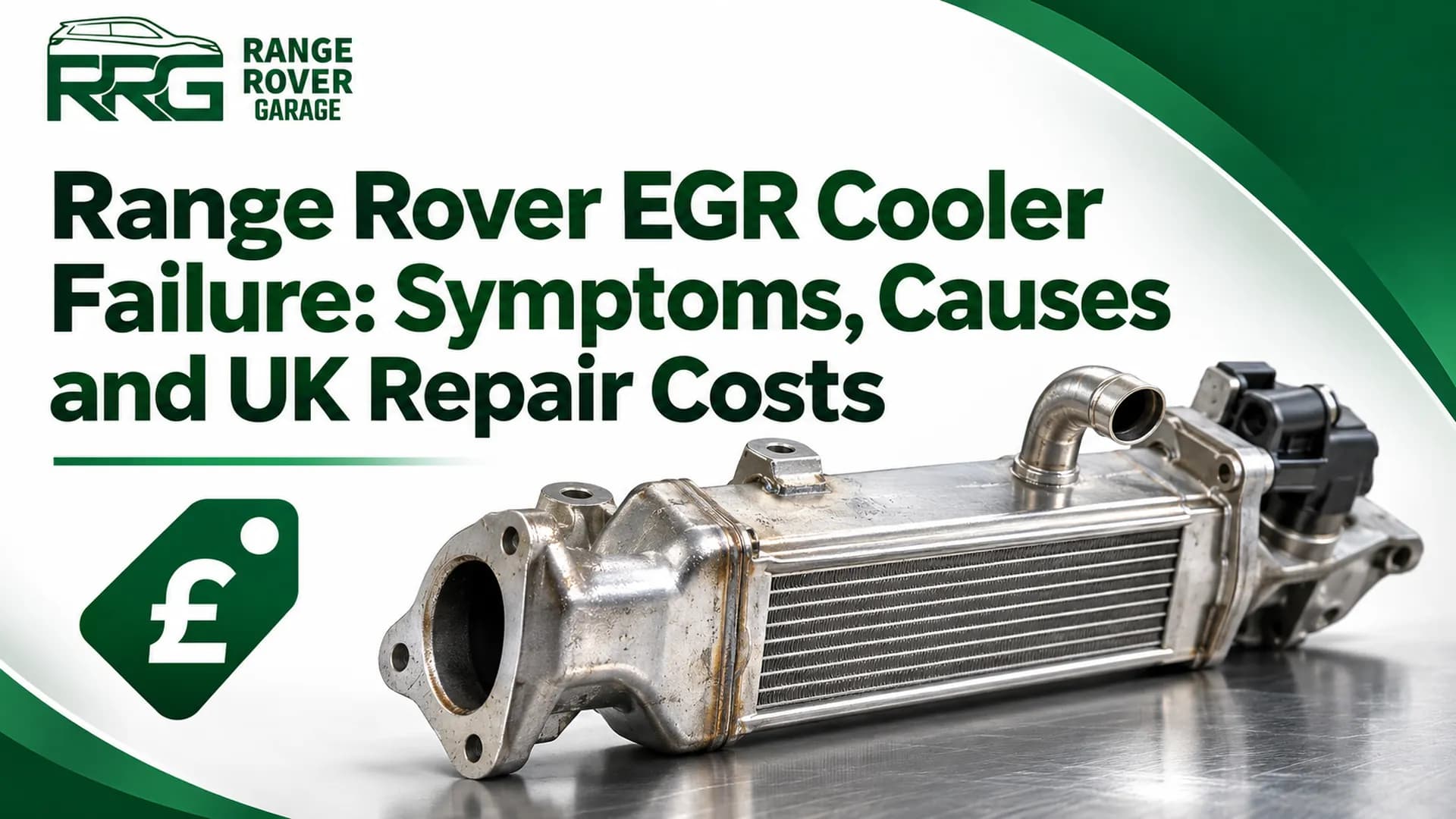
Your coolant level keeps dropping, but there is no puddle on the driveway and no wet hose in sight. Then you notice thick white smoke on a cold start, or a temperature warning on a long motorway run. That pattern points to Range Rover EGR cooler failure more often than most owners expect.
The EGR cooler sits where the engine's exhaust path meets its cooling circuit. When its internal passages crack or corrode, coolant escapes into the exhaust stream and burns away, so there is nothing to see underneath the car. Left alone, it can lead to overheating, power loss and, in severe cases, serious engine damage.
This guide explains what to look for, what causes the fault, how a specialist confirms it, and what drives the repair bill. It also covers the question most owners ask first: can you keep driving?
Key takeaways
- Unexplained coolant loss with no visible leak is the most common early warning.
- White exhaust smoke, a sweet smell and overheating often follow, but no single symptom proves the diagnosis.
- A pressure test, fault code scan and combustion gas check together separate an EGR cooler leak from a head gasket fault.
- A cracked cooler needs replacing. Cleaning cannot repair a physical leak.
- Losing coolant already? Book an EGR diagnostic with the specialists at Range Rover Garage before a small leak becomes an expensive one.
What Are the Symptoms and Causes of Range Rover EGR Cooler Failure?
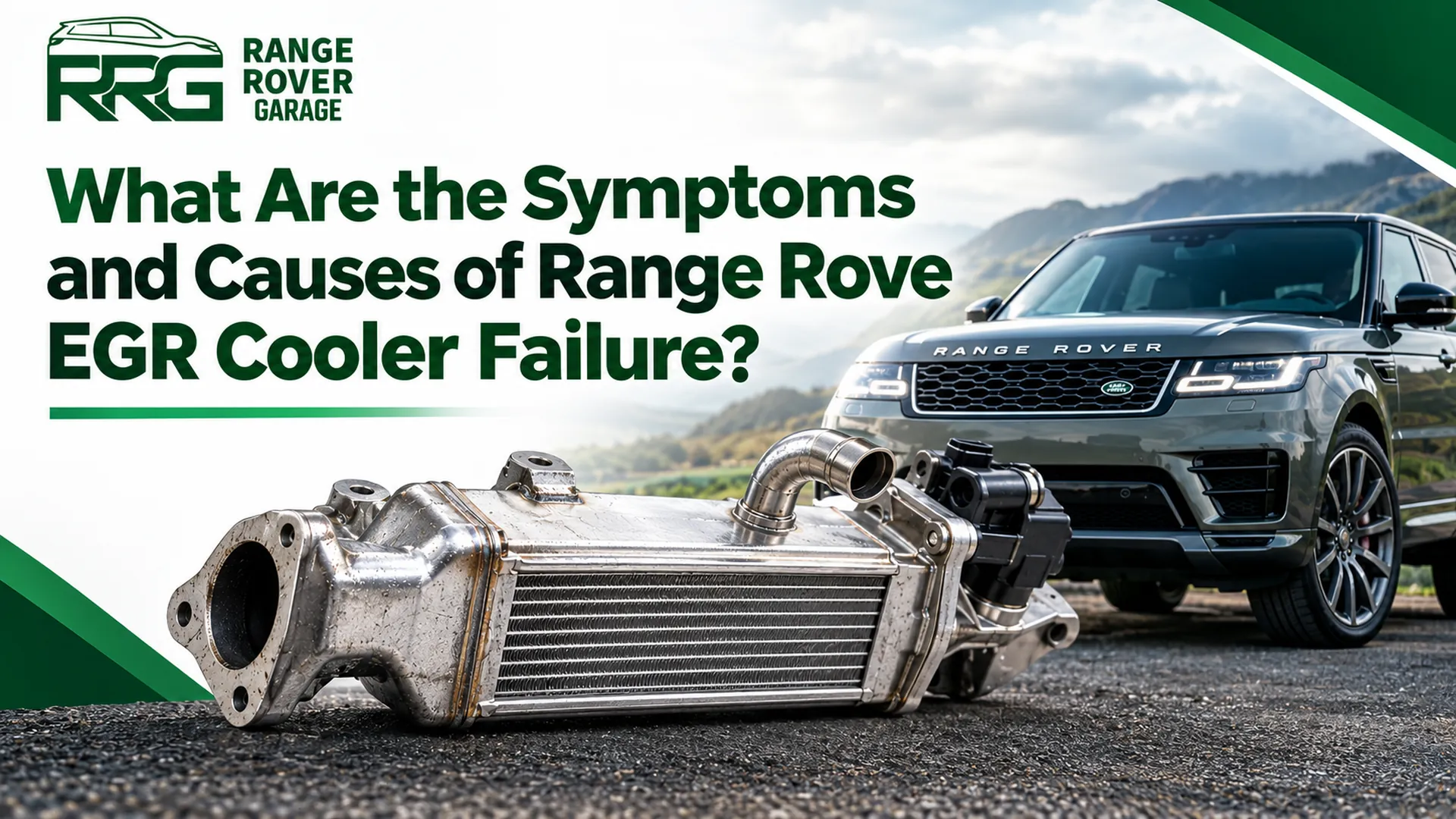
Exhaust Gas Recirculation, usually shortened to EGR, feeds a measured amount of exhaust gas back into the intake. That lowers combustion temperatures and cuts nitrogen oxide emissions. Because exhaust gas leaves the engine extremely hot, it first passes through the EGR cooler, a small heat exchanger that uses engine coolant to bring the gas temperature down.
That design is clever, but it puts hot exhaust gas and liquid coolant on opposite sides of thin metal walls inside the cooler core. Every heat cycle stresses those walls. When one gives way, the cooling system and the exhaust system become connected where they should never be.
Why Is My Range Rover Losing Coolant and Producing White Smoke?
When the cooler leaks internally, coolant is drawn through the damaged core into the exhaust gas flow. It travels through the EGR pipe, into the intake manifold and then into the combustion chamber, where it burns off. The coolant leaves through the tailpipe as vapour, which is why you see white smoke and find no drip underneath.
Here are the signs owners and technicians see most often:
- Coolant level dropping with no puddle. The expansion tank needs regular topping up, yet the ground stays dry.
- White smoke from the exhaust. It is often thickest on a cold start or under hard acceleration, and it smells different from normal diesel haze.
- A sweet smell from the exhaust or cabin vents. That is the scent of burning coolant.
- Overheating warnings. Low coolant means the engine cannot shed heat properly.
- Reduced power or limp mode. The engine management system protects the engine by limiting output.
- Engine management light. The ECU may log EGR flow or temperature faults.
- Bubbling in the expansion tank. Exhaust gas pushing into the cooling circuit pressurises the system.
Early failure is easy to miss. A small internal leak may cost you only a little coolant each week, with occasional smoke that clears after a few minutes. Many owners put it down to cold weather or a slow weep somewhere else. By the time warning lights appear, the leak has usually grown.
One caution matters here. No single symptom confirms an EGR cooler fault. White smoke and coolant loss also appear with head gasket failure, so treat these signs as a reason to get the car tested, not as a diagnosis.
What Causes a Range Rover EGR Cooler to Crack or Leak Internally?
Most failures come from a handful of causes that often work together:
- Thermal stress. The cooler swings between extreme exhaust heat and much cooler coolant. Repeated expansion and contraction fatigue the metal until fine cracks form.
- Carbon and soot accumulation. Deposits narrow the exhaust gas passages, restrict flow and create hot spots inside the cooler core. Short journeys make this worse, because the engine rarely reaches temperatures high enough to burn deposits off.
- Internal corrosion. Old or neglected coolant loses its protective additives and slowly attacks the cooler's internal surfaces.
- Coolant contamination. Poor quality or mixed coolant types speed up corrosion and leave deposits in narrow passages.
- Exhaust flow restrictions. A struggling diesel particulate filter or a restricted EGR path raises back pressure and temperature.
- Age and mileage. Like any heat exchanger, the cooler wears out over time.
It also helps to know that an EGR valve fault and an EGR cooler fault are different problems. The valve controls how much gas flows. The cooler reduces the temperature of that gas. A sticking valve causes rough running and fault codes. A leaking cooler is what causes coolant loss.
The next table shows how EGR cooler layouts vary across Range Rover models. Always confirm the exact part against the vehicle identification number, engine code and production date, because suppliers revise and supersede parts.
Model and generation | Typical diesel engine | EGR cooler note |
| Range Rover Sport L320 | 2.7 TDV6, 3.0 TDV6 | Cooler assemblies differ between engine variants |
| Range Rover L322 | 3.6 TDV8 | Left and right cooler assemblies, listed under LR003857 and LR003858 |
| Range Rover Sport L494 and Range Rover L405 | 3.0 TDV6, 3.0 SDV6, 4.4 SDV8 | Configuration depends on engine code and year, with 3.0 diesel applications associated with LR125548 |
| Range Rover Evoque | 2.2 diesel | Listed under LR057662 |
| Range Rover Velar and later models | Ingenium diesel | Different emissions hardware, so check fitment carefully |
These part numbers appear in supplier catalogues and are a guide only. A specialist should match every component to your vehicle before ordering.
Know the signs already? Book an EGR diagnostic and we will confirm the cause before you spend anything on parts.
How Is a Faulty Range Rover EGR Cooler Diagnosed?
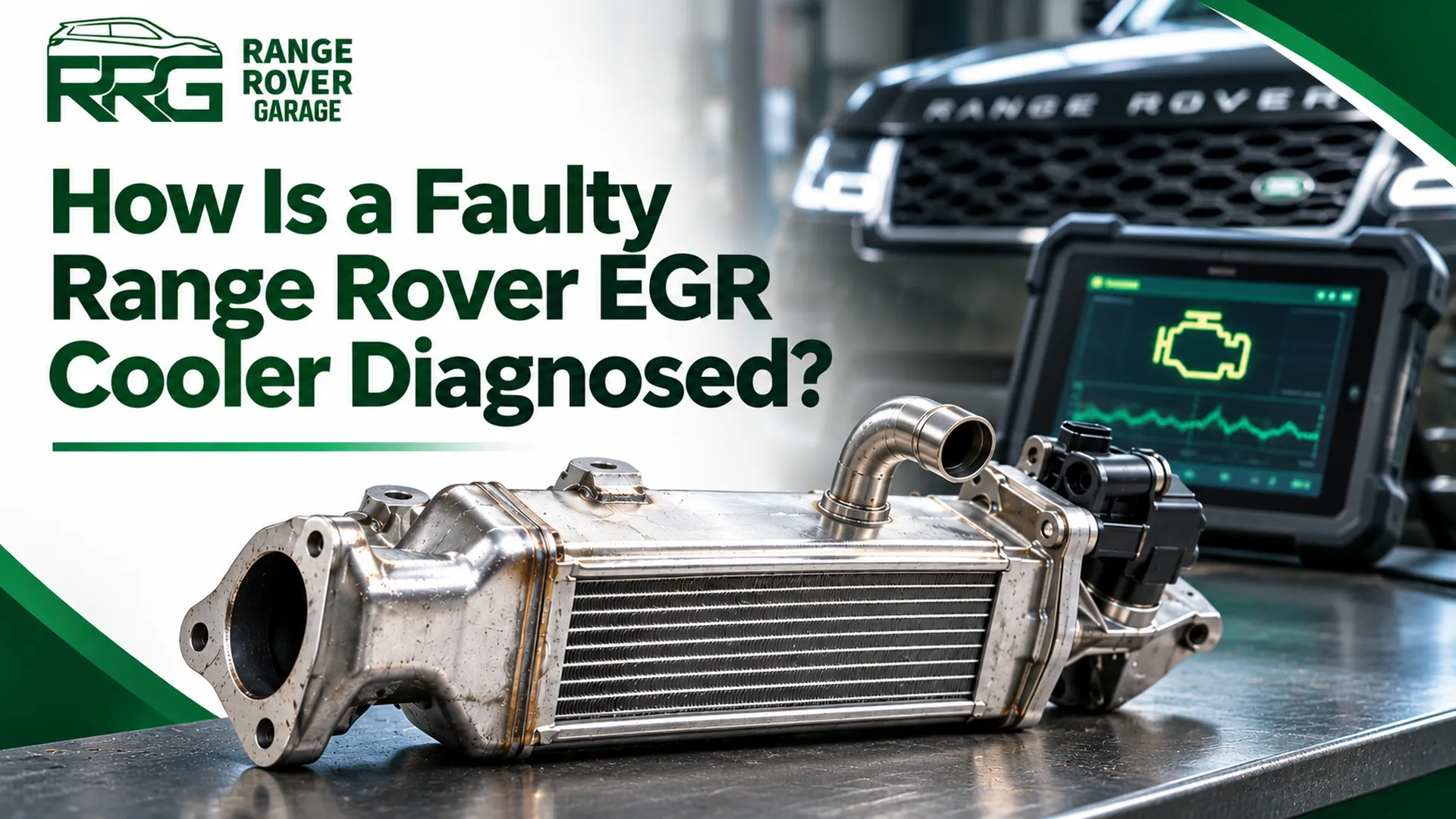
A reliable diagnosis never rests on one reading. Coolant loss, white smoke and overheating overlap with several other faults, so a specialist builds a picture from several tests and rules out the lookalikes. Guessing is how owners end up replacing a head gasket, a water pump or an EGR valve that was never the problem.
Which Tests Confirm EGR Cooler Failure: Pressure Test, Fault Codes or Both?
The answer is both, plus a few more checks. A proper diagnostic usually runs in this order:
- Visual inspection. The technician checks the EGR cooler, its pipes, the coolant hoses and the expansion tank for external leaks, staining and damage.
- Cooling system pressure test. The system is pressurised and watched for pressure loss. A drop with no external leak suggests coolant is escaping internally.
- Fault code scan. A diagnostic scanner reads stored fault codes from the engine control unit.
- Live EGR data. The technician watches EGR valve position, flow and exhaust gas temperature readings while the engine runs.
- Exhaust smoke inspection. Smoke colour, smell and timing give useful clues.
- Combustion gas test. A chemical test of the coolant checks whether exhaust gas is entering the cooling circuit.
A fault code points to an abnormality in the system, not automatically to the failed part. An EGR flow code could come from a blocked cooler, a sticking valve, a restricted pipe or a failing sensor. The code starts the investigation. It does not finish it.
Pressure test results also need interpreting. A system that holds pressure cold can still leak once the engine reaches temperature, so a good technician tests under realistic conditions.
How Can You Tell an EGR Cooler Leak From a Head Gasket Failure?
This is the comparison that matters most, because both faults cause coolant loss and white smoke. The table sets out how they typically differ.
Check | EGR cooler leak | Head gasket failure |
| Coolant loss | Gradual or steady, no external leak | Can be gradual or sudden, sometimes with oil contamination |
| White smoke | Often on start-up or acceleration, with a sweet smell | Often persistent, especially on warm-up |
| Pressure behaviour | System loses pressure internally | System may pressurise rapidly from combustion gas |
| Oil condition | Usually unaffected at first | May show milky residue or coolant mixing with oil |
| Combustion gas test | Can be positive if exhaust gas enters coolant | Often positive |
| Compression testing | Needed only if results stay unclear | Often needed to confirm cylinder sealing |
The overlap is real, which is why testing matters. A specialist may move on to a compression test when earlier results do not settle the question. Replacing the wrong component rarely fixes the problem, and it adds cost.
A short example shows how this plays out. An owner reports a Range Rover Sport topping up coolant every week with no marks on the driveway and a faint sweet smell after hard acceleration. The pressure test shows slow internal pressure loss. The combustion gas test points toward an exhaust gas path into the coolant, and the cylinder sealing checks out. That combination points to the EGR cooler rather than the head gasket, and the repair plan follows from it.
The EGR valve is a separate part of the same system. If your car shows rough running or fault codes but holds its coolant level, the valve is the stronger suspect, and it gets tested on its own.
Is It Safe to Keep Driving With a Leaking EGR Cooler?
Not for long. A slow leak may let you drive for a while, but you are gambling with the engine, and the risks grow as the leak does.
- Overheating. Falling coolant levels let engine temperature climb, which can damage the cylinder head and other components.
- Hydraulic lock. If enough coolant collects in a cylinder, the next start can cause severe damage. Liquid cannot be compressed, so the piston has nowhere to go. This is rare, but it is the most serious outcome and it is expensive.
- Contaminated intake and exhaust. Coolant carried into the intake manifold and exhaust adds to deposits and can harm other emissions components.
- Sudden breakdown. Limp mode or an overheating shutdown tends to arrive at the worst possible moment.
If you notice rapid coolant loss, heavy white smoke or a hot engine, stop driving, switch off and arrange recovery. If the engine has been standing and you suspect a significant leak, do not keep trying to start it.
Not sure what is causing it? Book a diagnostic with our Range Rover engine specialists and get a clear answer before the problem gets bigger.
How Much Does Range Rover EGR Cooler Replacement Cost in the UK?
There is no honest single figure, because the cost depends on your specific car and what the diagnosis uncovers. A straightforward single cooler on one engine is a very different job from a twin-cooler V8 with associated damage. That is why a reliable quote always follows an inspection, not a guess over the phone.
These are the factors that shape the final bill:
Cost factor | Why it changes the total |
| Model and engine | Different generations use different cooler designs, and access to them varies |
| Parts choice | Genuine Land Rover parts and quality alternatives differ in fit, longevity and warranty |
| Labour time | Deeper access to the cooler means more workshop hours |
| Diagnostic inspection | Pressure tests and gas tests take technician time but prevent unnecessary repairs |
| Related components | Pipes, seals, gaskets, thermostat or the EGR valve may need attention at the same time |
| Coolant and fluids | The system needs a correct refill and bleed after repair |
| Secondary damage | Overheating or contamination may add work, which is why early action saves money |
The cheapest-looking quote is not always the cheapest repair. A job that skips new seals, ignores a clogged EGR pipe or leaves air in the cooling system often comes back. Ask what the quote includes, which parts will be fitted and what warranty covers the work.
Can a Faulty EGR Cooler Be Repaired, or Does It Need Replacing?
A cooler with a crack, a corroded core or an internal leak needs replacing. A physical leak cannot be cleaned away, and any claim that it can should raise questions. Cleaning does have a place when a cooler is only partly restricted by soot and has no leak, but it is a different job from fixing a failed unit.
Many owners ask whether the EGR valve and cooler should be done together. It often makes sense when the valve is clogged or the labour overlaps, since access to one frequently means access to the other. It is not automatic, though. The decision should come from test results, not a standard package.
A proper replacement does not end when the new cooler goes in. A thorough workshop will follow this checklist:
- Inspect the connected EGR cooler pipes and hoses for damage and deposits.
- Fit new seals and gaskets where required.
- Check the wider cooling system for contamination and damage.
- Refill and bleed the coolant correctly to remove trapped air.
- Inspect the intake and exhaust paths for coolant residue.
- Scan the engine control unit for stored fault codes and clear them.
- Check EGR valve operation and live data.
- Complete a controlled road test.
- Recheck coolant levels and look for leaks after the car has cooled.
Skipping any of these steps is how repeat failures happen. Air left in the circuit can cause overheating on its own, and ignored soot or coolant residue can damage the new part.
Choosing the right specialist matters as much as choosing the right part. Range Rover Garage works on Range Rover and Land Rover diesel engines every day, from the first diagnostic through to the final road test. We explain what we find and why, and we confirm the work and warranty before we start.
Frequently Asked Questions About Range Rover EGR Cooler Failure
Can an EGR cooler cause white smoke?
Yes. When the cooler leaks, coolant enters the exhaust gas path and burns in the engine, leaving white smoke from the exhaust. Head gasket faults produce a similar sign, so a pressure test and a combustion gas test are needed to confirm the source.
How long does EGR cooler replacement take?
It depends on the model, engine and how accessible the cooler is. Some jobs are completed within a day, while twin-cooler engines or cars needing extra repairs take longer. Your specialist can give a realistic timeframe after inspecting the car.
Does a leaking EGR cooler always trigger a warning light?
No. A small internal leak can lose coolant for weeks before any light appears. Warnings tend to show up later, when coolant is low, the engine overheats or the EGR system reports a flow or temperature fault.
Can an EGR cooler leak internally?
Yes, and that is the usual way it fails. Coolant escapes inside the cooler core and burns off through the engine, which explains why owners find no external leak.
Does a diagnostic scanner identify an EGR cooler fault?
A scanner can show EGR related fault codes and live data, but it cannot prove the cooler has failed on its own. Pressure testing and gas analysis are needed to confirm an internal leak.
Can poor servicing cause EGR cooler failure?
It can contribute. Old coolant, mixed coolant types and neglected diesel particulate filter problems all increase corrosion and deposit build-up. Regular servicing and correct coolant make a real difference to the life of the EGR system.
How can I prevent EGR cooler problems?
Use the correct coolant and replace it on schedule, and mix in some longer drives so the engine reaches full temperature. Fix diesel particulate filter and EGR valve issues early, and investigate any unexplained coolant loss straight away. Regular engine diagnostics catch trouble before it spreads.
Is an aftermarket EGR cooler a good idea?
Quality varies. Genuine Land Rover parts offer the safest fit, while some alternatives perform well if sourced from reputable suppliers. Ask your specialist which they recommend for your engine and what warranty covers the part.
Final word
Range Rover EGR cooler failure rarely announces itself loudly. It begins with a little missing coolant, a faint sweet smell or smoke that clears after a minute, and it ends in overheating, limp mode or engine damage if ignored. The good news is that early diagnosis keeps the repair simple, and the right tests will tell you exactly what is wrong.
If your Range Rover is losing coolant, producing white smoke or running hot, do not wait for the warning lights. Contact Range Rover Garage to book an EGR diagnostic and speak to a specialist who will test properly, explain clearly and fix it once.